SLAC researchers find proof of altermagnetism, a new magnetic phase
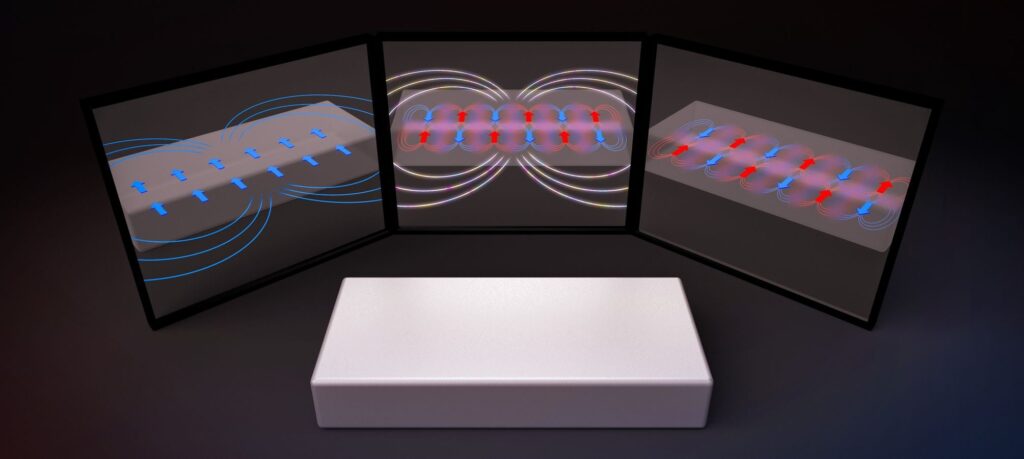
For decades, physicists recognized only two types of magnetism that occur in materials without external influence: ferromagnetism and antiferromagnetism. Today, in findings published in Science, a team led by the U.S. Department of Energy’s SLAC National Accelerator Laboratory has delivered conclusive experimental proof of a third magnetic phase called altermagnetism.
“In the past few years, scientists have observed phenomena that don’t fit neatly into the ferromagnetism-antiferromagnetism dichotomy,” explained lead author Daniel Jost, associate scientist at SLAC and Stanford Institute for Materials and Energy Sciences. “Researchers have been compiling evidence of a third type of magnetism that bridges the qualities of these two classes. We believe our results provide robust experimental confirmation that this third phase – altermagnetism – is real.”
Building on previous studies, this research confirmed that manganese telluride (MnTe) is an altermagnet – a new class of magnet that exhibits properties of both ferromagnetism and antiferromagnetism. Their results showed direct experimental evidence of chirality – an asymmetric magnetic structure, akin to a spiral staircase or a screw – in the spins of an altermagnetic candidate material.
Identifying these unique materials could allow researchers to manipulate their properties in ways that make them ideal candidates for advanced electronics, with applications including quantum technologies, memory devices and data centers.
A primer on magnetism
To most of us, magnetism is a tangible force: It’s what holds a child’s artwork to a refrigerator door and points a compass needle north. But to a physicist, magnetism is more complex. It’s a quantum property of a material, and not all magnetic materials have a directly observable magnetic effect.
In physics, a material is considered magnetic if its electrons’ spins – their internal angular momentum, which can be either “up” or “down” – are polarized, or ordered in a specific pattern.
In ferromagnets, all electronic spins point the same direction (up-up-up or down-down-down), creating an observable magnetic field. Humans have known about and made use of this class of magnets since ancient times. In 1933, scientists discovered another type of material with polarized spins. Antiferromagnets have alternating electronic spins (up-down-up-down) that cancel each other out, producing no net magnetic effect.
A new type of magnetism?
For nearly 90 years, this two-category system dominated our understanding of magnetism.
But in recent years, researchers have noticed that some materials don’t fit neatly into either category. Certain materials seemed to exhibit features of both antiferromagnetism, such as alternating spin configuration with no net magnetization, and ferromagnetism, such as the ability to use spin currents. These behaviors were once thought to be mutually exclusive.
In 2022, researchers proposed the term “altermagnets” to label this wily class of materials.