Why the Future of Human Health Starts in the Soil with Josh Tickell
Guy Kawasaki:
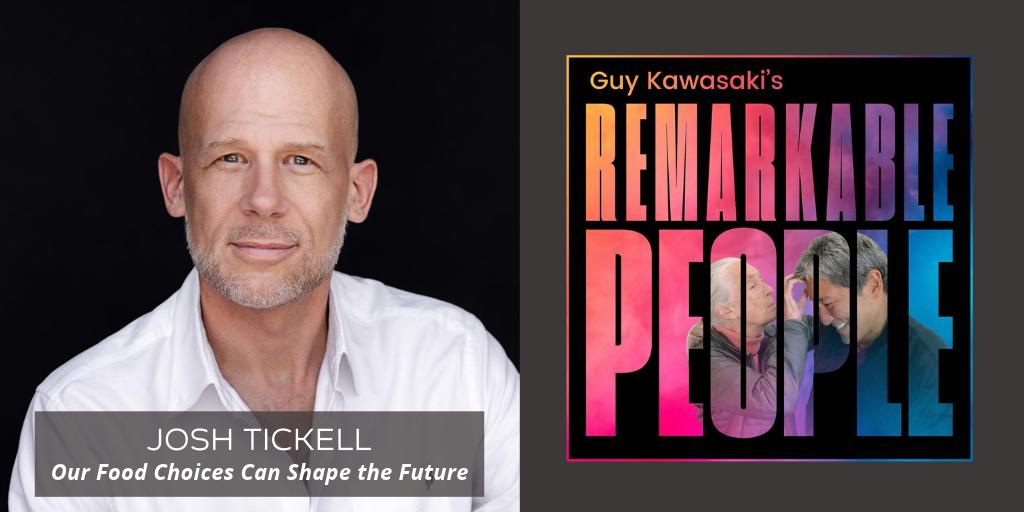
Hello everybody, I’m Guy Kawasaki. This is the Remarkable People podcast, and my buddy here, his name is Josh Tickell. He’s a filmmaker, he’s an author, he’s a director.
As you can tell by the posters behind him, he has that great documentary, Common Ground, and he has a book out, and this book is changing my diet fundamentally, so it’s called Kiss the Ground. And basically what we’re going to do today is we’re going to dig into the topic of regenerative farming and food and what to eat, what not to eat.
And not necessarily from a nutritional standpoint, but more from an overall social impact standpoint. Is that an accurate statement there, Josh?
Josh Tickell:
Yeah. It has nutritional ramifications, of course. Everything we eat does. But we do look at food through a different lens, and that is, how do you change the world with what you eat?
Guy Kawasaki:
Yeah. I must say until I read your book I can’t tell you that I had that lens, but I appreciate you adding that lens to my repertoire of lenses here. So let’s get started if you will. Welcome to the show.
Josh Tickell:
Thank you, Guy. Thanks for having me.
Guy Kawasaki:
Yeah, at a very personal level, first of all, do you buy all your produce at farmer’s markets? Is that how it works when you’re Josh Tickell?
Josh Tickell:
Usually I say Tickell, but honestly Tickell is easier for people to remember. It’s been that way my whole life. I think, for me, food is a crisis because I know too much. And when you know a lot about your food, every purchase decision is a little bit of a quandary, right?
So on a weekly shopping expedition, ideally farmers market, but if I’m traveling, if I’m filming, if I’m working, then that’s not a possibility. Then, a lot of it comes from the local health food store.
And of course, if that’s not a possibility for me, the challenge is always avoiding as much as possible the middle of the grocery store where the bags, boxes, and cartons are and working your way around the edge and seeing what kind of fresh food, fresh fruit, fresh vegetables, meat, dairy, all of that. The stuff on the edge, that’s what I go for.
Guy Kawasaki:
You know, when you mentioned that in the book, I thought, “What the hell is he talking about?” And then I thought, “Oh yeah, when you go to a market, all the produce is on the outside edge of the market, and when you come to the inside, it’s the canned soda, it’s the potato chips, it’s the Doritos.”
All that stuff is in the middle of the market, and all the good stuff is on the outside of the market. And I must say, I never thought of that. And there must be some kind of analysis that if you put all the crap in the middle and drive people there to the high margin crap, you make more money, right? They’re not doing it as a favor to us, right?
Josh Tickell:
Yeah, consider this. About 65 percent of what we eat in America is hyper-processed food, right? Bags, boxes, cartons. Look at the American sort of system right now. About 65 percent of Americans suffer with a major chronic food-related illness. So what you eat equals your health, and where do you find that stuff? It’s in the middle.
Every grocery store is organized the same way. Even meat and dairy is around the outside. So if it actually came from a real animal or it came from a real plant, it’s on the outside. The inside, if I make a box of whatever, it’s going to cost me pennies on the dollar.
I’m going to charge you a lot of money, right? It’s marketing. It’s the colors. It’s the stuff that you’re going to pick up because it’s colorful, and that’s where I’m going to make the money as a food manufacturer.
Guy Kawasaki:
Now, may I point out that John Mackey wrote the foreword. So are you telling me that even if I go to a Whole Foods, the junk is in the middle? Or can I feel a little bit self-righteous that on the weekends I go to a farmers market, during the week when I need stuff I go to Whole Foods, I’m good, Josh, I’m good? Or guilty as charged?
Josh Tickell:
Yeah, look, the original health food network that was in the U.S. when I was driving the Veggie Van around, those original health food stores were pretty cool, right? Whole Foods standardized that and it made it into kind of like not a fast food nation, but a health food nation in a way.
And then, John has since stepped out, and of course now Whole Foods is owned by Amazon. So this is the irony of the food system is we keep turning it back into a system, right? And it has benefits, but it has massive drawbacks. So part of what we don’t think about is the health and ramifications of our food choices.
It’s usually, “Hey, if it’s in this store, it’s better for us.” Well, not necessarily. That could be marketing, too
Guy Kawasaki:
Every time I buy broccoli at Whole Foods, I feel like, man, I’m really proud to help Jeff Bezos, but anyway, that is a different discussion.
Josh Tickell:
Yeah, exactly. No, I know.
Guy Kawasaki:
You used the term, and people throw this term around all the time like everybody understands what it means, and I don’t completely understand it, but what does it mean when you say something is ultra-processed? Kind of processed, not processed? What does all that mean?
Josh Tickell:
Because we don’t know where food comes from as a culture, we primarily live in cities, right? Suburban and urban environments, so our food comes to us. So much of it comes in packages. That’s very different than 1950.
Just seventy-six years ago, post-World War Two America was getting the majority of its food from fresh sources. So if you bought dinner, you bought chicken, you bought dairy, you bought eggs, and you bought vegetables, and from that you made dinner.
Now we buy a tremendous amount of things in containers. And so if you’re looking at a container and it’s got more than five or six ingredients on it, that is generally a hyper-processed food item. And the majority of acres that we grow in the U.S. are corn, soy, hay, and wheat. The majority of what we eat comes from those products.
So you can’t go out and eat a wheat field. You can’t go out and eat a corn field. So we’ve got this system of growing big commodities, processing them in factories, and shoving them into the middle of the grocery store, and then we eat that stuff, and then we get sick from that. Now, we have a lot of calories, but they’re not healthy.
Guy Kawasaki:
Man, you have really simplified my shopping now. So basically I’ll stay on the outside edges of the market, and if I look at the label and there’s more than five things, I don’t buy it. Even I can remember that, so yes, we could end the podcast right now and I have made people more remarkable.
Josh Tickell:
Yeah. Just as an experiment for a week, can you change the percentage of food that you eat from a bag, a box, or some kind of carton? Just for a week and see if you can do it because it’s actually quite hard now because of the way our food is processed and because the way we get our food.
Guy Kawasaki:
And if I could pull that off, it’s a double bottom line because not only am I eating better food, I’m not creating plastic containers, and there’s a whole lot of other things. And it probably means that if it’s not in a plastic container, it wasn’t sent 3,000 miles in a diesel-burning truck. I mean, there’s a lot of ripples here, right?
Josh Tickell:
A lot of ripples. And so you start to think about transportation and fuel and energy use, right? We start to think about growing more locally. Can we source more locally? Can we support those farmers who live more locally? And that supports our local ecosystem, and then it goes on and on, right?
Guy Kawasaki:
Maybe I’ll go on the poke diet.
Josh Tickell:
Yeah, there’s a reason why blue zones, people lived for a long time in places like Hawaii and Japan.
Guy Kawasaki:
So you introduced a concept which when I first read it, I said, “Man, that is an oxymoron.” And the oxymoron is regenerative farming. What in the world is regenerative farming?
Josh Tickell:
Right. We take the concept of regeneration, something that grows back. That’s where we got it from. Does a lizard’s tail grow back? Can your liver grow back? And even in some cases in human beings, we can even lose a piece of a finger and it’ll grow back. It regenerates.
There’s a cellular knowledge of how the original thing is supposed to be. So it’s more than regrowth when you’re dealing with an organ and it comes back. And so applied to nature, the idea of regeneration is can you take some part of an ecosystem that’s gone, and can it regenerate?
So it is regrowth, but is regrowth from the perspective of being grown from its original source? Okay, so when we talk about regenerative agriculture, we’re talking about a way of farming where we’re actually growing food, and in growing food, we are regrowing the fundamental resource that the food comes from.
So what’s the fundamental resource? Where do we grow most of our food on planet Earth with the exception of a very small amount that we grow in the oceans?
Guy Kawasaki:
Soil.
Josh Tickell:
Soil. Exactly.
Guy Kawasaki:
Okay.
Josh Tickell:
Yeah. Can you regrow soil? And the answer is yes. And so regenerative farming aims to regrow the basic resource needed to grow the thing that we eat. So you end up with more and better soil than you started with. That’s the idea.
Guy Kawasaki:
And if magically, you know, all these farmers embrace this concept, can we actually feed enough people using this system? Or do we have to have these large fields of wheat and stuff like that with chemicals and all that? Or can regenerative farming take care of our needs?
Josh Tickell:
Yeah. And that’s the big question is can we feed the world? Can we feed the world with regenerative agriculture? And you got to kind of go back to the idea of why did we come up with this idea of feeding the world in the first place, right? And look, the short answer to your question is yes, we can do it with regenerative agriculture.
The long answer is you have to understand where that nomenclature came from, feeding the world, and it really came from a wheat crisis that occurred in Russia around the same time as the oil shocks of the 1978, 1979 oil shocks. Russia had a depletion of wheat. The U.S. has always used food as a means of diplomacy.
One may say the U.S. historically has used food as a weapon of diplomacy, but I would like to think of it as that we have used food as a means to create diplomacy. So the United States created a huge campaign around that time for its farmers that we had to feed the world because there wasn’t enough wheat crop.
Global wheat stocks had gone down, but it really came from Russia. And so of course, we start exporting all this wheat to Russia. We depress global food prices, and what happens to farmers? They go bust.
And this is the cycle that we keep creating with this industrial model is not enough, too much, people go out of business versus a long-term regenerative plan where each region is stabilized for its food source.
So even the nomenclature “feed the world” is a misnomer. We produce way more food than we can eat globally. We produce 30 percent to 40 percent more calories than human beings can eat, but it doesn’t get to the places it needs to get to due to refrigeration, transport, politics, corruption, and a million other things, right?
So we keep producing industrial foods on an industrial model based on a meme that was created in order to secure diplomacy between two nations. It’s absolutely insane.
Guy Kawasaki:
So wait, so are you saying that if magically we could get all the food that is created distributed to all the people who need to eat the food we’ve created, we would end starvation in the world?
Josh Tickell:
In a split second.
Guy Kawasaki:
Wow.
Josh Tickell:
In a split second. Starvation is a political problem. It is not a function of caloric output on planet Earth today.
Guy Kawasaki:
Wow.
Josh Tickell:
We currently produce more than enough food to feed ten billion human beings. Between technology and politics, we face only human impediments to feeding people, not technological, not growing impediments. And that’s sad commentary on where we’re at as a species, that we’re producing enough, but people don’t have enough.
Guy Kawasaki:
Okay. Continuing on my quest in food for dummies here, the next term I want you to explain is biosequestration. So what in the world is that?
Josh Tickell:
If we think about what carbon is, carbon is the basis for all life, right? Carbon’s just an element. It’s on the periodic table of elements. But as far as we know, as far as human knowledge goes, we don’t know of a life form that doesn’t necessitate carbon as the central element of building cells, bones, and all the rest of it.
Even the most basic life forms, amoebas, algae, carbon is the substrate that they’re made from. So if we understand what carbon is and then we look at the climate crisis and we go, “Oh, wow, for twenty-something years, the climate crisis has attacked carbon dioxide.” One carbon with two oxygens.
That combination, which usually comes from burning fossil fuels and comes out of a tailpipe, goes into the atmosphere. If you consider carbon is the basis of life, there are only three places we can put carbon dioxide currently that we know of. We can put it in the atmosphere. Well, we’ve done a good job of that.
We can absorb it into the oceans, and according to all the ocean scientists that study this particular issue, that creates ocean acidification. It bleaches and kills corals, it changes the nature of how fish feed and how the entire ocean ecosystem works, and it disables the ocean from doing the things we need it to do ecologically.
Those two locations to put carbon dioxide didn’t work out. But there’s a third location that we really have underutilized, and it can hold more carbon than all the trees, plants, and the atmosphere itself, and that’s called the soil. And so when we talk about biosequestration, what we’re talking about is using the biology of the soil.
Now, it could be applied to oceans as well, but really in this context, it’s the biology of the soil to sequester, to pull carbon dioxide out of the atmosphere. Plants breathe in carbon dioxide, if you remember your high school biology. And what do they breathe out? They breathe out oxygen, which means the carbon has gone somewhere.
And the where is into the roots. And in a functioning ecosystem, it goes into the roots, and it goes into the soil, and that’s where it can stay for thousands of years.
Guy Kawasaki:
So are you saying that basically plants photosynthesizing carbon dioxide is pulling carbon dioxide out of the air and putting it into the ground?
Josh Tickell:
Yes. Add carbon into the ground, not carbon dioxide into the ground, carbon into the ground.
Guy Kawasaki:
Right, putting carbon into the ground. I guess in a sense, we’re all here, we got to get more trees, more trees, more trees. Are you saying that basically any plant helps this?
Josh Tickell:
Yes.
Guy Kawasaki:
And given that, if that is true and we had more plants and better farming practices, like how much can it dent the problem of carbon-based emissions that’s polluting the atmosphere and the ocean? Are we talking about we’re making a small dent, or this could be a solution?
Josh Tickell:
That is widely disputed, but according to the more optimistic end of the spectrum of the tests and studies in science, we’ve put over a teraton of carbon into the atmosphere, largely through burning fossil fuels, and the soils, if managed correctly, could store that teraton of carbon.
So look, from a climatological perspective, does that absolve us of finding a way off of fossil fuels eventually? No. We still have to do that no matter what, but it does something that I think we’re going to need to do, which is buy ourselves a lot of time.
Because as we’re seeing with the Green Revolution, which I worked very hard for, I made multiple films, I worked for years of my life as an advocate for green energy, helped companies raise billions of dollars for green energy early on.
We’re now seeing that green energy has its own consequences, so we’ve got to think through it better. We’ve got to do a better job, right? We can’t strip-mine huge portions of the world to build batteries so that we have a better world. That didn’t work out. So we need time. We need time to figure out how to get off of fossil fuels. The soil can give us that time.
Guy Kawasaki:
Are we basically discussing the four per 1,000 concept here?
Josh Tickell:
Well, the four per 1000 concept for viewers, listeners who are super unfamiliar with this subject.
Guy Kawasaki:
I never heard of it until two days ago.
Josh Tickell:
Right. Yeah. This is something that the French Ministry of Agriculture came up with, and it was four parts per 1,000 of carbon in the soil, right? Can you get a little bit of carbon in all of the world’s soils?
That’s a great idea, and it’s something that never fully caught on with the climate community. With our films and books that I’ve participated in, we created an initiative called 100 Million Acres, which was 10 percent of U.S. agriculture. Could we get 10 percent to shift? Turns out we could. We’re not quite there yet, but we’re close.
And then we had to create the Billion Acres initiative to do the globe because that would be like 10 percent of the global agriculture, maybe a little less, maybe a little more, and now we’re up to about 340 million acres into transition with regenerative agriculture. So could we scale it? Yes. It’s already scaling.
Could we sequester a lot of carbon into the soil? Yes. It’s well underway, but the mission has a long way to go.
Guy Kawasaki:
Okay, so I am driving along in the middle of America, or anywhere, California, Central Valley, and I’m driving along. I say, “Well, oh, there’s regenerative agriculture.” What does it look like? Why is it any different than I’m driving past a field of wheat? What’s the marker that, yeah, that guy’s doing regenerative farming?
Josh Tickell:
Generally, when you see a regenerative farm, you see a lot of diversity. That’s the first indicator. So it’s not just trees, it’s not just grasses, it’s not just animals. It’s usually a combination. It could be trees with grasses in between and animals going through it, or it could be grasses with some trees on the edges, with crops in the middle, with animals pulsed through it once in a while.
But diversity is one of the keys. So you would generally not see 10,000 acres of the same genome and species of corn. That’s generally not considered truly regenerative.
Guy Kawasaki:
I mean, suppose that I am the CEO of Monsanto or Cargill, and I’m listening to this, and I’m saying, “These guys are clueless. There’s not going to be fields of diversified agriculture. The scaling happens when the whole 10,000 fields wheat, and we can just automate the whole process.” What do you say to that guy?
Josh Tickell:
Look, that’s a valid perspective because that’s the way we built these companies, and that’s the way we built this infrastructure, but just because you’ve done something one way for a while doesn’t mean it’s going to be done that way forever. The issue with industrial agriculture is we’re using more chemicals to produce less calories.
So if you look globally at the amount of pesticides, fertilizers, and chemicals that we use to produce the same amount of calories, the per acre use of those inputs has skyrocketed. But the per acre caloric yield has only barely gone up, so we’re using precipitously more chemicals to produce arguably less calories.
That is not a model that we can sustain into 2050. I was just speaking at Nestlé’s headquarters in Switzerland. I just did a talk for Nestlé, largest food company in the world, two hundred and seventy-seven thousand employees. They’re already at 25 percent regenerative in their supply chain. 25 percent.
Their goal is to get to 50 percent by 2030. So if the largest food company in the world can source a quarter of their product from regenerative agriculture, I think we can do it.
Guy Kawasaki:
Are we talking like chocolate beans?
Josh Tickell:
We’re talking Kit Kats. We’re talking baby food. We’re talking cake mix. We’re talking pizzas.
Guy Kawasaki:
But isn’t that food in the center of the market?
Josh Tickell:
Well, here’s the irony, okay? Rome wasn’t built in a day, and neither was America, right? So what we’re talking about is a fast food nation that’s gotten addicted to foods that are probably not very good for us. The first thing we’re going to say is let’s work from consumers up and let’s work from the big companies down.
I can’t change the business model of Cargill or Nestlé or ADM or any of these companies, I can’t do that. That’s a massive enterprise, but what I can do is I can help them change their sourcing. Now, meanwhile, I can help millions of consumers make better choices. And as consumers, these are trends.
None of this happens overnight. As consumers make better choices, guess what the companies are going to supply? Better foods. So yeah, today your diet may be soda and junk food and potato chips and that may be 65 percent of your diet as an American. But in the near term future, we’re going to go, “Wow.”
Every study that we’ve done shows that the last thirty, forty years of life are the most expensive thirty, forty years of life because we’re pumping our bodies with so many pharmaceuticals and doing so many surgeries. It doesn’t make economic sense, and it doesn’t make life sense. Why don’t we eat healthy, and then we live longer and we’re happier?
Guy Kawasaki:
When I read about the four per 1,000 concept, I said, “That sure makes sense to me.” So, yeah, ten years ago, why didn’t Barack Obama and Vilsack sign onto this? Why did we walk away? We, the United States, why didn’t we jump on this bandwagon?
Josh Tickell:
Look, I think pharmaceuticals are an easy fix, modern medicine is a miracle, you can get terrible ailments that would’ve killed you only twenty-five years ago, and we live through them, and we live well. So I’m not anti-Western medicine. I’m not anti-pharmaceutical.
But we overuse that, and we underutilize preventative medicine and preventative maintenance, which is why there’s this new movement with combining food and medicine. Food is medicine. And so you see a lot of doctors now jumping onto the food is medicine bandwagon. These are shifts in consciousness that take time.
I don’t think when we were sort of looking at a pre-COVID world, we were in the same mentality that we’re in now. I think COVID shifted people. I really do. I think we got a big shock, a big awareness, a big wake-up call that health is not guaranteed.
And Kiss the Ground, the first soil film that I worked on, that came out during COVID, and it went viral, and I think it went viral because people were tired of watching Tiger King, and they saw Woody Harrelson, a poster with him holding up some carrots, and they’re like, “Well, I’m curious. What does food have to do with whether or not I’m healthy? Is soil connected to my health?”
And so there was a new questioning that people did when they were stuck at home with this horrible global pandemic that we all lived through. So post-COVID, now where we’re at is we’re in a world where we’re questioning what were we told about pharmaceuticals and health.
Was that the right thing to do? And can we look toward creating a new baseline of health for ourselves and for other people? Can companies participate? Can we push companies toward healthy products? These are all very new questions when it comes to food activism, is what I like to call it, eating as a form of activism. Very cool idea if you think about it.
Guy Kawasaki:
Wait, but Josh, the question was why didn’t Obama agree to the four per 1,000?
Josh Tickell:
Wait, did I dodge your question? Is that what you’re saying? Listen, I don’t know the answer to that question, to be patently honest. I never got to meet Obama. I met some of the people in his administration, and they were pretty forward-thinking.
But I do know that what I see, politically at this point, is a different awareness post-COVID. I didn’t purposefully dodge your question. I just actually didn’t know the answer.
Guy Kawasaki:
Okay. There’s so many questions in my mind it’s like, “Oh my God, this guy can answer my questions.” So next question is what exactly does the USDA Organic label mean?
Josh Tickell:
What does it mean? Every time you ask a question, I hate to go with another question, but I do think we have to talk about what does the USDA do first because I don’t think most people even know what the USDA does, right?
Guy Kawasaki:
Good point.
Josh Tickell:
And so if you look at the federal government, all these different departments, we have security, we’ve got Social Security, we’ve got health, and we’ve got this thing called the United States Department of Agriculture.
And really, the goal of the USDA is to safeguard, secure, and help facilitate a good national food supply. National security is directly tied to our ability to feed ourselves. If we can’t feed ourselves as a nation, then we don’t have national security. So the USDA has all these different programs.
They have programs for farmers that do education. They support different universities that do farm education. They monitor crops. They help safeguard crops against disease, pests.
They give farmers insurance, so the farmers don’t go out of business when the weather goes bad. So it’s a very complex department with a lot of moving pieces, but what it helps to do is it helps to make sure that Americans, particularly, have a tremendous amount of calories.
We eat perhaps more calories than any human beings have ever eaten at any time in history, and it shows. Back in the 1950s, there was this idea of wow, we could produce food two different ways. We can use the chemicals from the war and the technologies that we developed during World War Two, and we can bomb fields and put a lot of chemicals on them, and they’ll react.
Or we can do it organically. And so it took about thirty years for those organic people to gain enough voices. This came up through the hippie movement, consciousness revolution, peace, love, you know, Woodstock, and organic food became a thing.
And they pressured the USDA for years and years and years and years and said, “You need to standardize organic,” because there were all these scams. People were putting poison in apples. They were literally selling poisoned apples to kids and putting organic on the side of them, right? Not small trace amounts of poison, large amounts of poison. And so this scandal was happening in the 1970s into the 1980s.
Finally, the USDA relented and said, “Okay, we will because we’re a huge agricultural organization, we will create a standard based on input from farmers and consumers that safeguards the organic label. That means when it says organic, it has biodegradable chemicals, if chemicals are used. It is restoring the health of the fields. It does not contain significant amounts of the dangerous chemicals that you find in other food.”
And they developed a standard, and then they developed a sticker, and that’s what USDA Organic was up until very recently. Now, there’s a problem with USDA Organic, and that is over the past fifteen years, the USDA Organic label has not been able to safeguard foods coming from foreign countries.
Remember, USDA inspectors work in the United States. They do not work in Mexico. They do not work in El Salvador. They do not work in Brazil. They do not work in China or Africa or anywhere else. So a food being imported that is USDA Organic certified is often not checked by the USDA.
So if you see USDA certified organic cherries, for instance, from Mexico, there’s very little guarantee that those are USDA Organic. Now, if it’s USDA Organic in the United States, that does have to get checked by an inspector once a year minimum.
Guy Kawasaki:
Oh, another bubble burst here.
Josh Tickell:
And it’s not 100 percent of foreign, but there have been so many instances, unfortunately, where we literally can’t ascertain now if it is a foreign product entering the U.S. We can’t ascertain that it is actually organic.
Guy Kawasaki:
Okay, so I have one more question about USDA Organic, which is that it’s supposed to mean that there’s nothing GMO in it, right?
Josh Tickell:
Yes. There’s a little fuzzy area in there, but genetically modified foods are generally considered outside the purvey with a couple of exceptions.
Guy Kawasaki:
Now, pardon my skepticism, but why is there an assumption that all GMO is bad? If you cross two breeds of cherry trees, did you not just genetically modify something? And didn’t GMOs save the papaya industry in Hawaii, and doesn’t it reduce insecticide use as you create that, you know, are more resistant? Why is GMO so tarred and feathered?
Josh Tickell:
There are two schools of thought on this, and I wish I could give you a binary it’s good or it’s bad answer because I feel like that would be helpful right now. But I think it’s good to consider the spectrum of what’s out there. Now remember, humans have been crossing and breeding foods for 10,000 years.
Even the corn that we have today, the corn that we have today would not have been possible, and this boggles the mind when you think about it. How did human beings know? It has taken literally thousands of generations of corn. They estimate that corn didn’t even become edible for hundreds of years of crossing.
So somehow human beings were crossing different types of corn for hundreds of years without even being able to eat it, and passing that tradition on to other generations to cross corn to finally get even to an edible corn, which is many generations from what we have today, right? So the first edible corn are these tiny little things that they look like baby corns.
So I don’t even know how human beings knew to tell other human beings, “Keep doing this. One day this will be edible, and this will sustain the world.” I have no idea how that worked, but it does boggle the mind. So when you look at genetic modification, what we’re talking about is we’re talking about the genome in a fruit.
Let’s say a tomato is a good example because that has been a highly contested product. Often what we’re talking about is not one standard deviation from the original genome. It is not simply a cross with another tomato. The GMO sort of idea, a lot of it came, again, in the 1950s.
They would irradiate seeds in nuclear reactors and see how the radiation morphed the genome and whether or not those seeds would be stronger. Okay. So now we fast-forward. Now we got these machines, CRISPR. Anyone can buy a CRISPR machine. You can resequence the genomes in your basement or your home office in my case.
I could put one next to my laser printer right there, and I could be sequencing genomes while I play with my AI and give it prompts to build the next version of whatever. So genetic modification has become extremely available, extremely cheap, and so what we’ve seen is we’re taking things like pig genes and we’re crossing them into a tomato.
On the surface, that’s fine. What’s not being done and is being done better in the European Union is very granular long-term testing to say, “Okay, how does that affect human health? How does that affect environmental health? If we’re putting these back in the environment, do we then have super pig tomatoes?”
Okay, that’s extreme. That’s not what’s actually happening, but there are starting to be epidemiological health studies that indicate that basically consumption of heavily transversed genetic material is contraverse to health, meaning we are seeing long-term health effects.
Again, this is a new area, so I’m not going to say it’s binary. It’s not black or white. But there is mounting evidence to indicate that potentially ingesting tremendous amounts of this stuff is not good for us.
Now, on the flip side, has genetic engineering saved certain industries and might it be necessary in a changing climate future planet where we’re experiencing, you know, I just got off the phone with somebody in Egypt. They’re experiencing 140 to 150 degrees that they’re planting crops into.
I don’t know that we have enough time to manually hybridize and adapt crops for those temperatures. So two sides to every coin, two sides to a story. I think the jury’s still out, but my suspicion is because of the availability of CRISPR, we’re going to do it anyway.
I think we need more health testing, and I think we need to be more careful. But ultimately, this might be a push comes to shove because of climate change situation.
Guy Kawasaki:
Okay. I tell you, Josh, if GMO is really bad, based on the amount of papaya I eat in Hawaii, I am definitely going to grow a second head shortly.
Josh Tickell:
That’s good. You’ll have two people to do podcasts. You can do twice as many.
Guy Kawasaki:
All right. So another oxymoron I learned about from reading your work is the mythical well-managed cow, and this gave me a ray of hope because I love to eat steak. Are you saying that you might build a case that a well-managed cow can help in climate change? Or is that just wishful thinking?
Josh Tickell:
Well, again, another controversial issue. I am actually extremely pro-cow, okay? I’m pro-cow.
Guy Kawasaki:
How can that be?
Josh Tickell:
I am a staunch environmentalist. I’ve been an environmentalist since I was six years old. It’s when my mom stuck my first protest sign in my hand, and I’ve grown up in the environmental movement.
Now, the environmental movement is a spectrum. There’s a lot of different people in there. There’s vegans that’ll watch this show and they will be upset, right? They will be very upset that I said that. You cannot show me a functional ecosystem on planet Earth that does not have animals.
There’s no such thing. Ecosystems by their very nature are trophic, meaning there are multiple layers. Every layer plays a role. What we did in the Midwest is we stripped out the bovines. We had buffalo. The buffalo built the soils that we live on today.
We’re still drawing off the buffalo bank account, which was the poop and the pee from these animals creating the tall grasses that created the roots, that created the structure, that created the prairies where we grow corn, soy, hay, and wheat. If the buffalo had never roamed, it wouldn’t matter whether you’re a vegan or an omnivore or carnivore, you would not eat today.
Guy Kawasaki:
Really?
Josh Tickell:
Yeah. So four-leggeds are critical for building soil. You cannot appreciably build soil without animals. So I know vegan farmers, and they’re like, “Look at this great vegan farm.”
And you go, “Great. What are your inputs?” Fish emulsion, blood meal, shells for calcium, right? All animal products. So in a farming ecosystem, you’re constantly pulling, you’re demineralizing the soil. You’re pulling minerals out because you’re intensifying crops. If you’re pulling minerals out, you got to put minerals back in.
What is the highest concentration of minerals? Animals. So most vegan farmers that I know who grow vegan crops are using animal products to grow those crops. So I don’t see a world in which you don’t grow food, and I don’t see a world in which you don’t participate in animal agriculture.
That’s a misnomer. You do. If you eat, you participate in animal agriculture. At the very least, you’re eating from the soil that the animal created. Now, here’s the problem. We stripped off the animals, and what’s happening to our soil? It’s blowing away, even if you’re living in California, and you’re like, “Well, I live in California,” great.
Drive up the I-Five, Interstate Five. Get off the interstate, which most people never do. Drive into the Central Valley, which is the largest producer of fruits, nuts, and seeds in the nation. We produce between 5 percent and 10 percent of the pulses. The foods the doctors tell us we need to eat more of. It’s in California.
Go into a field. Walk into a farm field. They’re not going to shoot you. You’re just walking into a field. Pick up a hand of soil and tell me what happens. It’ll run through your hand like beach sand. Not only did we transform the agriculture of the Central Valley, we used agriculture. That was the largest wetland in the Western United States.
We drained it. We killed the life that used to exist, which was largely bison, birds, and oak trees. It was an oak savanna and a wetland. We created this moonscape, and we import all the animal products into that area to grow lettuces and tomatoes and things like that. This idea of separating cows out of nature is a bad idea.
I understand that sometimes you have to take them out of field for winter, or there are certain instances where you need to, quote-unquote, “finish an animal” to get its weight up. Those are not ideal, but we do them. The real problem is we’ve pulled cows out of agriculture, not that we’re eating cows. We have dismantled the system that grows soil.
So we’re losing soil, we’re turning it into dust, and when we lose soil, we lose productivity, we lose water retention. We create macroclimates that don’t work. And yes, if you don’t put the cow back in, you’re not going to fix the problem. So guess what? We need cows. And guess what you need to have cows? An economy that allows the cows to work.
And guess what that means? People who eat meat because somebody’s got to pay for those cows to be on that land. So I’m sorry, but we have to continue to eat cows if we’re going to save the planet.
Guy Kawasaki:
Why are you apologizing? So basically, Josh, at my house I have solar panels. I have those solar panels connected to batteries. More or less, I produce more power than I consume, and I charge my electric vehicle, so I hardly ever buy gas. So with a clear conscience, can I eat a rib eye every once in a while?
Josh Tickell:
Yes, especially if it’s sourced locally because you don’t want your meat to be more valuable in diesel fuel than it is in calories to your body, right?
Guy Kawasaki:
Man, this is a high point of the Remarkable People podcast.
Josh Tickell:
I’ve had some great Hawaiian sourced beef actually. Yeah, you’ve got some incredible ranchers on those islands actually.
Guy Kawasaki:
I’m going to have the papaya and beef recipe book. Okay, so next question. Like, tell me, you had an entire diatribe about tilling the soil. And I read that, I was like, “What’s so bad about tilling soil? How else do you plant stuff?” What’s the deal with tilling soil?
Josh Tickell:
Yeah. I hope everybody gets to watch the films that I participated in making. There’s some great films out there, a lot of new films about regenerative agriculture. I participated in making three of them: Kiss the Ground, Common Ground, and Groundswell. They’re on Amazon Prime Video these days. But even if you just watch the trailer, that’s great, too.
In Common Ground, the second film, we spent a lot of time with a farmer named Rick Clark, and Rick was a cool guy because he was a conventional farmer who grew up tilling the soil, and then he realized one day when he was watching the rain wash across his field and take all of the dirt from his field into the ditch that he was using and losing the most valuable resource on his farm.
He was losing the soil. So Rick figured out how to use something called a roller crimper. Very simple device, tows behind the tractor. Instead of cutting the crop out after the grain is harvested, it rolls the stalks of the crop over and flattens them down on the ground. So now you’ve got a field of thatch.
Imagine just pushing your wheat stalks over. It’s thatch. It covers the surface. Now, he figured out how to use another device, which is just standard farm equipment. It’s called an air seeder or a no-till drill. What it does is it goes over the surface of that thatch, and it plants seeds directly into the thatch, into the dirt under the stalks.
So now you’ve got stalks covering the ground. You’ve got your seeds planted in the ground. Guess what happens? The microbes in the soil eat the thatch. It goes away. It becomes dirt. It becomes more soil. It builds the soil up. And by the time that’s done, guess what starts to happen? The next crop starts to come up from the soil.
So now you haven’t burned, you haven’t tilled, you haven’t destroyed, you haven’t upset the soil. Now, guess what happened to Rick? I’ll tell you.
He started saving a lot of money per acre. He was using a lot less chemicals because he didn’t need as much fertilizer. He didn’t need as much glyphosate, that very, very bad chemical that’s in all of our bloodstreams now. It’s in rainwater. It’s in breast milk.
Guy Kawasaki:
You mean the one we just made okay to use again? That one?
Josh Tickell:
Yeah, that one. He stopped having to use that, right? And so by the time Rick got his system figured out, he was saving about 400 dollars an acre per year. He used less diesel fuel. He had to go less times in the tractor. That worked out to millions of dollars for his farm.
So that’s a dollars and cents case scenario. And if you’re a farmer in the U.S. and you’re tilling, I highly encourage you to watch Common Ground.
Or if you’re a big company and you’re buying from farmers, if you’re buying wheat products, corn products, soy products, I encourage you to watch Common Ground because I want you to see Rick’s story because it’s a story about saving money and doing something smarter, but it’s bigger than that.
The soil is alive. It’s connected through this web of mycorrhizal fungi. It’s like an internet. It connects across the soil like this big, beautiful sort of network of incredibly, guess what? That network is actually a highway system for nutrients.
One plant will need nutrients in a part of the field, and another plant will actually send nutrients across the mycorrhizal fungi network to that plant.
They communicate. Thousands, millions, billions, trillions of microbes are moving in and out of this system, transferring nutrients to the roots of plants, moving water, sequestering carbon. And guess what happens when we till? We take a massive piece of metal. It would be like you’re sitting in your house.
You’re sitting, having breakfast, you’re drinking your coffee, and all of a sudden, a wrecking ball comes through the middle of your house, and you scream, and you scream, and you scream. But it doesn’t matter because you’re not even finished your cup of coffee and your house is rubble. That’s what tilling does to that underground world.
So ideally, we don’t want to till the soil because all that stuff is what brings the nutrients to the plants that we eat. So if we till the soil, we don’t get the nutrients in our body, and we get sick.
Guy Kawasaki:
Wow. This guy you just discussed, this is not the guy who has the farm in Nebraska, right? That guy’s name is Gabe Brown, right?
Josh Tickell:
Right. Yeah, so North Dakota’s Gabe Brown.
Guy Kawasaki:
I found that to be the most interesting chapter about old Gabe Brown is in the middle of North Dakota, and he’s doing things to rip off an Apple ad, he is thinking differently, right?
Josh Tickell:
He’s thinking differently. He is.
Guy Kawasaki:
Now, you just painted this lovely picture of no-till, polycrop, all this stuff. Why aren’t all farmers doing this with all these advantages of saving 400 dollars an acre and all that? Is it just momentum? Is it just resistant to change? Or are you not telling us something that’s negative?
Josh Tickell:
Let me tell you something. I can get on this podcast with you every day of the year, right? We could ten times your listeners. We could 100 times. We could be out to 100 million people could listen to this podcast.
Guy Kawasaki:
Stop right there. Let’s do that. How do we do that?
Josh Tickell:
Yeah. Okay, we’ll start next week. All right? Now, let’s say we had 100 million people listening every single week, we’re talking about these issues every week, and I go, “Guy, we got to stop eating the stuff in the middle of the grocery store. We’ve got to stop drinking the Coke and the Pepsi, and we got to stop eating the chips and the Frito-Lays and all this stuff.” And you know what would happen?
Guy Kawasaki:
Nothing.
Josh Tickell:
People would still drink the Coke and the Pepsi, and they’d still eat the Frito-Lay chips, right? So when people go, “If this is so much better as a farming method, why don’t people do it?”
It’s like human beings have to have two things to change. We have to have a big, scary monster chasing us that’s going to eat us, and then we’ve got to have a really great thing that we’re going to get if we’re going to do it. What’s the benefit to me, and what’s the danger to me?
Those two things have to be big enough to make us do something different. Human beings don’t change naturally. We change because of outside factors that are put onto us. So the average age of a farmer in the United States is seventy-five years old. The average race is white, and the average gender is male, right?
Guy Kawasaki:
I’m not liking where this is going.
Josh Tickell:
And these guys have been doing what they’re doing despite a system that’s tried to put them out of business every step of the way, despite nature, despite a roulette wheel called the markets of food.
So you’re talking about the most hardened, stubborn, strong-willed human beings on Earth, and you come up and you go, “Look, you’re going to save some money, and you can use some less chemicals.”
They’re like, “Who are you? I’ve been doing this for fifty years whippersnapper. Last thing I want you coming in here with your Kiss the Ground book and movie telling me what to do.”
Listen, farming is one of the hardest professions. It makes filmmaking look easy, right? It’s so humbling. If you’ve ever tried to grow a significant amount of food, it’s a hard job. So I don’t beguile farmers that have not embraced regenerative agriculture. I do celebrate farmers and heroes that have embraced it.
We’re seeing a lot more regen on the coasts. We’re seeing a lot more regen numerically with young women farmers, and we’re seeing a lot more regen with young farmers, farmers under the age of forty.
So if we want to see regen, what we’ve got to do is we’ve got to provide land access, which means smart financial institutions have to be able to provide land to young farmers because young farmers, they’re in.
You don’t even have to sell them. They’re like, “I’m doing it.” That’s where we’re really going to see the change, and we should still continue to support every single farmer and rancher, regardless of how they’re doing it.
Guy Kawasaki:
Amen.
Josh Tickell:
They bring us food, right? This is not about bad farmer. This is about let’s get the next generation in. Let’s celebrate the people who’ve weathered the storm up to now because they’re still putting food on our tables.
Guy Kawasaki:
Exactly. I agree. Okay. I have two questions for you.
Josh Tickell:
I probably have sixteen answers.
Guy Kawasaki:
Yeah, unless you avoid them.
Josh Tickell:
Yeah. Touché.
Guy Kawasaki:
Question number one is, what’s the deal with raw milk? Do you drink raw milk?
Josh Tickell:
So I’m a bit lactose intolerant, I’ll be honest with you. When I do milk, I try and find it raw, and I’m a big proponent of raw milk. Yeah.
Guy Kawasaki:
Okay. And the last question for you is suppose that I’m listening to this and I’m in my Tesla, and I’m saying, “Yeah, I buy into this. I want to foster the plants pulling carbon out of the air. I want to foster diversity and organic, and I buy into the Josh program.” What do you want them to do in a perfect world?
Josh Tickell:
Read my book, watch my movies, all that self-promotional stuff, yeah. Kiss the Ground. Yay, but really what I want people to do is a couple of experiments. I want you to go to your regular grocery store, not a special store, and I want you to begin to think about what’s the price difference for you for buying, again, we talked about organic, it’s not perfect, but for buying organic versus not.
I’m not telling you to do it. I want to ask you what the price difference is. I want you to calculate it in your mind, a week of shopping, right? Because a lot of times organic is more, sometimes it’s not. Okay? So that’s the first thing.
Guy Kawasaki:
Before you go to the second one, let’s be clear here. When you say go buy organic, it’s not because there’s a little shelf talker that says it’s organic. You mean USDA Organic.
Josh Tickell:
It’s a green and white label. It’s a circle.
Guy Kawasaki:
All right, sorry to interrupt.
Josh Tickell:
That’s okay. No, people have to know. Labels at the grocery store are confusing. The second thing is go look and see, just see if you see any regenerative labels yet because they’re coming.
They’re a little circle, says regenerative organic or regenerative, so usually right next to the USDA logo. And just do a little price shopping. My guess is it’s minimal difference in price for you to buy 10 percent, 20 percent, 30 percent of your groceries that way.
The other big thing I love to do is, gosh, if you can get out on a Sunday or Thursday afternoon, whenever your farmers market is, you can support those guys, those local farmers, that is a big deal.
That is a huge, huge deal. Most farmers operate on very small margins. A lot of people go, “Well, I can’t afford it.” I’ve never been to a farmers market and been like, “Hey, can I buy a pound of carrots? I only have five bucks instead of six.” Farmers are great. They’re willing to negotiate.
They want to sell their produce. The other thing is, I grew up on food stamps. There’s a lot of people in America on the SNAP program and that affects children disproportionately, affects people of color disproportionately, right?
So you want to understand. Usually, you can go to a farmers market with a SNAP card. Ninety-nine times out of a hundred, you can do that, and there are certain states which will double your SNAP money at a farmers market, meaning you might only be able to buy one bottle of Pepsi for three or four bucks, but you can buy two chickens.
So I think it’s important for us to really think, let’s look at where there are real barriers to entry into this conversation pricewise, and it’s important for you to be aware where are your own barriers. Sometimes you put up your own barriers to your own health. Let’s not put barriers that we don’t need.
Let’s start to move in this direction. Do some experiments with your family. See if you can get them to eat more around the edge of the grocery store. And this is just stuff to play with.
It’s not, “Hey, look, you have to do this or we’re all going to die.” It’s just like there are better choices. We all want to live better. We all want to be more healthy. We all want to have more time with our kids. Hey, here’s one way to do that.
Guy Kawasaki:
Oh, I love that. And should we all go and plant a tree or two? Will that help? Or is that just symbolic?
Josh Tickell:
Absolutely. Oh my gosh. Plant as many trees as you can in your life. That is a good thing, and if you can’t plant a tree, then go make a friend with a tree and just put your hand on it. We don’t spend enough time in nature, and often we forget that we can just go sit under a tree. It’ll reorganize your mind, I promise you.
Guy Kawasaki:
All righty. This has been a just delightful episode, Josh, and I’m going to shop different.
Josh Tickell:
Yeah. Let’s think different. We’ll eat different. Maybe we’ll do a little shopping different. Yeah.
Guy Kawasaki:
Thank you very much. I want to thank you. I want to thank my staff, which is Madisun Nuismer, who is the co-producer and listening right now. There’s Jeff Sieh, who’s going to listen and edit. Shannon Hernandez, who’s going to also listen and edit. And Tessa Nuismer, who is our researcher.
Thank you very much, and someday I will come to Ojai, and we will go to the bookstore. What’s the name of that bookstore?
Josh Tickell:
Bart’s Books.
Guy Kawasaki:
Bart’s Books.
Josh Tickell:
Yeah, great store.
Guy Kawasaki:
Any of you listening and you ever go to Ojai or Santa Barbara or Ventura or any place close to Ojai, you have to go to this bookstore. I’ve never seen a bookstore like this, Bart’s Books. It’s open air bookstore.
Josh Tickell:
Yeah. Books are in the open. And when you come, we’ll go to the farmer’s market, we’ll get a bunch of ingredients, we’ll make a great meal, and you can meet my dog who finally fell asleep after trying to bite me through half the interview.
Guy Kawasaki:
Oh, Josh, I thank you so much, and bless you, and I hope you are very successful in your work. All the best to you.
Josh Tickell:
Thank you. Likewise. Thank you, Guy. Have a great day.