
Which Is Best for Your Home?
Ductwork is the part of your HVAC system nobody sees until something goes wrong. When it’s time to replace or add runs, you’ll hear two words early: flexible and rigid. The debate over flexible vs rigid ductwork isn’t about one being better in general. Each does certain jobs well and other jobs poorly, and the right mix depends on the house. Here’s how to think about it before you talk to a contractor.
Each Material Has a Job in the System
Start planning ductwork replacement, and you’ll notice quickly that no two quotes agree. One says flex. Another says rigid. Neither explains why.
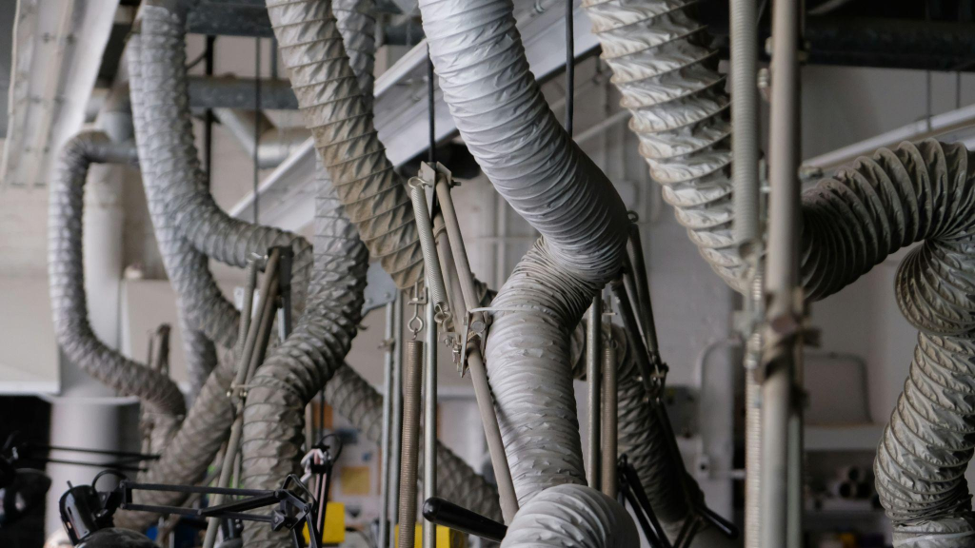
Flex is an insulated tube with a wire coil inside. It snakes around obstacles and goes in fast, so it’s a natural fit for the short hop from a main line to a register. Rigid duct is sheet metal, mostly galvanized steel, and it keeps its shape. The walls are smooth, so air slides through, which is what you want on the long straight stretches that move most of the air. Every joint in metal ducts has to be sealed, but when that’s done right, they’re hard to beat for trunk lines.
Cost plays a part too. Flex is usually cheaper and quicker to install, which explains why you see it everywhere. Rigid takes more labor, though on the right runs it pays you back in airflow and lasts longer. Neither one of them is bad. The trouble starts when the wrong type goes in the wrong spot, or when either one is installed carelessly.
Most Flex Problems Are Installation Problems
Flex gets a bad reputation, but a lot of that comes from sloppy duct installation, not the material itself. A run that sags, kinks, or sits crushed in a tight corner chokes airflow no matter how good the duct is. The Department of Energy’s guidance is specific: hang flexible duct from supports no more than 4 feet apart, use straps at least 1.5 inches wide, and let it sag no more than half an inch per foot between hangers.
They also add that resting a flex run on ceiling joists or truss members is fine, as long as it’s still properly supported. It also blames poor installation for lost airflow, wasted energy, and moisture problems. Homeowners rarely trace it back to the ductwork, though. What they notice is simpler: one room that never warms up, and a system that seems to run forever.
Common flex mistakes to watch for:
- Long spans between hangers, so the duct droops
- Sharp kinks at turns instead of gentle bends
- Duct left compressed or crammed into a tight space
- Narrow straps that pinch the duct
- Loose or untaped connections at the ends
If you’re getting a second opinion on a quote, ask how the runs will be supported and how the connections will be sealed. Good duct installation answers those questions without hedging.
How We Decide Run by Run in Monterey Homes
Material choices work best when they’re made run by run, not for the whole house at once. A long trunk through an open attic is a different job from a short branch squeezed through a tight chase. The best answer to flexible vs. rigid ductwork is usually a mix.
That’s where an inspection comes in. Fuse Monterey, for example, lays out the order of operations: a technician looks at the system first, walks the homeowner through what was found and what the choices are, and only then puts a number on the job. For ducts, that means the material gets picked based on what’s really up in the attic or under the house. The same page brings up coastal moisture and humidity as part of working in Monterey County. Any duct that runs through a damp space deserves good sealing and insulation for exactly that reason. A careful inspection helps determine whether flexible vs rigid ducts are better suited to each area of the home.
A few questions help the conversation: Where does each run go? How long and how bent is it? Is the space dry or damp? How much room is there to work? The answers usually point to the right material for each stretch. Older homes can add surprises, since existing ducts may be undersized or poorly routed, and a replacement plan has to deal with what’s already there. Comparing flexible vs rigid ducts for each section helps ensure the right material is selected for efficient airflow and long-term performance.
Match the Material to the Run
Here’s a simple starting point. Rigid metal ducts tend to suit long, straight main lines, and flex suits short final connections. Treat the table as a guide, not a rule.
| Run | Usually a good fit | Why |
| Main trunk line | Rigid metal | Holds its shape, low resistance |
| Long, straight branch | Rigid metal | Smooth walls move air easily |
| Short connection to a register | Flex | Easy to route, quick to install |
| Tight turn or obstacle | Metal elbow, then short flex | Avoids kinks |
| Damp crawl space | Well-sealed, insulated duct | Limits moisture trouble |
If a quote picks one material for every run in the house, ask why. Sometimes there’s a good reason. Often there isn’t. Whatever the mix, joints should be sealed and supports spaced evenly. Comparing flexible vs rigid ducts helps ensure each HVAC run uses the right material for proper airflow and long-term performance.
In Conclusion

Neither material wins every time. Rigid metal is great for the long, straight runs, flex is handy for the short, tricky ones, and good installation matters more than either. If you’re comparing quotes, ask what goes where and why.
Find a Home-Based Business to Start-Up >>> Hundreds of Business Listings.