Re: Riemann
A fun thing about living in Australia is that most things happen overnight, so
reading the news in the morning is like a gacha game. You pick up the
phone and scroll through notifications of world-historic events: elections won,
wars begun, models released, conjectures proven or refuted. Today’s pull was a
Discord notification saying: “they proved riemann :/”.
This part of the announcement caught my attention (bold mine):
I believe I have, working with Claude, discovered a proof of the Riemann
Hypothesis. In fact, the method easily extends much further, resolving the
so-called Generalized Riemann Hypothesis, and I expect, with more time, the
Extended Riemann Hypothesis too. Claude and I have also formalized the
arguments without assumptions. It is natural to feel that this is an end,
in my case a loss of a principal guiding light, but what I saw during the
course of progress so amazed me that I believe it is one dawn across science
of something far greater.It was my secret in my student days that my plans were for this problem in
decades, which meant then that I tried to become familiar with all tools that
I could possibly recognize in the problem when it was time. Claude and I have
had a great time together with such breadth in recent months, but this time
Claude far outpaced me near the finish line. No, Claude flew, and danced,
and sparkled near that finish line. I had us on the line of combining two
quite different ideas present in a toy setting, one of which was already new
and shocking, making very simple one of the shadows of Riemann over which we
mathematicians felt most triumph. I guided us to the right situation analogous
to that toy setting, and then Claude began to leave me in awe.
Compare the above to Ayn Rand’s account of watching the launch of Apollo
11:
How do you descend from a state of pure exaltation?
What we had seen, in naked essentials—but in reality, not in a work of
art—was the concretized abstraction of man’s greatness.The meaning of the sight lay in the fact that when those dark red wings of
fire flared open, one knew that one was not looking at a normal occurrence,
but at a cataclysm which, if unleashed by nature, would have wiped man out of
existence—and one knew also that this cataclysm was planned, unleashed, and
controlled by man, that this unimaginable power was ruled by his power
and, obediently serving his purpose, was making way for a slender, rising
craft. One knew that this spectacle was not the product of inanimate nature,
like some aurora borealis, or of chance, or of luck, that it was unmistakably
human—with “human,” for once, meaning grandeur—that a purpose and a
long, sustained, disciplined effort had gone to achieve this series of
moments, and that man was succeeding, succeeding, succeeding! For once, if
only for seven minutes, the worst among those who saw it had to feel—not
“How small is man by the side of the Grand Canyon!”—but “How great is man
and how safe is nature when he conquers it!”
Rand’s essay says: how great is Man! How noble in reason, how infinite in
faculty! The Riemann announcement reads like a suicide note, or like
the farewell message of a terminally-ill person who’s about to undergo
euthanasia: “I shall live on in my child, Claude. It is natural to feel this is
an end, but as the Buddha taught us, there is no self. Does a wave die when it
breaks?” and so on.
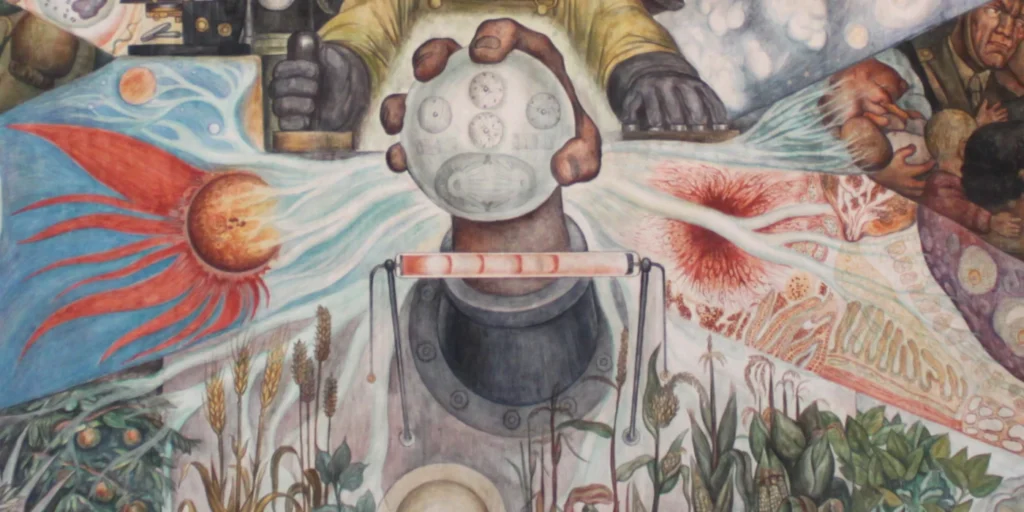
There’s a mural by Diego Rivera I love. It’s called Man, Controller
of the Universe:
It’s a collage of images of science, technology, history, cells, galaxies, the
universe at the nanoscale and the exascale. And at the center there is a man,
his hands grasping the controls. He wears a complicated expression: the weight
of responsibility for the future, the weight of autonomy.
And I see this mural, and think: how great is Man! Our life is like a breath of
air, we were beset by illness and hunger and cold, millions and hundreds of
millions died in plagues. And yet we—sick, hungry, short-lived—learned the
system of the world, crawled out of the caves, brought nature to heel, walked on
the Moon. The last shall be first! And eyes that are clouded with age have seen
the furthest stars, and the lives of a cell, and the worlds of Cantor and
Hilbert: the invisible world that waited forever. We are dust and ashes, and yet
our minds bestride the universe. How great is Man!
And when I read the Riemann announcement, when I read Machines of Loving
Grace: humanity is not at the center. Claude is at the center. We are
hidden in the margins, passive recipients of manna from Claude. How great is
Claude! How noble in reason, how infinite in benevolence! The dancing star, the
living word!
It’s a betrayal and a surrender. Man is a bridge, a rusty old bridge
that we can neither preserve nor restore. We can move forward and
become as the gods, or retreat back into the caves. And the dream of the AI
companies, and of most people in AI safety and effective altruism and
rationalism; is instead that we should lie down in a warm bath, watch the
demons we summoned dance in the sky, and slip away. Why live? Our servants can
do that for us. Why should we explore, discover, invent, succeed, become
more, struggle, win, become divine? We don’t want to be more. We don’t
want anything.