OFAC Sanctions Hizballah-Linked Gold Traders in Lebanon and Türkiye: A Screening Update for Precious Metals Businesses
On November 18, 2026, the Treasury Department’s Office of Foreign Assets Control (OFAC) added Lebanon-based Gold Global Company and Türkiye-based Sankari Gold Kuyumculuk Ticaret Limited Sirketi (Sankari Gold) to the Specially Designated Nationals and Blocked Persons List (SDN List) in a Hizballah (Hezbollah)-related action. OFAC published the notice in the Federal Register on November 23, 2026 (91 FR 75639). Companies that buy, sell, refine, finance, ship, or import gold and jewelry, or that deal with counterparties in Lebanon or Türkiye, should update their screening now.
Key Takeaways
- OFAC added Lebanon-based Gold Global Company and Türkiye-based Sankari Gold Kuyumculuk Ticaret Limited Sirketi to the SDN List on November 18, 2026, under E.O. 13224, as amended. Treasury designated Hassan Khechen, Ibrahim Khechen, the Wa Ta’awanu Association, and its founder in the same action.
- Both company entries carry OFAC’s secondary sanctions risk tag under section 1(b) of E.O. 13224, as amended by E.O. 13886.
- Unless licensed or exempt, U.S. persons are generally prohibited from dealing with blocked persons, including providing or receiving funds, goods, or services.
- OFAC requires blocked property to be reported within 10 business days.
- DTL’s read: gold, jewelry, and precious metals businesses should rescreen counterparties on names, aliases, addresses, and registration numbers, not names alone.
Two Gold Traders Added to the SDN List
Treasury announced the designations under E.O. 13224, as amended, OFAC’s counterterrorism authority. The action covered two groups. The first is the Wa Ta’awanu Association, a Lebanon-based charity Treasury described as Hizballah-affiliated, and its founder, Afif Abdel Rida Chouman. The second is a gold and cash network that Treasury stated is run by Hizballah and Iran’s Islamic Revolutionary Guard Corps-Qods Force (IRGC-QF).
According to Treasury, Lebanese businessman and money changer Hassan Khechen and his brother Ibrahim Khechen transferred funds from the IRGC-QF to Lebanon on Hizballah’s behalf, in coordination with Hizballah financial officials. Treasury stated that Hassan Khechen owns Gold Global Company and uses it to transfer money from several transit countries to Lebanon. Treasury also stated that Hassan Khechen controls Sankari Gold, which helps Gold Global Company move gold bullion and cash from Africa, and that the network uses couriers to carry cash across borders.
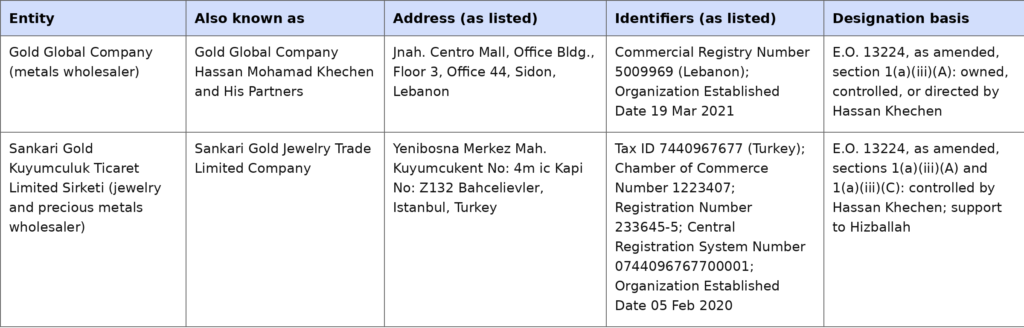
The Federal Register notice lists the following identifiers for the two companies:
Both entries also state that the entity is subject to secondary sanctions under section 1(b) of E.O. 13224, as amended by E.O. 13886.
What the Designations Mean for U.S. Persons and Foreign Counterparties
Treasury’s November 18 release sets out the consequences of the designations:
- Blocking. All property and interests in property of the designated persons that are in the United States or in the possession or control of U.S. persons are blocked and must be reported to OFAC. Entities owned 50 percent or more, directly or indirectly, individually or in the aggregate, by one or more blocked persons are also blocked.
- Prohibited dealings. Unless authorized by a general or specific license or otherwise exempt, OFAC’s regulations generally prohibit transactions by U.S. persons, or within or transiting the United States, that involve property or interests in property of blocked persons. This includes providing funds, goods, or services to, or receiving them from, a blocked person.
- Foreign financial institutions. Treasury stated that engaging in certain transactions with the designated persons may risk exposure to secondary sanctions. OFAC can prohibit, or impose strict conditions on, U.S. correspondent or payable-through accounts for a foreign financial institution that knowingly conducts or facilitates a significant transaction on behalf of a designated person.
- Penalties. Violations may result in civil or criminal penalties for U.S. and foreign persons, and OFAC may impose civil penalties on a strict liability basis.
- Reporting timeline. OFAC guidance states that parties must report blocked property to OFAC within 10 business days of the property becoming blocked.
Designated persons may petition OFAC for removal. Our guide, Getting Off the SDN List: A Practical Guide to OFAC’s Administrative Reconsideration Process, walks through that process.
Ownership, Control, and the Screening Gap
OFAC’s 50 Percent Rule addresses ownership, not control. Under OFAC FAQ 398, an entity that is controlled, but not owned 50 percent or more, by one or more blocked persons is not automatically blocked under the rule. In this action, OFAC listed Sankari Gold by name, citing Hassan Khechen’s control of the company.
DTL’s read: Automated list matching is a starting point, not a complete control. A counterparty can be blocked without appearing on the SDN List under its own name, and affiliates of designated persons can operate under aliases or new registrations. Businesses in the gold trade should screen on every identifier OFAC publishes and should look at who owns and runs their counterparties. We covered the same lesson in OFAC’s Extreme Networks Settlement: Why Screening Names Alone Is Not Enough and in our analysis of OFAC’s March 31, 2026 advisory on sham transactions.
Action Items for Gold, Jewelry, and Precious Metals Businesses
In our experience, the businesses that handle new designations well act within days, not at the next annual review. We recommend the following:
- Confirm your screening tool has loaded the November 18, 2026 SDN entries, then rescreen open orders, customers, suppliers, refiners, consignees, freight forwarders, and couriers.
- Screen on the listed aliases, addresses, and registration numbers. Sankari Gold’s listed address is in Istanbul’s Kuyumcukent jewelry complex, so review other counterparties at that address.
- Review the ownership of Lebanon- and Türkiye-based counterparties for interests held by any of the designated persons, applying the 50 Percent Rule’s aggregation principle.
- Review payment and shipment chains for gold bullion or cash moving from Africa through Türkiye or Lebanon, the pattern Treasury described in this action.
- If you identify blocked property, block it, do not release it without OFAC authorization, and file the required report within 10 business days.
- If a past transaction involved a designated party, talk to counsel about whether a voluntary self-disclosure to OFAC is appropriate. OFAC’s Economic Sanctions Enforcement Guidelines treat voluntary self-disclosure as a factor in the penalty analysis.
How Diaz Trade Law Can Help
Diaz Trade Law advises importers, exporters, and financial counterparties on sanctions screening programs, transaction vetting, blocked and rejected transaction reports, voluntary self-disclosures, and SDN List removal petitions. For recent context, see U.S. Government Continues to Signal Sanctions Enforcement as a Priority: Three Recent Cases and OFAC Extends Cuba Sector Sanctions Risk to Electronics, Manufacturing, Marine, and Technology.
Contact Diaz Trade Law at 305-456-3830 or visit diaztradelaw.com to review your sanctions exposure.
ATTORNEY ADVERTISING. This article is for general informational purposes only and does not constitute legal advice or create an attorney-client relationship. Prior results do not guarantee a similar outcome.