‘It’s just vape shops, nail shops, charity shops’: Can anything save the British high street? | Retail industry
On 22 May 1987, retail history was made in Rotherham. Parkgate Retail World, thought at the time to be the UK’s largest open-air shopping centre, welcomed shoppers for some one-stop retail therapy. The official opening was marked in swanky fashion with a “breathtaking” display from Marlboro’s red-and-white branded biplanes, followed by a “spectacular” laser show, the first in South Yorkshire. Helen Worth – Coronation Street’s Gail Platt – cut the ribbon before jovial local people jostled to fill their car boots with goods from Comet, Jolly Giant and Poundstretcher.
Almost 40 years on, the razzle is a bit less dazzling. Parkgate, as the retail park is called now, looks like any large big-box outdoor shopping centre you might find on urban fringes. There’s a Primark, a Sports Direct and a Matalan, plus (of course) a Frankie & Benny’s. Shoppers still seem to love it. “I think it’s ideal. It’s got everything here,” says Robert Gordon. The 66-year-old retired factory production manager had popped to Pets at Home to get a cupcake and toy for his dog Bruno’s fourth birthday.
Gordon has lived in Rotherham for 24 years. “A lot of people come to outlets like this. It’s very rare we go into the town centre and, if we did, we’d go to Sheffield,” he says. He is hardly an outlier. Almost half of Britons don’t visit their high street weekly. Instead, shoppers are opting for retail parks. Business is so strong, retailers are scrambling for spots, even paying extra to secure their place. By the end of 2025, only 4.8% of retail park lots in Britain were vacant, according to real estate consultancy Knight Frank – the lowest level on record. Vacancy rates for UK high streets, on the other hand, sit at 13%, reports Savills.
Gordon remembers a time two decades ago when you “couldn’t move” in Rotherham town centre, especially at the weekend. “It was packed and all the local shops were busy. Now these big outlets have taken over.” He admits his shopping habits come at a cost to the local community. “We are part of the problem,” he says. “It’s not progress. You used to meet people, but now you’re lucky to see anyone you know. Most people will come here and shop, get what they need and go back home.”
Jo Hill, 59, and her husband Richard, 65, are also Rotherham locals. Until recently, they hadn’t set foot in the town centre in nearly two decades. “What you see is either vape shops, nail shops or charity shops,” says Jo, who is semi-retired. Rotherham town centre is bookended by Parkgate at one end, and Meadowhall – one of the UK’s largest indoor shopping centres – at the other. The couple were visiting Parkgate to buy a printer from Currys. “For the big stuff, it’s either here or Meadowhall,” says Richard.
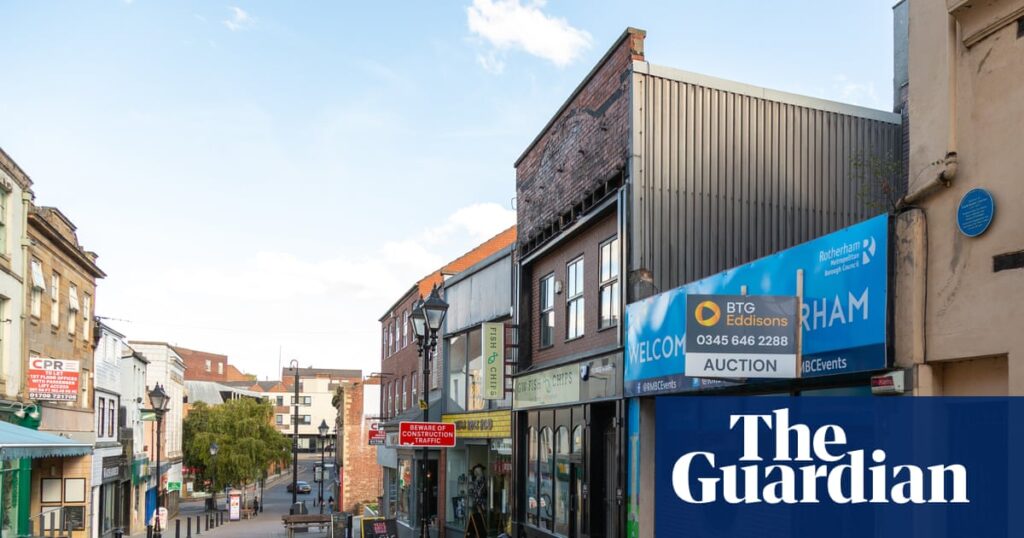
A short journey away, in Rotherham town centre, the picture is different. About 70 retail units, 24% overall, are vacant, far higher than the national average, and it is immediately apparent. One of the first things you see when leaving the train station is a derelict branch of BrightHouse, a rent-to-own retailer selling large appliances and furniture, which shut down in 2020. Further up is an anonymous-looking shopfront with smashed windows, graffiti and empty panelling where a shop sign should be – another shuttered chain, Fultons Foods, which closed in 2022. The only identifying mark is a window sticker: “There’s always change at Fultons.” Vape shops, discount chains and charity shops dominate the street.
The arrival of Parkgate Retail World nearly four decades ago wasn’t without friction. Even then, market traders expressed fears about the impact on business and, in Westminster, parliamentarians warned that these mini shopping metropolises would drain jobs from the high street, “disembowel towns and villages” and disadvantage those unable to drive.
Donna, who owns a furniture shop, and Saj, who runs a sandwich deli, are on their lunch break when I stop them. “It’s declined totally. I really wish it hasn’t, but it has,” says Donna. Nowadays she usually serves about four or five customers, and her daily takings have declined to “virtually nothing”, she says. Saj agrees that footfall is nonexistent.
The pair say safety is one reason that locals, especially elderly people, are staying home. “People have had their bags stolen, or been followed into banks; you’re watched when using the cash machines,” says Donna. “People will only come if they feel safe. It was always the older generation that came into the shop buying beds. Now their families won’t let them come out.” In 2023, a government analysis found that the number of crimes carried out per 1,000 people in Rotherham town was 160, 72% higher than the national average at the time. Recent police data shows there were 1,105 crimes, including 356 violent and sexual offences and 188 instances of shoplifting recorded in central Rotherham in August of this year alone. Nearby Sheffield city centre recorded 836 crimes in the same period. Donna says drug users also hang around her shopfront. “They sleep in my doorway sometimes. There’s needles and all sorts left. We’re not getting anybody into the shop because it looks bad.”
For Saj, the lack of affordable parking is another problem killing the high street. Car ownership has soared since the advent of the retail park. In 1971, 52% of households in Britain owned a car. A decade later, this had jumped to 60%, and by 2022 nearly three-quarters of households had a car. On its website, Parkgate touts its “over 2,000 free parking spaces”, all in one concentrated area.
Within Rotherham town centre, there are 1,610 spaces, which, until fairly recently, were all paid – though the council has recognised parking as a challenge. In 2016 it cut long-stay charges from £6.50 to £3.50 a day, and last year, it introduced free parking for one hour on weekdays. At the weekend, some spaces are free all day, but many, while acknowledging the council’s efforts, say it is not enough.
Sitting on a bench and lapping up the sun on Rotherham High Street are Leo Lopez and Claire Mercer. “I’ve seen a massive change,” says 50-year-old Lopez, a support worker. Mercer, also 50, a road safety campaigner, agrees. “You don’t come here to do general shopping after 3.30pm. It’s aggro caused by drugs mainly. People are more out of their head by that time. It’s an unfortunate truth, but it’s everywhere.”
The state of the town centre “deteriorates the morale”, says Lopez. And it may be contributing to the rise of rightwing populism: research by the thinktank Power to Change published last year found higher support for Reform UK in areas with run-down high streets that have high vacancy rates. Mercer says a part of town filled with ethnic minority shops and restaurants has been disparaged by some as “a foreign bazaar”. “Would they prefer the shops were empty? It’s much better to have busy shops, but people don’t like change.”
The town centre isn’t totally devoid of good news. Days before I came to town, Yella Brick Road – a quirky clothing and homewares shop – was preparing to close its doors, a decision it reversed after loyal shoppers flocked to keep the business afloat. Owner Dannii Paston has been trading in the town centre for 17 years. “Recently, people are just careful with money. We’re a shop where you don’t need anything in here – it’s all treat spends,” she says.
Surprisingly, it was the relocation of Primark, the supposed big, bad clothing behemoth, that Paston believes cost her the most business. “I didn’t think they were our customers, but actually, people would go to Primark for certain things like pants, tights or a cheap dress for the 10-year-old, then come to us for themselves,” she says. Even when the chains were in the town centre, their limited stock couldn’t compete with their warehouse-sized counterparts in Parkgate, says Paston. “It’s a societal shift on how people want to shop. Why would you go into a tiny high-street shop that’s got a quarter of the selection?
She believes supermarkets were the first to pull customers from town. In many large Morrisons branches, for example, you can take your passport photo, wash your clothes in an on-site launderette and even have keys cut while doing the weekly shop. Sainsbury’s has closed 420 Argos high-street shops since 2020, after acquiring its parent company, and shifted them inside its larger stores. “It’s like a little high street,” says Paston.
The out-of-town shopping destination – whether it’s a retail park, mall or outlet – hasn’t always been part of British life. The UK’s first such complex, Gem Superstore, opened in West Bridgford, Nottingham in 1964. Operated by an American company, Government Employees Mart, it brought US-style shopping to Britain – and demand was through the roof. The Goldfinger star Shirley Eaton was brought in for the official opening day, when 30,000 people rushed down its aisles. At 110,000 sq ft, fairly paltry compared with the sprawling shopping complexes that followed, it was more akin to a modern-day large supermarket. Two years later, Asda, then still a fledgling chain of small grocers, bought the site for its first superstore.
London’s Brent Cross Shopping Centre, which opened in 1976, took things to the next level. Traders feared that the 800,000 sq ft behemoth – boasting air conditioning (unheard of at the time) and the triple threat of Fenwick, John Lewis and Marks & Spencer under the same roof – would hammer local trade, and the Labour government tried to thwart the development. But Barnet council, in a Tory stronghold where Margaret Thatcher held her parliamentary seat, gave it the enthusiastic thumbs up. The indoor shopping centre opened the year after Thatcher’s ascendancy to leader of the opposition in 1975. Already there was consensus among local authorities that out-of-town shopping centres would destroy high streets but, after the Tories entered Downing Street in 1979, planning rules were eased. “There is a change of attitude in the 1980s which begins to allow these out-of-town locations,” says Alistair Kefford, the chair of urban studies at Leiden University in the Netherlands. In 1981, there was one out-of-town retail park in the UK. By 1988, there were 90 and at the end of 1996, there were 385.
In the end, the critics were right. “There’s only a certain level of consumer demand within a regional economy,” says Kefford. “If you build a wonderful, shiny, exciting new shopping mall or retail park, it doesn’t create a lot of new shoppers. They just stop going somewhere else.”
The bruising figures bear this out. In 2024, 13,479 shops across the UK closed their doors. While retail accounts for 5% of the UK economy and less than a tenth of employment, an area’s former glory is often starkly highlighted by its decrepit high street. “Dying high streets make people feel ashamed of their place, that their life is falling apart,” says Eddie Blake, a director at the architecture practice Studio Weave.
How to save the high street has become fertile political territory. Parkgate lies within John Healey’s constituency. In 2019, the now-chancellor scolded M&S for shutting its branch in the shopping complex, about a decade after relocating from Rotherham town centre, meaning the retailer would “disappear from the town for the first time in 125 years”. Since entering No 11, Healey has said “blighted” high streets will soon be “on the up”. Last month, Andy Burnham announced £210m in funding to regenerate down-on-their-luck high streets. But Kefford is sceptical. “Retail is a barometer – it’s not an engine. Where you see retail doing well, it’s a sign that the regional economy itself is doing well, but retail by itself won’t make a place wealthy. It’s not an engine of growth because it relies on people spending their disposable income,” he says.
Efforts to turn the ship can often be futile. “Once a location has set off down a particular path, it’s very hard to get out of it. In fact, everything leads further and further down that path. The narrowing range of shops, the growth of empty properties – these are things that snowball and get worse and worse,” says Kefford.
So, are UK high streets doomed? Shops “are probably not going to come back”, says Kefford, but there’s still hope. “In the 1950s and 1960s, town centres sustained loads of uses. There were many more houses and social activities: churches, working men’s clubs, community associations, charities, theatres. We need to think more fundamentally and creatively about what is the point of a town centre,” he says.
This may be good for society, too. Blake says the retail parks and shopping centres, and the cars we use to get to them, contribute to an “atomised culture that makes people feel alone”. A multifunction high street can better facilitate social interaction: “The small-grain interactions of social life are better, higher quality, and more frequent.”
Until then, many of us will be drawn to these bland, uninspiring shopping pens on the fringes of town. On my way to the train station, the No 8 bus pulls up on the high street, having just stopped at Parkgate. Sure enough, the passengers who alight are carrying bags from Primark, TK Maxx and Sports Direct.