Is a Too-Big-to-Fail Bank Safer? Only for Money Over the FDIC Limit
Just the Tip:
FDIC insurance covers at least $250,000 of your deposits at every insured bank. Up to that amount, your money is just as safe at a small bank as at a too-big-to-fail giant. Choose your bank on fees, rates, and service, and keep a larger balance fully insured rather than betting on a rescue.
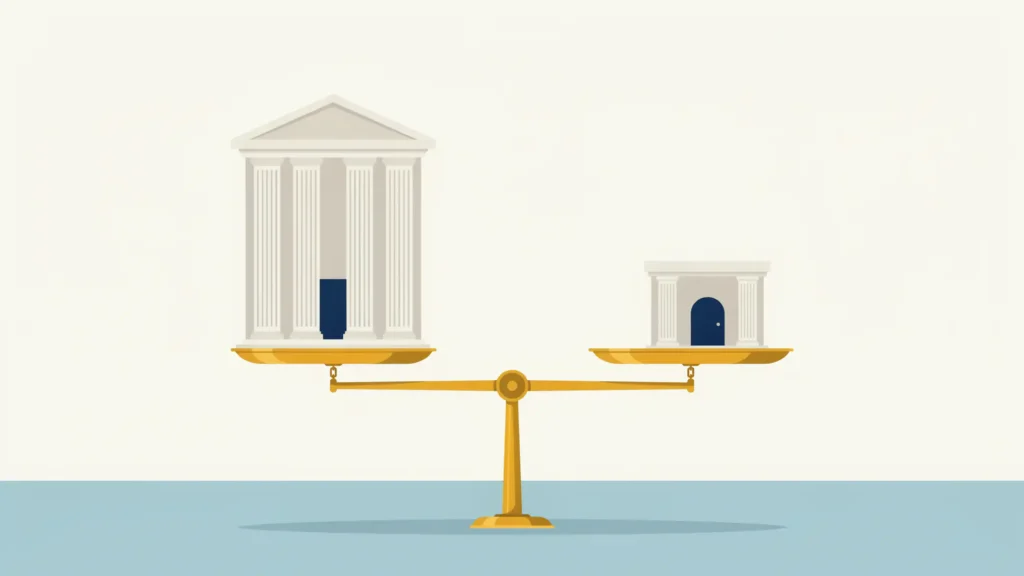
At the end of 2022, more than 99% of U.S. deposit accounts were under the insurance limit, the FDIC found. Only a balance above the limit could gain anything from a bank’s size, and even that gain is smaller than the too-big-to-fail label suggests.
Regulators call too-big-to-fail banks systemically important, because their collapse could drag down the economy. Each November the Financial Stability Board, an international body that monitors the global financial system, lists the world’s systemically important banks. Its current list includes eight from the U.S., among them JPMorgan Chase, Bank of America, Citigroup, and Wells Fargo. Those banks must hold extra capital and go through the Federal Reserve’s annual stress test, a check of how their capital would hold up in a hypothetical recession. Since a 2018 law, the Fed’s stricter standards apply automatically only to banks with $250 billion or more in assets, up from $50 billion.
Those rules make a giant less likely to fail, but no law guarantees a rescue if one does. Under the 2010 Dodd-Frank Act, a failing giant the government takes over must be wound down, and taxpayer money can’t be used to keep it alive. In 2023, regulators did cover every deposit at Silicon Valley Bank and Signature Bank, two banks not on the list. That took an exception for failures that threaten the financial system, which the Treasury secretary approved, according to their joint statement. Depositors under the limit, at any bank, needed no rescue at all.
So choose your bank on what you’ll notice: its monthly fees, the rate it pays on savings, and the help you get when something goes wrong. Banking at one of the biggest U.S. banks makes sense for branches and ATMs nearly everywhere, not for safety. Confirm any bank you consider is FDIC-insured on the FDIC’s BankFind Suite.
If you or your business keeps more than $250,000 at one bank, move the part the FDIC doesn’t insure to a second insured bank instead of counting on another exception.
Compare the best high-yield savings accounts to pick a bank by its rate and fees, not its size.
Get one money tip every morning

Join 50,000+ readers. Actionable, free, no nonsense – just the tip.

Subscribe and we’ll send you 101 Essential Money Tips to get you started.
The 101 money moves that matter most, from the foundations to protecting what you’ve built.
No spam, ever. Unsubscribe anytime.
Advertiser Disclosure: Many or all of the offers that appear on this site are from companies that compensate us, and some companies pay for sponsored content. That compensation may influence which products we cover and where and how they appear on a page, including the order in which they appear. We do not include every company or offer available in the marketplace.