How The ’65 Chevy Caprice Turned The Impala Into A Working-Class Cadillac
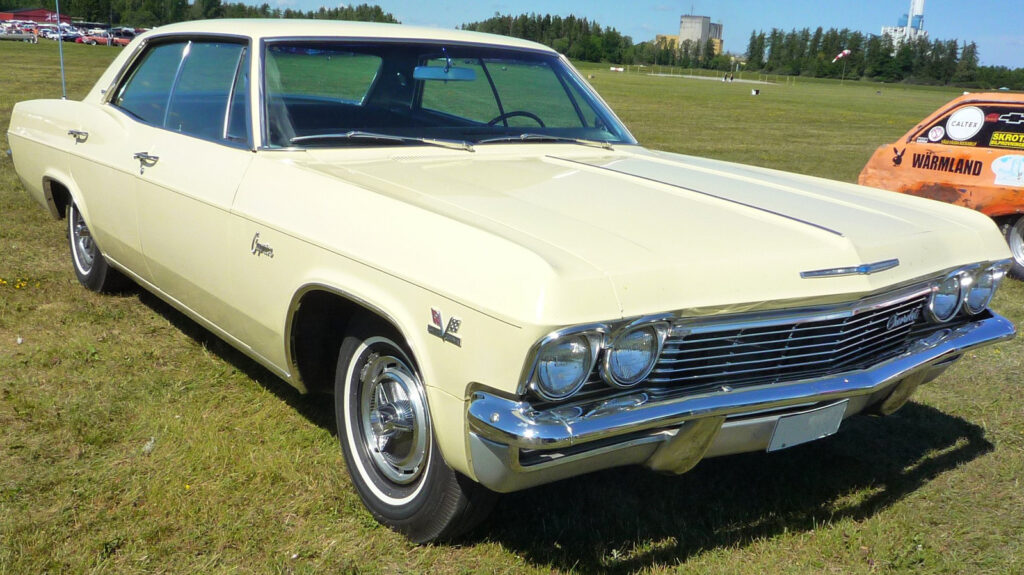
Rewind the clock back to the mid-1960s, and the American automotive scene was arguably at a cultural high-point. Every manufacturer offered a diverse selection of fantastic automobiles, General Motors included. Under just its banner alone, we had the rise of the Muscle Era with the 1964 Pontiac GTO, America’s first sports car, the Corvette, the innovative Oldsmobile Toronado, the wacky rear-engined 1960 Chevrolet Corvair, and so much more. One car that gets somewhat overlooked carries a name which endured until the 2010s: the Caprice.
Much like the first GTO, the Caprice wasn’t its own specific model, but rather a trim level. It was based on the Impala, specifically, which General Motors branded as the Caprice Custom Sedan by Chevrolet. Much like how the GTO represented the pinnacle of a Tempest’s muscle potential, the Caprice was essentially the most luxurious Impala. It’s an early example of what we might see today in something like an Alpina BMW, basically fully loading a car, putting on bespoke bodywork, adding plenty of luxury quirks, and finishing it with top-tier engines.
Among the aforementioned quirks, the Caprice had plenty that affected its mechanical components, a welcome upgrade from the otherwise boaty, lazy full-size cars of the day. It featured heavy-duty coil suspension, heavier body mounts and frame upgrades, thick carpeting for plenty of sound deadening, and more. It apparently proved so lucrative that GM separated it into a distinct model, the 1966 Caprice, which lived on as Chevrolet’s top-end luxury car until 1970 in its first generation. Let’s dive in and explore more.
Under the Caprice’s hood
The Caprice isn’t just a show-piece trim package, it was actually quite substantial, and that was important in a full-size sedan like this. They were not lightweight cars. Of course, that benefited the Caprice in a sense, because its massive frame and good suspension lets cars like these soak up bumps with ease.
It originally came with a host of powertrains to help shove it down the road, namely the 195-hp Turbo-Fire 283, the 250-hp 327, the 396 ci Turbo-Jet making 325 hp, or the top-tier 396 pushing a quoted 425 hp. All of these were mated to either a three-speed column shift, four-speed floor shift, or an automatic in the form of a Powerglide or Turbo-Hydramatic, with the latter only available on the 325-hp 396. Naturally, all of this came with little in the way of other upgrades, retaining the wallowy suspension and rather sub-par brakes.
That said, in top trim, this was certainly a capable car. The 396 could move mountains, much less the 4,250-pound Caprice, and it came with durable extras like a Posi 12-bolt rear end and those frame upgrades. Bear in mind that this was the same year that the original Dodge Charger had come out, which itself could be optioned with the 425-hp rated 426 Hemi. Granted, there’s a world of difference between the NASCAR-derived HEMI and the 396, but the point remains — no one would accuse a Hemi Charger of being slow, despite also being a giant luxury boat of its day. The same is true for the well-equipped Caprice.
Why the Caprice was significant
This harkens back to a time when the massive full-size sedan was in decline, but personal luxury was in vogue. Other companies capitalized on this trend, mainly Ford with the LTD, which released alongside the Caprice as its own trim level for the 1965 Galaxie 500. This spurred both automakers to quickly develop these cars into their own full-fledged models, which then competed against one another. They weren’t as exclusive as the top-end stuff, but they were still exceptionally appointed.
The significance, then, is in the price versus what you got. A top-end 1966 Cadillac Fleetwood, for instance, cost some $6,695 new without options, about $71,000 today. Meanwhile, you could get a Caprice for exactly $3,000, so less than half of the Caddy. Granted, the quality will reflect the price, but even so, you still get plenty of luxury for your buck. The sound deadening, soft suspension, supple leather interior with optional Strato-Bucket seats, a bevy of engine and transmission options, and so on — it was good value for its day, considering the average single-person salary was $7,400 at the time. It was honest, affordable, middle-class luxury.
This recipe led the Caprice to enjoy early success as Chevrolet’s new top-tier luxury car, replacing the Impala from which it was derived. While only available as a sedan at first, you could order a 1966-1970 example as a two-door or a six or nine-passenger station wagon as well. Its reputation carried it for decades, but with the decline of personal luxury cars in the 1990s, Caprices were relegated largely to fleet work before being phased out.