How Long Can Life Wait?
How long can an organism remain inert and still be viable when conditions improve?
The question has big implications in three areas of space exploration. On time scales of years to decades, it dictates our approach to contamination risk when building space probes. On time scales of centuries to millennia, it has implications for how life may have spread around the early Solar System. And if individual organisms can survive for geological time periods—tens to hundreds of millions of years—then this greatly increases the likelihood of our finding life in asteroids and on Mars.
The first place the question of viability comes up is the problem of contamination. Rockets are highly septic structures that sit outside in the Florida sun and launch (from a microbial perspective) absolutely oozing life. When sending spacecraft to potentially habitable worlds, it’s important to know whether we can depend on harsh conditions in space to sterilize them, or have to try to do it ourselves. The question is particularly acute for Mars, where transit times are short, and where we already know conditions on the surface are not lethal enough to eliminate survivors.
The uncontested killer of organisms in space is ultraviolet light, which disrupts DNA after just a few seconds of exposure. Ozone and atomic oxygen in the upper atmosphere prevent short-wavelength ultraviolet light from reaching us on Earth, but organisms on the hull of a spacecraft are exposed to the full spectrum of these damaging rays. (The surface of Mars get a sterilizing dose too, though not as bad as free space.) Experiments in orbit have shown that it is UV light, far more than cold, vacuum, or cosmic radiation, that makes space lethal for microorganisms.
But those same experiments show that it takes very little to shield organisms from the worst of UV exposure. A thin film of dust, or a crevice in a spacecraft, or even just the bodies of fallen comrades, are all sufficient to protect surviving microbes a layer or two down. And once there’s shade to hide behind, the little ones do quite well for themselves.
In a three-year experiment begun in 2015, Japanese scientists hung plates covered with bacteria off the side of the International Space Station to see how well they would fare there. They found that after three years, colonies of deinococcus radiodurans were not just revivable, but in better shape than a control group that spent that time inside the space station. By their estimates, a pellet of D. radiodurans 1 mm in size should be able to survive direct exposure to interplanetary space for 2-8 years, and potentially stay viable there for decades if shielded from sunlight.
An interesting aspect of the Tanpopo research is the fact that D. radiodurans doesn’t have special defenses against DNA damage. If you just look at how badly it gets beat up by exposure to radiation and vacuum, it fares no better than bacteria like E. coli, which can’t survive in space at all. But D. radiodurans turns out to be a champion healer, outshining everyone in its ability to repair DNA, including double-strand breaks that cleave the molecule into fragments. Instead of protecting DNA directly, the bacterium employs chemical defenses (antioxidants) that protect the repair enzymes themselves.
The Tanpopo results and experiments like it are bad news for Mars exploration. They imply that live microbes from Earth have already reached Mars and are vegetating under the carapaces of landers. Whether these grim survivors pose a contamination hazard depends on how effective a barrier the Martian surface is to would-be colonizers, and whether transport pathways exist connecting the surface to any habitable Martian environment, which would presumably be deep underground.
The remarkable longevity of microbes in space also vindicates NASA’s policy of crashing expensive deep space probes into Jupiter and Saturn at the end of their missions instead of leaving them in uncontrolled orbits that, decades or centuries hence, could lead to an impact with a potentially habitable world like Enceladus or Europa.
A second context where viability matters is in trying to evaluate lithopanspermia scenarios for the origin of life in the early Solar System. In these scenarios, a large impactor hits Planet A and ejects life-bearing rocks into deep space. These orbit the Sun for a while before eventually falling on Planet B. Because of the relative escape velocities and energies involved, Planet A in these liaisons is almost always Mars, and Planet B is usually Earth. If organisms can remain viable inside frozen rock for periods of thousands or hundreds of thousands of years, this dramatically increases the likelihood that life in the early Solar System could have moved between planets, and that life on Earth might have a Martian origin.
Lithopanspermia started off as a fringe idea, almost a provocation, put forth by Lord Kelvin in the 1870s to explain the origin of life on Earth. But time has been kind to the theory, and in recent decades it has found itself propelled to the edge of straight-up respectability by a series of important discoveries.
The first breakthrough came in the 1970s, when meteorite studies showed that heating during atmospheric entry was limited to the outer centimeter or two of rocky meteorites. This meant any meteorite larger than a golf ball could land on Earth without having its interior sterilized. If anything inside it was still alive, it had a chance of emerging intact, 1950s sci-fi movie style, to conquer the Earth.
The second big finding was an impact model developed in the 1980s to explain the enigmatic presence of small pieces of Martian rock on Earth. Scientists knew the rocks had to be from Mars because tiny inclusions of air trapped inside them had the same isotopic signature as the Martian atmosphere, as sampled by Viking. Clearly some cataclysm had been necessary to fling these rocks into space, but they had survived it without being vaporized or melting. In 1984, Jay Melosh, an expert on crater formation, found that there was a zone near large meteor impacts where direct and reflected shock waves could interfere to propel sheets of surface rock into space without substantially heating them. This mechanism, called spallation, gave near-surface life forms in what Melosh called the ‘fecund zone’ a survivable pathway into space.
Important corroboration for this model came in 2000, when researchers studying remnant magnetism in a Martian meteorite called ALH84001 found that it had never been heated above 40˚C, about the temperature of a nice hot bath on Earth. The meteorite had started life sitting around on Mars, and was ending its life sitting around on Earth, without much happening in the interim that would distress a microbe. It was positive proof that rocks could make the full trip from Mars to Earth without getting cooked.
The next piece of the puzzle—whether microbes could even live inside of rocks—was settled decisively with the arrival of modern gene sequencing techniques in the 1990s. As I wrote about a few months back, this revolution established the existence of a deep biosphere on Earth, a layer of slow-living bacteria and archaea many kilometers deep, living contentedly in rock. These deep-dwelling organisms inhabit a world that is chemically and thermodynamically isolated from the surface, with generation times that can stretch into the thousands of years. Some of them even dine on radiolytic hydrogen gas, and are therefore completely decoupled from the biosphere as we know it. They have no reason to care what lies far overhead.
Obviously, such strong, independent microbes are excellent candidates for lithopanspermia theories. The one open question is how long they can survive in space. From a microbe’s perspective, the only perceptible differences between planetary living and life inside a meteorite will be gravity, temperature, and radiation.
How microgravity affects microbes is a fascinating topic that deserves its own article. Here we’ll simply ignore it and assume that it has no effect on longevity.
Temperature is a bigger factory. A basketball-sized rock orbiting at a Mars-like distance from the Sun will have an equilibrium temperature of about -50˚C, while closer to Earth, the temperature will climb to about -10˚C (the exact figure depends on how reflective the rock is and how fast it spins). This makes organisms buried in permafrost an attractive analogue for how long an interplanetary traveler might survive.
In 2007, a team led by Sarah Stewart Johnson looked at bacterial DNA in permafrost and found evidence that bacteria in layers 400,000 and 600,000 years old remained viable. They saw no sign of survivors in permafrost cores that were 740,000 and 1,000,000 years old. To avoid dealing with contamination issues, her group didn’t directly try to grow these surviving bacteria in culture. Instead, they looked for long, intact strands (4,000 base pairs or more) of universal bacterial DNA, arguing that strands of this length could only belong to a living organism. Their research found that microbes in subzero environments were not truly dormant, but were staying metabolically active at levels just high enough to actively repair damage to their DNA, a result consistent with other observations of the underground biosphere.
This long lifetime means that cosmic radiation is probably the limiting factor on microbial survival in space. You may remember from my post about radiation tradeoffs that shielding from cosmic rays makes things worse before they get better, and from that perspective, ‘basketball sized’ is about the worst kind of meteor to ride in. It is too small to provide effective shielding, but big enough to create harmful cascades of secondary radiation that actually increase the total dose. In that worst-case environment, d. radiodurans could still probably last for 50,000-100,000 years before sustaining irreparable damage. So we can consider 50,000 years the upper limit for interplanetary travel time on small rocks, and 500,000 years a limit on larger ones.
Finally, there’s the question of absolute endurance. Can we hope to find truly ancient microbes on Earth, forming a kind of living snapshot of older, happier times? If we ever discovered 3 billion year old bacteria frozen under a Martian glacier, would there be any hope of reviving them?
The answer to this question also affects our odds of finding modern life on Mars. That planet was habitable in the distant past, and remains volcanically active today. There are still infrequent events, like a volcanic eruption or meteor impact, that leave a warm spot in the Martian crust that can last for a hundred thousand years or more, creating a sort of oasis of habitability in time. If microbes on Mars are able to stay dormant over geological stretches of time (hundreds of millions of years), then they might be able to wait out the cold, dark lean years between these rare warm periods, in much the way that desert plants on Earth endure years of drought and then bloom after a rainfall.
Here the answers get murky.
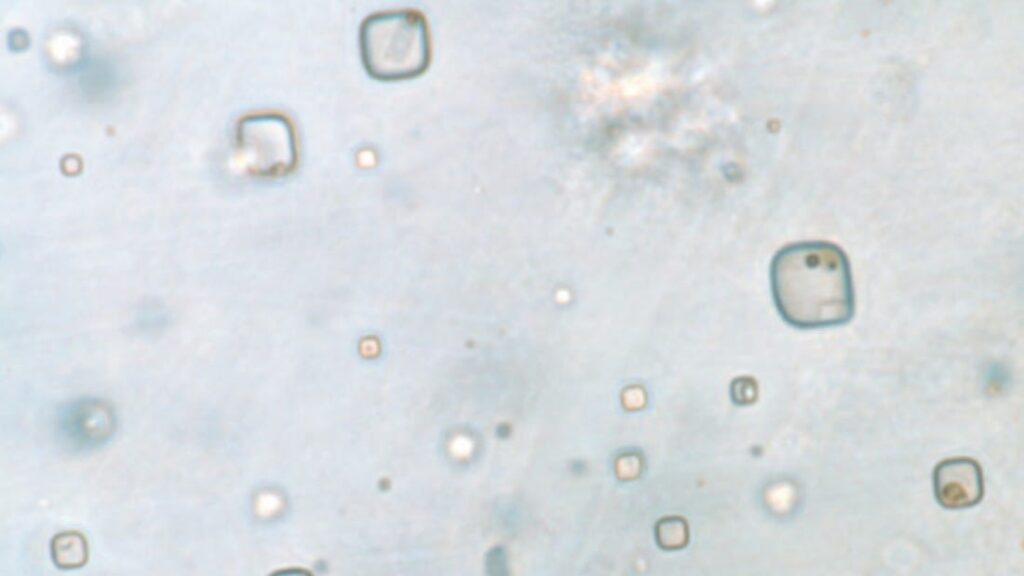
For nearly a century, microbiologists have been finding what seem to be viable microbes in ancient deposits of evaporated salt called halite. Halite forms when isolated seas and lakes dry up over time, a process that naturally traps minute inclusions of brine and whatever happens to be living in it, permanently encasing them in large crystals of salt.
Halite has nice properties when it comes to archiving microbes: its antiquity is easy to verify, it isn’t permeable to liquid or gas like amber, and thin sections of it are transparent, so you can look for water inclusions and individual trapped organisms visually. But efforts to culture these putative ancient survivors have always foundered on the contamination problem.
In a 2000 paper in Nature, a team led by Russell Vreeland claimed to have revived a 250 million year old bacterium locked away in a tiny droplet of brine encased in New Mexican halite. His team used stringent sterilization techniques that they claimed reduced the chance of contamination to less than one in a billion, They named the bacterium they were able to culture 2-9-3, and analysis of its ribosomal DNA showed it to be a close relative of a salt-loving organism called V. marismortui, which lives in the Dead Sea.
The trouble is that the resemblance was a little too close. In a paper titled “The Permian bacterium that isn’t”, Dan Graur and Tal Pupko compared ribosomal DNA from 2-9-3 and V. marismortui and found that the two sequences were exceptionally similar, differing by only two base pairs. But if 2-9-3 really had been isolated from its relative for a quarter billion years, enough random mutations in the rDNA should have accumulated for there to be a difference of at least 50 base pairs. Indeed, by the standards of the field, the two taxa could be functionally called identical.
There were other reasons to be uneasy. DNA is not a poster child for thermodynamic stability, and the idea that long strands of it could survive for hundreds of millions of years was hard to swallow (compare the much more modest limits established for DNA in permafrost discussed above). Even if you argue that DNA packed into spores in a saline environment is more stable than free-floating strands of the stuff, you arrive at lifetimes that fall about four orders of magnitude shy of Vreeland’s claim.
There’s also the matter of radiation. A small fraction of the potassium found in rocks is naturally radioactive, and over the course of 240 million years, the background radiation in a salt formation like Vreeland’s should deliver a cumulative dose of 100,000 Gray, more than ten times the dose used in industry to sterilize packaged food.
But the claims have kept coming. In 2007, Vreeland and Tim Lowenstein reported finding living archaea in a 112 million year salt inclusion. Unlike the 240 million year claim for bacterial in the Salado formation, this one seems to have landed in the literature without anyone either challenging or confirming it. In 2014, a different team led by Saala Jaakkola in China reported finding eight (!) strains of viable halophile archaea microbes in a salt crystal about 40 million years old. Like Vreeland, they used contamination controls they considered stringent, chiseling off the outer shell of each crystal before treating the exposed salt with an acid and base rinse.
All this has left the field with a conundrum. Researchers keep finding modern-looking organisms in demonstrably ancient halite. The measures taken to prevent contamination are stringent. The molecular evidence is unequivocal: these ‘revived’ microbes are mostly close relatives of modern strains.
One potential answer is obvious, that the ghost of contamination still lingers. In a 2023 master’s thesis, Beowulf Owen at the New Mexico State University showed that Vreeland’s sterilization protocol was not enough to kill bacterial spores (it needs an additional step using bleach). While a separate research group claims to have sequenced 250 million year old archaeal genomes found in the same halite deposit as Vreeland’s 2000 claim, they have not published details of their sterilization process.
One way out of the morass is to stop trying to disinfect big chunks of halite, and instead go after the inclusions directly. In 2003, a team under MR Mormile used an aseptic drill and pipette to directly extract trapped brine from inside halite inclusions. In particular, they were able to photograph candidate microbes in the crystals, extract them in sterile conditions, and culture them directly with no opportunity for the bulk contamination that plagues older methods.
The good news is that they found viable organisms in the salt. The bad news is that the deposits they did their work in are young, only 97,000 years old. So the question of what exactly is coming back to life in Permian halite remains open.
The situation is frustrating. The oldest claims don’t use the most stringent techniques, while the stringent techniques haven’t been applied to old formations. In particular, it should be easy to run a whole-genome comparison of 2-9-3 and V. marismortui, to establish how far the similarity between them extends beyond ribosomal DNA, further establishing their identity, but nobody seems to have done it. All we can say is that there’s solid proof that microbes can remain viable in halite inclusions for 100,000 years, and disputed evidence that they might remain viable over tens of millions of years. Those are some wide error bars.
I describe all of this at length because it gives a taste of the kind of trouble scientists might run into trying to analyze samples from Mars. Even working in fancy laboratories with known organisms on Earth, analyzing kilogram-size chunks of raw material, scientists have still struggled to close the chain from seeing a bacterium visually, to extracting it aseptically, to finally characterizing its DNA.
Imagine trying to do this in Martian conditions, where the biochemistry and makeup of potential life forms are unknown, the equipment may have to be tele-operated with a forty minute time delay, and live microbes from Earth may be riding along as stowaways on the lander.
Or if you prefer a sample return scenario, imagine trying to do the analysis in a category-5 cleanroom on Earth, using samples so precious that they cannot be examined in bulk or meaningfully altered.
One prerequisite for searching for relic or extant life on Mars is that we’re going to have to get a lot better at finding life on Earth. We already have one example where bacterial contamination of an asteroid sample briefly fooled scientists into thinking they had found extraterrestrial life. The stakes in analyzing returned Martian material will be far higher.
Some of the problem is cultural. Geologists, petrologists, and microbiologists come from different scientific tribes that don’t typically read one another’s papers, or buy one another beers. Even the various subfields can often talk past each other, and many researchers have yet to absorb the full implications of modern sequencing techniques on their field. What’s worse, no funding agency has made a search for deep life (whether antique or modern) a priority, or even tried to coordinate disparate efforts to at least standardize on things like sterilization protocols.
If there’s a bored billionaire out there who wants to make a lasting impact, there would be worse ways to spend money than by funding a comprehensive attempt to characterize the deep biosphere, including developing standardized techniques for sterile drilling and for sequencing single cells found in challenging environments like brine inclusions. The work might not be immediately glamorous, but it could lead to real breakthroughs on Earth, and pave the way for epochal discoveries on Mars.