
DOJ’s First “Near-Miss” NPA: What the Extreme Networks Resolution Means for Late Disclosures
On October 27, 2026, the Department of Justice announced a non-prosecution agreement with Extreme Networks, Inc., which DOJ described as its first in a “near-miss” case under its department-wide Corporate Enforcement and Voluntary Self-Disclosure Policy. The resolution is the criminal side of the same Russia-related conduct OFAC settled the same day, which we analyzed in our October 29 article. Exporters, U.S. parents of foreign subsidiaries, and companies weighing a sanctions or export controls disclosure should read the two resolutions together.
Key Takeaways
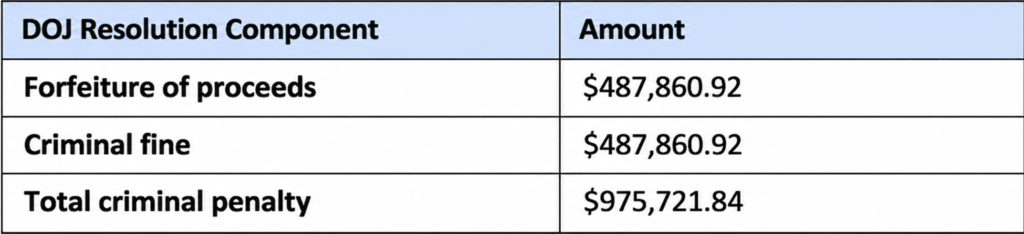
- DOJ’s National Security Division entered its first non-prosecution agreement in a “near-miss” case under DOJ’s department-wide Corporate Enforcement and Voluntary Self-Disclosure Policy, resolving Extreme Networks’ Russia-related sales for a total criminal penalty of $975,721.84.
- DOJ found the company’s disclosure was not timely, yet still credited it as a near-miss voluntary self-disclosure based on full cooperation and remediation.
- OFAC, reviewing the same conduct, treated the apparent violations as voluntarily self-disclosed and egregious. One disclosure produced different assessments at two agencies.
- Companies weighing a disclosure of potential sanctions or export violations should evaluate DOJ, OFAC, and BIS exposure together, and early.
Same Conduct, Two Agencies, Two Assessments
According to DOJ’s announcement, from about March 2018 to March 2022, Extreme Networks, through its then-Russia-based subsidiary, Extreme Networks Rus LLC, processed and fulfilled 11 purchase orders for networking equipment and services to Moscow Machinery Building Plant Avangard (MMZA). DOJ stated that MMZA, a Russian weapons manufacturer, was owned by JSC Concern Almaz-Antey, which OFAC added to the Specially Designated Nationals and Blocked Persons (SDN) List in July 2014, and that the sales were made without the required OFAC license or authorization.
DOJ also stated that Russia-based employees concealed MMZA’s identity from the company’s global trade compliance group, and that the company, as a result, filed false electronic export information through the Automated Export System and smuggled goods from the United States. The investigation was conducted by the FBI Charlotte Field Office, the Commerce Department’s Bureau of Industry and Security, and Homeland Security Investigations.
The criminal resolution
Source: DOJ Office of Public Affairs, Press Release No. 26-1264 (Oct. 27, 2026).
DOJ stated that the forfeited amount matches the revenue the company earned from the sales, and that Extreme Networks will also resolve a parallel administrative action by OFAC.
How DOJ and OFAC each viewed the disclosure
The most useful part of this case for practitioners is the side-by-side view. The table below sets out what each agency stated. OFAC figures are drawn from OFAC’s October 27, 2026 enforcement release as summarized in our prior article.

Sources: DOJ Press Release No. 26-1264; OFAC Enforcement Release (Oct. 27, 2026).
DTL’s read: the two agencies apply different frameworks. DOJ evaluates disclosures under its Corporate Enforcement Policy, while OFAC applies its Economic Sanctions Enforcement Guidelines, 31 C.F.R. part 501, Appendix A. A disclosure that earns full voluntary self-disclosure credit at OFAC is not, on its own, a qualifying voluntary self-disclosure at DOJ, and an “egregious” determination at OFAC did not prevent a near-miss NPA at DOJ. Companies should not assume that one agency’s treatment predicts the other’s.
How the Near-Miss Track Works
DOJ’s Corporate Enforcement and Voluntary Self-Disclosure Policy sets out three paths: declination, a near-miss NPA, and other resolutions. Under Part II, if a company fully cooperated and timely and appropriately remediated, but is ineligible for a declination solely because its good-faith self-report did not qualify as a voluntary self-disclosure, or because it had aggravating factors that warrant a criminal resolution, the Policy states that the Department shall:
- Provide a non-prosecution agreement, absent particularly egregious or multiple aggravating circumstances;
- Allow a term length of fewer than three years;
- Not require an independent compliance monitor; and
- Provide a reduction of at least 50% but not more than 75% off the low end of the U.S. Sentencing Guidelines fine range.
To qualify as a full voluntary self-disclosure under the Policy, the disclosure must be made in good faith to the appropriate Department component, prior to an imminent threat of disclosure or government investigation, and within a reasonably prompt time after the company becomes aware of the misconduct. DOJ’s announcement states that Extreme Networks’ disclosure to NSD was not timely and occurred under imminent threat of disclosure by a news publication. DOJ credited it as a near-miss disclosure instead.
What DOJ credited

Source: DOJ Press Release No. 26-1264.
This is a change from how we have covered NSD disclosures before. In May 2025, DOJ declined to prosecute a company that self-disclosed export control offenses to NSD within days of learning of them, under NSD’s prior standalone policy. See DOJ Declines Prosecution of Company That Self-Disclosed Export Control Offenses. Extreme Networks shows the department-wide path for a company that did not meet that timing standard.
Action Items for Exporters and U.S. Parents
The following reflects DTL’s analysis and recommendations, not agency positions.
- Treat the disclosure clock as running from discovery. In our experience, companies lose disclosure credit to events they do not control: a whistleblower, a press inquiry, a subpoena, or an agency inquiry to a counterparty. Here, DOJ identified a news publication as the imminent threat.
- Decide where to disclose as a single strategy. Filing with OFAC or BIS and filing with DOJ are separate decisions with separate standards. Map criminal exposure before the first submission goes out. Our Bloomberg Law feature on voluntary self-disclosures walks through the BIS, OFAC, and DOJ frameworks.
- Build the cooperation and remediation record now. Every step DOJ credited here (distributor termination, screening upgrades, added compliance staff, M&A diligence) is documentable. If a disclosure is late, that record is what remains available to earn credit.
- Close the visibility gap with foreign subsidiaries. DOJ stated that local employees concealed the customer’s identity from the global compliance group. Screening that relies on data the subsidiary chooses to share may miss the end user.
- Screen ownership, not only names. As detailed in our prior article, OFAC treated MMZA as blocked through its majority owner. For more recent cases, see our roundup of U.S. sanctions enforcement actions.
When to call DTL
If an internal review, an acquisition, or a distributor relationship has surfaced a possible sale to a blocked party or an export without the required license, the timing of the next decision matters. Diaz Trade Law advises companies on voluntary self-disclosures to DOJ, OFAC, and BIS, and on building the cooperation and remediation record that agencies credit. Contact us at 305-456-3830 or through diaztradelaw.com.
Attorney Advertising. The hiring of a lawyer is an important decision that should not be based solely upon advertisements. This article is for general informational purposes only, does not constitute legal advice, and does not create an attorney-client relationship. Prior results do not guarantee a similar outcome. Diaz Trade Law, P.A., 12700 Biscayne Blvd, Suite 401, North Miami, FL 33181.