Democrats won Congress. Now they must win back trade policy
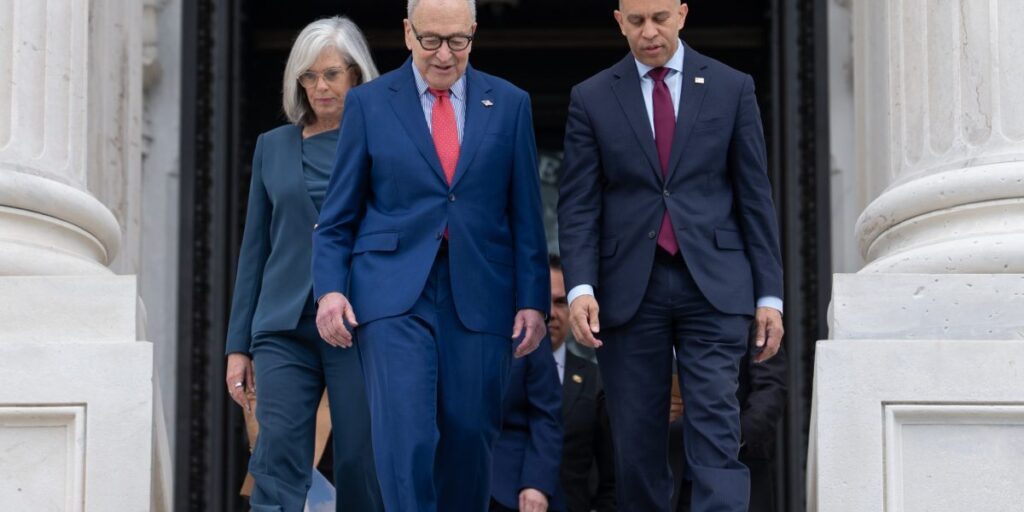
Days after winning Congress, Democrats are debating whether and how to restore congressional authority over tariffs. Some in the party are focusing on reining in Donald Trump’s sweeping tariffs on allies like Canada, while others hope that a 2029 Democratic President might direct Trump’s expansive tariffs toward progressive priorities, such as raising labor standards. This debate is missing two things. First, it blames trade failures on Trump, when both the Trump and Biden administrations pursued similar trade policies that failed workers. Second, it focuses on taking tariff power back from the president but overlooks Congress’s role in setting trade objectives.
I have spent my career trying to make trade work for American workers. As a progressive, I urge congressional Democrats to take stock of the lessons from both the Trump and Biden administrations, which requires a course correction, even if it means restraining a future Democratic president.
Both administrations, acting unilaterally, have cost us. Congress once shared control over trade policy. Under Trade Promotion Authority (TPA), it linked its up-or-down vote on trade agreements to its negotiation objectives that included enforceable labor and environmental standards. Both administrations essentially ignored it.
Trump used it once, for the United States-Mexico-Canada Agreement. Biden never used it, let it lapse, and redirected resources into domestic production. Both relied on decades-old tariff statutes that alienated allies and raised consumer prices. The results? Partners turned to [Al%20Jazeera,%20Oct.%2028,%202025]China, and allies have signed trade agreements without us. Under Biden’s domestic policies, U.S. factory production fell and manufacturing jobs stalled. Unilateralism, even under Biden’s “worker-centered” trade policy, didn’t work. Here’s why.
1. Tariffs Antagonize Trade Partners Without Improving Labor Rights
When I was a trade negotiator in the first Trump administration, we were pressured by both Democrats and Republicans to use tariffs and other sanctions to get countries to treat their workers better at home. The theory was that market leverage would force better labor and environmental standards in partner countries and level the field for U.S. businesses that meet those standards.
We tried that theory. It didn’t work for us, and it hasn’t since.
Trade partners have valid reasons to resist U.S. trade pressure. They don’t want to appear weak to their constituents. And our market leverage isn’t the silver bullet we think it is. Governments can turn to China for financial support. In Cambodia, while the United States and the European Union considered withdrawing trade benefits in 2019 over worker-rights violations, China pledged $588 million in aid. While we waited for Cambodia to give in to trade pressure, The Wall Street Journal reported in July 2019 on a draft agreement granting China’s navy a 30-year lease at Cambodia’s Ream base.
2. Tariffs Don’t Deliver for Workers
Progressives rightly champion workers who are losing jobs to global trade. Tariff policy doesn’t protect workers in the United States from job loss; it taxes them at the grocery store and when their jobs depend on a steady, affordable supply of steel and aluminum. The average hourly wage for manufacturing production workers rose 6.6 percent from January 2025 to October 2026, which is only slightly higher than 5.8 percent inflation.
3. Congress Must Embrace a More Patient Trade Policy
By letting its trade authority lapse, Congress gave up its main say in trade negotiations. The result has been rushed deals with unrealistic commitments. The Agreement on Reciprocal Trade between the United States and Cambodia, negotiated in months in 2025, committed Cambodia to protect internationally recognized labor rights, including freedom of association and prohibitions against forced labor. The International Labor Organization recently found that Cambodia still violates those standards. If we want trade commitments to translate into action, we need deliberative consultations at home and abroad. The deal with Cambodia would have been more realistic if Congress had required Cambodia to amend its laws before the deal could be finalized.
Patient efforts under the United States-Mexico-Canada Agreement, by contrast, paid off. With time to debate the labor-rights commitments domestically, Mexico passed critical labor legislation to protect independent trade unions.
A new Democratic majority must focus on reviving deliberative processes in trade policy. It should require transparent, participatory consultations at home, including trade-sector workers and their representatives. It should also require trade partners to consult their businesses and workers before agreeing to labor and environmental commitments. Congress should start in January by requiring its approval for new tariffs, as Democratic leaders now promise. They must also enact a new TPA centered on participation by workers and other stakeholders at home and abroad. President Trump will likely veto both, but doing so would put on record that he prefers unchecked trade power over new agreements that would benefit U.S. companies and workers. Congress would still have drafts ready for whoever takes power in 2029.
The opinions expressed in Fortune.com commentary pieces are solely the views of their authors and do not necessarily reflect the opinions and beliefs of Fortune.