
CTPAT Certification: Benefits, Eligibility, and Requirements
An Importer’s and Customs Broker’s Guide to CTPAT Certification
Recent changes to U.S. customs enforcement have brought renewed attention to the Customs Trade Partnership Against Terrorism (CTPAT) program. Under Executive Order 14411, non-resident importers face new requirements involving CTPAT certification or the use of a CTPAT-certified U.S. customs broker, making it more important than ever for businesses engaged in international trade to understand the program’s eligibility requirements, certification process, and benefits.
CTPAT is a voluntary public-private partnership administered by U.S. Customs and Border Protection (CBP). The program encourages businesses to strengthen their international supply chain security practices in exchange for certain benefits, including reduced inspection risk and priority treatment when examinations are required.
But CTPAT certification involves more than submitting an application. Participating companies must demonstrate that they have implemented appropriate security measures, assessed their supply chain risks, and established procedures for monitoring compliance.
This article explains how CTPAT works, who is eligible, the specific security criteria for importers and customs brokers, and the certification process.
What Is CTPAT?
CTPAT was established in November 2001 as part of CBP’s efforts to strengthen supply chain security following the September 11 terrorist attacks.
The program is based on a straightforward principle: businesses that voluntarily implement stronger supply chain security measures can help CBP identify and reduce security risks before shipments reach the United States.
These practices may include cargo security, physical access controls, personnel security, cybersecurity, business partner screening, and documented procedures for identifying and responding to security incidents.
CTPAT Certification in an Era of Heightened CBP Enforcement
As CBP increases its focus on customs enforcement, revenue protection, and supply chain accountability, CTPAT certification is becoming an increasingly valuable consideration for businesses engaged in international trade. Executive Order 14411, Strengthening Customs Enforcement, reflects this heightened scrutiny, particularly regarding importer transparency, duty collection, and compliance with U.S. customs laws.
In this environment, CTPAT certification can help businesses demonstrate their commitment to supply chain security, strengthen internal compliance procedures, and potentially reduce shipment disruptions through the program’s trusted-trader benefits. Although certification does not shield a company from audits, penalties, or enforcement actions, it can serve as an important component of a broader customs compliance and risk management strategy.
New CTPAT Requirements for Foreign Importers of Record
Executive Order 14411 and CBP’s November 6, 2026, interim final rule, Heightened Requirements for Foreign Importers of Record, significantly increase the importance of CTPAT participation for foreign importers and the customs brokers that represent them. Under the new regulations, effective January 5, 2027, foreign importers of record generally must either be CTPAT validated themselves or designate a CTPAT-validated, licensed customs broker to make entry on their behalf.
Merely being a licensed customs broker will no longer be sufficient to file entries for a foreign importer that is not CTPAT validated. The regulations also establish new importer-status declaration and broker verification requirements, with certain broker compliance obligations eligible for delayed implementation. These changes make CTPAT validation a critical consideration for maintaining access to the U.S. import process.
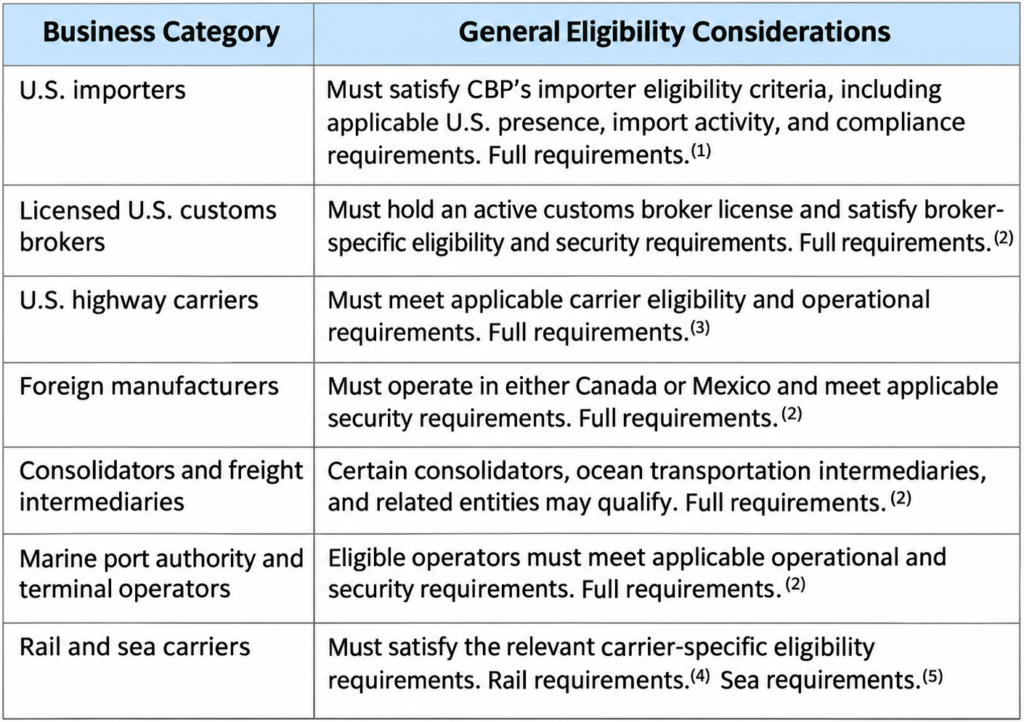
Who Is Eligible for CTPAT Certification?
CTPAT is available to several categories of businesses involved in international trade. However, eligibility requirements vary depending on the applicant’s role in the supply chain.
Links:
- Importer Eligibility Requirements
- Marine Port Terminal Operator Eligibility Requirements
- CTPAT 101 Tear Sheet
- Rail Carrier Eligibility Requirements
- Sea Carrier Eligibility Requirements
Not every company involved in international trade automatically qualifies. Businesses should review CBP’s eligibility requirements for their particular category before beginning the application process.
What Are the Benefits of CTPAT Certification?
One of the primary reasons companies pursue CTPAT certification is the potential for more predictable and efficient cargo processing. CTPAT-certified businesses may receive several benefits, depending on their membership category and status.
Reduced examination risk. CBP generally considers CTPAT-certified companies lower risk from a supply chain security perspective, which can result in fewer security-related examinations.
Priority processing when examinations occur. Certified participants may receive priority treatment when shipments are selected for examination, potentially reducing delays.
Access to FAST lanes. Eligible participants may benefit from Free and Secure Trade (FAST) processing at designated land border crossings, subject to applicable requirements.
Assignment of a Supply Chain Security Specialist. Participants work with a CBP specialist who provides guidance on program requirements, security practices, and validation.
Potential benefits through mutual recognition arrangements. CBP has mutual recognition arrangements with certain foreign customs administrations, which may provide additional benefits for qualifying participants.
Stronger internal security practices. The certification process encourages businesses to document procedures, assess vulnerabilities, and establish greater accountability throughout their supply chains.
Importantly, CTPAT certification does not guarantee that shipments will avoid inspection, nor does it eliminate an importer’s obligation to comply with U.S. customs laws.
What Are the CTPAT Minimum Security Criteria (MSC)?
The CTPAT Minimum Security Criteria (MSC) establish the security standards participating companies must meet to obtain and maintain certification.
CBP maintains separate MSC requirements for different types of supply chain participants. This distinction recognizes that the security risks and operational responsibilities of an importer are different from those of a customs broker, manufacturer, or transportation provider.
Although the requirements share common principles, including risk assessment, business partner security, personnel security, and cybersecurity, companies must comply with the criteria applicable to their particular business category.
CTPAT Minimum Security Criteria for U.S. Importers
U.S. importers are responsible for evaluating and addressing security vulnerabilities throughout their international supply chains.
Because importers often work with manufacturers, suppliers, freight forwarders, carriers, warehouses, and other service providers, their CTPAT obligations extend beyond their own facilities.
The importer-specific MSC addresses several important areas.
- Security Vision and Responsibility
Importers must establish a commitment to supply chain security, including management oversight and clearly assigned responsibilities for maintaining the company’s security program.
- Risk Assessment
Importers must conduct and document risk assessments that identify potential vulnerabilities in their international supply chains. These assessments should consider geographic risks, business partner practices, transportation routes, and other factors that may affect cargo security.
- Business Partner Security
Importers must establish risk-based procedures for evaluating relevant business partners, including manufacturers, suppliers, transportation providers, and other companies involved in moving merchandise.
- Cybersecurity
Importers must implement appropriate measures to protect information systems, sensitive business data, and electronic shipment information from unauthorized access or compromise.
- Conveyance and Instruments of International Traffic Security
Applicable requirements address the security of containers, trailers, and other transportation equipment, including inspection procedures and measures to identify tampering or unauthorized access.
- Seal Security
Importers must address applicable seal control requirements, including procedures for securing, verifying, and documenting seals used to protect international shipments.
- Procedural Security
Importers must maintain procedures designed to protect cargo and shipment information throughout the import process. These may include verifying shipping documents, identifying discrepancies, and reporting suspicious activity.
- Agricultural Security
Importers must address applicable measures to prevent the introduction of agricultural pests and contaminants through cargo, packaging, and transportation equipment.
- Physical Security
Cargo handling and storage facilities, Instruments of International Traffic storage areas, and facilities where import/export documentation is prepared in domestic and foreign locations must have physical barriers and deterrents that guard against unauthorized access.
- Physical Access Controls
Importers must implement appropriate safeguards to prevent unauthorized access into facilities/areas, help maintain control of employees and visitors, and protect company assets.
- Personnel Security
Importers must establish appropriate employee screening, access management, and personnel security procedures, consistent with applicable law.
- Education, Training, and Awareness
Employees must receive appropriate training to recognize security threats, follow established procedures, and report potential incidents.
The scope of these requirements depends on the importer’s operations and the specific provisions of the applicable MSC. Importers should review the complete CBP criteria rather than relying solely on a general checklist.
CTPAT Minimum Security Criteria for Licensed U.S. Customs Brokers
Licensed U.S. customs brokers have a separate set of CTPAT Minimum Security Criteria tailored to their role in facilitating customs transactions and managing sensitive import information.
Unlike importers, customs brokers generally do not manufacture merchandise or control the physical movement of cargo throughout the international supply chain. Their security responsibilities therefore focus more heavily on brokerage operations, business relationships, personnel, information systems, and the facilities under their control.
The broker-specific MSC addresses several important areas.
- Security Vision and Responsibility
Customs brokers must demonstrate management commitment to security and establish responsibility for implementing and maintaining their CTPAT security program.
- Risk Assessment
Brokers must evaluate security risks relevant to their operations, including internal procedures, business relationships, and vulnerabilities associated with the services they provide.
- Business Partner Security
Brokers must establish procedures for assessing relevant business partners. CBP’s broker guidance distinguishes between importer clients and service providers, recognizing that brokers have different relationships and responsibilities with each group.
- Cybersecurity
Because customs brokers routinely handle sensitive commercial and customs information, cybersecurity is an important part of their security programs.
Brokers must address applicable measures to protect electronic systems, prevent unauthorized access, and safeguard information used in customs transactions.
- Procedural Security
Brokers must maintain documented procedures designed to protect the integrity of customs transactions and relevant shipment information.
These procedures may include reviewing documentation, identifying discrepancies, maintaining appropriate records, and reporting suspicious activity.
- Physical Security and Access Controls
Brokers must implement applicable security measures for their offices and other facilities, including controls intended to prevent unauthorized access to sensitive information and operational areas.
The specific measures depend on the broker’s business model and facilities.
- Personnel Security
Brokers must establish appropriate personnel security procedures, including employee screening, access management, and safeguards relating to employees who handle sensitive customs information.
- Education, Training, and Awareness
Employees must understand applicable security requirements, recognize potential threats, and know how to report suspicious activity or security incidents.
Customs brokers should carefully review the complete broker-specific MSC to determine which requirements apply to their operations.
A customs broker’s CTPAT certification is separate from the certification status of its importer clients. A broker’s participation does not automatically make its clients CTPAT-certified, and importers remain responsible for their own customs compliance obligations.
Other CTPAT Participants Have Their Own Minimum Security Criteria
In addition to importers and customs brokers, CBP maintains category-specific Minimum Security Criteria for other eligible CTPAT participants, including foreign manufacturers, highway carriers, rail carriers, sea carriers, consolidators, and marine port authority and terminal operators.
These requirements are tailored to the participant’s role in the international supply chain. For example, transportation providers may have additional responsibilities involving conveyance security, while manufacturers may have requirements addressing production facilities, cargo handling, and business partner controls.
Companies should consult the current CBP Minimum Security Criteria for their specific business category before applying for certification or evaluating their existing security programs.
How to Apply for CTPAT Certification
The CTPAT application process requires companies to evaluate their existing security practices and demonstrate how those practices satisfy CBP’s requirements.
Step 1: Confirm Eligibility
Before applying, businesses should review the eligibility requirements for their particular entity category. This includes confirming that the company meets applicable operational, licensing, and business identification requirements.
Step 2: Conduct a Supply Chain Security Risk Assessment
Applicants should evaluate their operations against the applicable Minimum Security Criteria.
The assessment should identify security vulnerabilities, evaluate existing controls, and establish corrective actions where necessary.
Completing this work before submitting an application can help identify weaknesses that might otherwise delay certification.
Step 3: Submit an Application Through the CTPAT Portal
Eligible businesses can apply through CBP’s online CTPAT Portal. CBP does not charge a fee to join CTPAT, although businesses may incur internal expenses associated with implementing and maintaining security measures.
Step 4: Complete the Security Profile
Applicants must submit a security profile explaining how their operations satisfy the applicable Minimum Security Criteria. The profile should describe actual company practices rather than merely stating that policies exist.
Supporting documentation may include security procedures, risk assessments, training records, and business partner screening processes.
Step 5: CBP Reviews the Application
A CBP Supply Chain Security Specialist reviews the submitted materials and evaluates whether the company meets program requirements.
According to CBP, the program has up to 90 days to certify or reject an application after satisfactory completion of the application and security profile.
Step 6: Complete the Validation Process
After certification, CBP generally conducts an initial validation within one year to evaluate whether the company’s security practices are implemented and operating as represented.
Validation may involve facility visits, documentation reviews, interviews, and examination of relevant security procedures.
Once validated, companies are subject to annual reviews and periodic revalidations, typically every three years, to ensure continued compliance with CTPAT security requirements.
Is CTPAT Certification Worth It?
Whether CTPAT certification makes sense depends on the company’s operations, shipment volume, supply chain complexity, and ability to maintain the required security measures. For high-volume importers, reduced examination risk and more predictable cargo processing may provide meaningful operational benefits.
For customs brokers, participation may strengthen internal controls, support client relationships, and demonstrate a commitment to protecting sensitive shipment information.
However, certification also requires an investment of time and resources.
Companies must assess their security practices, implement appropriate controls, document their procedures, and maintain compliance over time.
Before applying, businesses should evaluate whether the anticipated benefits justify the administrative and operational commitments.
Preparing Your Business for CTPAT Certification
CTPAT certification can provide valuable benefits for eligible importers, customs brokers, and other international trade participants. However, successful participation requires more than completing an application.
Businesses must understand the Minimum Security Criteria applicable to their particular operations, identify security vulnerabilities, implement effective controls, and maintain documentation demonstrating ongoing compliance.
For importers, this often means evaluating security risks throughout the international supply chain. For customs brokers, it means assessing brokerage operations, business relationships, information systems, and other relevant security responsibilities.
Diaz Trade Law assists businesses with customs compliance matters, including evaluating regulatory requirements, identifying compliance risks, and developing strategies to address CBP expectations. Companies considering CTPAT certification or reviewing their existing security programs should evaluate how the program fits within their broader customs compliance obligations.
Read more: