
WTO Blog | Data Blog

By Donal Smith (WTO), Marc Auboin (WTO), Ana Luiza Dutra (IFC), and Tatiana Nenova (IFC)
Global trade opens opportunities for economic growth. However, moving goods across borders, between exporters and importers, involves counterparty risk such as payment and liquidity risk. Trade finance facilitates trade by mitigating these risks.Using a new dataset, we find that volatile global financial conditions constrict the availability of trade finance, especially in emerging markets and developing countries. In addition, the level of development of local financial markets influences the supply of trade finance by global institutions.
The historical record illustrates that open economies tend to grow faster, and more steadily, than closed ones(1). Increased competition and higher technology adoption both improve productivity and income growth(2), (3).
Although sometimes overlooked, trade finance is closely associated with the rapid expansion of international trade over the past several decades(4). Access to trade finance is thus essential for countries to fully engage in and benefit from the global economy. Conversely, reductions in access tend to amplify downturns through the trade channel.
Between 15 and 20 percent of the steep decline in trade during the 2008-2009 global financial crisis was attributable to shortages of trade finance, according to multiple studies(5). Further evidence on the importance of trade finance in averting a collapse in trade was observed during COVID-19(6).
Unmet demand for trade finance has been consistently large for at least a decade, amounting to about 7-10 percent of global merchandise trade(7). More structurally, there is also a well-documented and persistent gap in the provision of trade finance that remains outside acute crises.As a result, many companies cannot access the financial tools they need to capitalize on trade opportunities.
What makes trade finance essential?
Given the time-lag between the production of goods, shipment by an exporter, and final receipt by an importer, trade finance is an economic necessity(8). While it is essential in facilitating trade, it has its own inherent risks: payment risk, delivery risk, and liquidity risk. Trade also crosses different legal jurisdictions, operational environments, and countries with different risk perceptions-all of which are more acute in emerging markets and developing economies.
For example, a coffee supplier in South America requires money to harvest the crop and to ship it to Europe. An importer in Europe would be reluctant to pay upfront as there is a risk the goods don’t arrive. From a producer’s side, there is a risk of nonpayment when the goods do arrive. A solution is a financial product that removes the payment risk barrier between importers and exporters.
Trade finance instruments, whether intermediated by commercial banks or between firms, mitigate many of these risks and come in many forms(i). For example, in the case of a letter of credit, the bank of the buyer provides a guarantee to the seller that it will be paid-regardless of whether the buyer fails to pay.
This also addresses the risk of nondelivery by protecting a buyer (importer) from paying for goods that are either noncompliant or never shipped because the exporter (seller) must present documents proving execution of the contract. Trade loans and supply chain finance, such as receivable financing, address the liquidity and financial risks of producing or shipping goods prior to receiving the export receipt.

Bolstering the evidence base for the role of trade finance
Previous analysis of the relationship between trade and trade finance has been impaired by the lack of a consistent set of statistics covering transactions across countries(10). Indeed, in 2014, the Bank for International Settlements wrote: “There are no readily available data covering the global bank-intermediated trade finance market.”(11)
We analyzed a new global trade finance dataset from the International Chamber of Commerce (ICC) Trade (Finance) Register(ii). The data spans more than 100 countries and have been collected since 2011 from more than 20 global banks (Box 1).

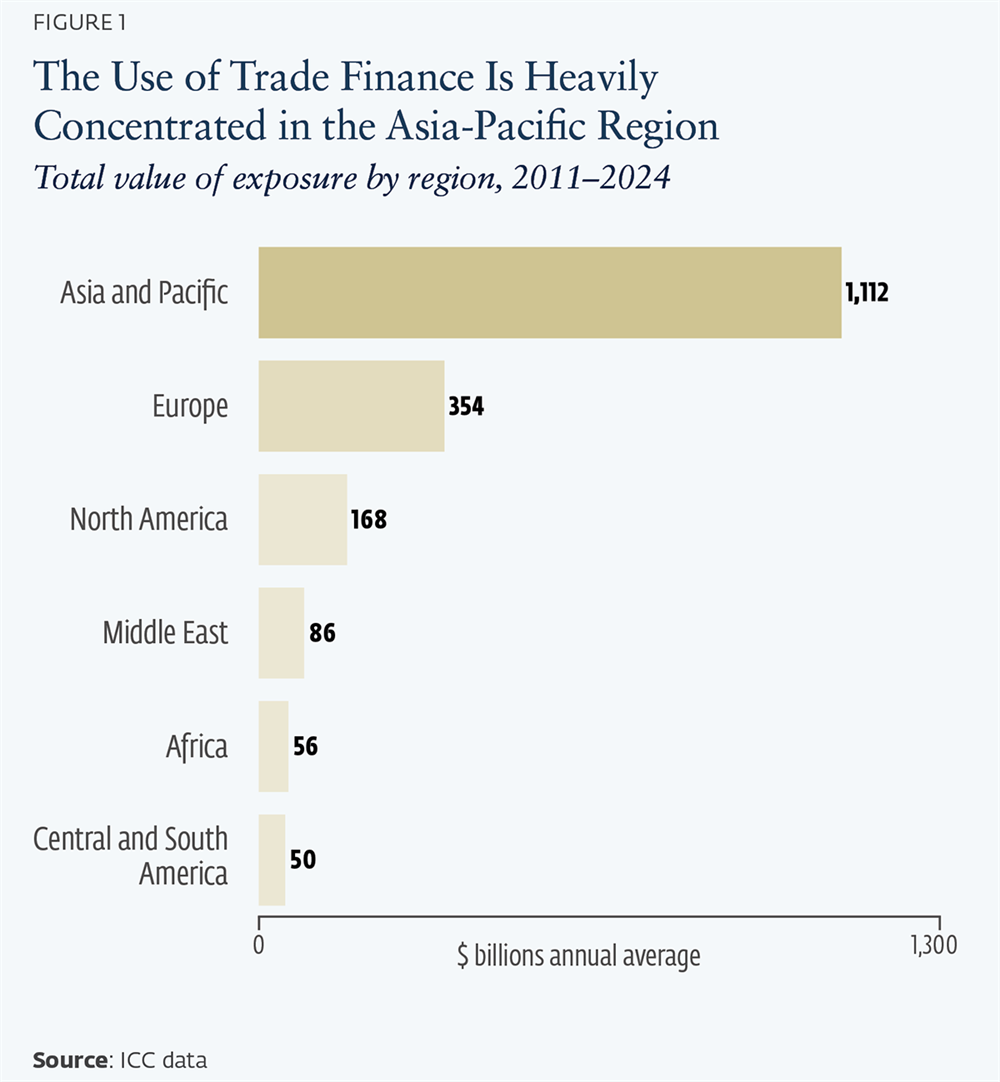
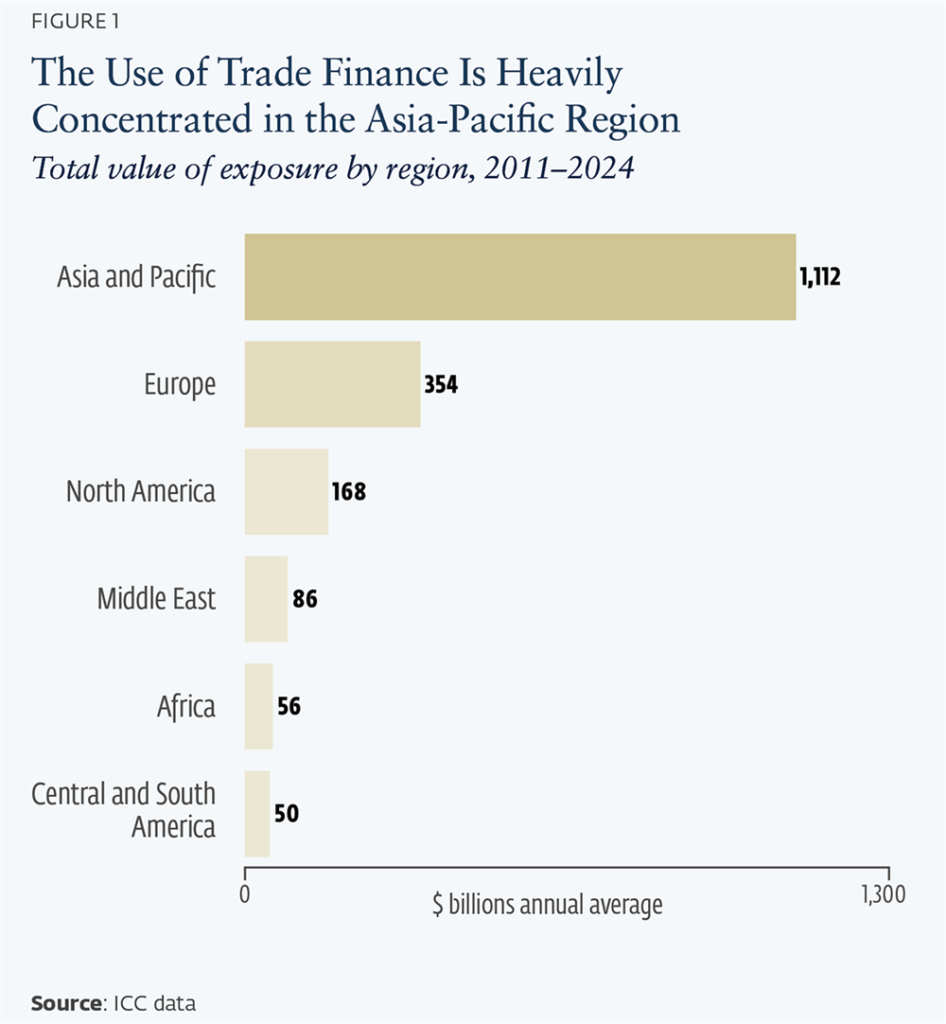
The raw data reveals several features: the Asia-Pacific region is the largest user of trade finance in US$ value and as a share of trade, on average (Figures 1 and 2), followed by Europe and North America. Trade loans account for a significant share of trade finance in Central and South America, Asia-Pacific, and North America (Figure 3), but less so in Europe and Africa, relative to payment guarantee products (letters of credit and guarantees)(iii). Trade finance, as opposed to interfirm financing, is used more heavily for trade covering longer distances, newly formed trade relationships, and trades involving countries with weaker contractual enforcement, less financial development, and higher political risk(12), (16).
Drawing from the literature, we modeled the evolution of these trade finance flows as a function of a range of explanatory variables, such as country-level trade flows, the breadth of financial market development, GDP, as well as a broader set of global financial variables, since it has been observed that trade finance supply could be sensitive to global financial conditions or volatility.
Key takeaways
First, there is a significant association between a country’s trade growth and bank-intermediated trade finance growth (Figure 4). This is intuitive. Trade finance is strongly driven by the demand for trade-a result consistent with earlier literature but now supported by wider empirical evidence, robust to the span of a sample of 100 countries. A 1 percent increase in trade growth is associated with a 0.41 percent increase in bank-intermediated trade finance.

Second, the pace of trade finance flows is associated with the level of financial development: A one-point increase in the financial market development index of countries is associated with a 10 percent increase in trade finance growth. The fact that bank-intermediated trade finance expands at a faster rate within more financially developed markets is a key finding. It must be viewed through the prism of the previous finding:
While trade growth is on average associated with an increase in trade finance, large banks in the sample are more likely to accelerate their trade finance supply in countries with stronger financial infrastructure.
Third, the volatility of global financial conditions impairs the bank-intermediated supply of trade finance. We used the VIX, a widely used proxy of global uncertainty in the literature, measuring the volatility of S&P 500 equity options indices. We found that a one-point increase in the VIX index is associated with a 3.3 percent decline in trade finance growth(iv). In general, developing regions are impacted more negatively by global financial uncertainty while, for North America, there is evidence of lower sensitivity to shocks.
Conclusion
Financial conditions matter for access to trade finance both globally and at the country level. The evidence provided by this data supports a policy response that seeks to ease access to trade finance during crisis episodes, and to strengthen local capacity in the medium-to-long run, particularly in emerging and developing economies to improve shock resilience. Broader access to trade finance would boost a country’s capacity to access global markets. This has a real economic impact since trade and growth are positively correlated long term.
BOX 1
Dataset analysis
$1.6 trillion to $2 trillion in trade finance flows
|
The underlying transaction-level data in the ICC Trade Register amounts to approximately 40 million observations. While not encompassing the entire universe of trade finance, this large, well-maintained, and consistent dataset does cover $1.6 trillion to $2.0 trillion in trade finance flows annually (by instrument, by country of destination). For comparison, the global trade finance market stood at an estimated $5.2 trillion in 2020, or about 6 percent of global GDP(v). Importantly, developing countries are well represented, accounting for half of the sample.
Previously the ICC has used the information to publish annual risk performance indicators by instrument in “Trade |
Register Reports.” As part of an agreement among the ICC, the World Trade Organization (WTO), and the International Finance Corporation (IFC), the data can now be used for economic analysis(vi). The timespan and coverage allow insights to be established on the drivers of global trade finance.
While the dataset provides a unique opportunity for a detailed glimpse into global trade finance, an important caveat is that it is based on the available data, which represents a portion of total trade finance. A feature of the dataset is that the total value of trade finance exposures reported by the sample banks has tended to decline. This can indicate a reduced reliance on banks for trade finance activity, |
an increased market share of banks not in the sample, or an increased reliance on other forms of trade finance, such as open account financing, trade credit, and credit insurance(vii). This is difficult to disentangle and is another feature of the complexity of trade finance datasets.
The database contains six short-term trade finance product categories:
|
Appendix

Variables
Country-level variables
Trade is the total trade volume of a country taken as the sum of imports and exports divided by two. GDP is measured at the country level. Tier 1 capital to risk-weighted assets is a measure of the stability of the banking system. Financial market development is measured by the Financial Markets Depth Index as a measure of a countrys overall financial development. The Commodity price index is the Commodity Export Price Index, Individual Commodities Weighted by Ratio of Exports to Total Commodity Exports.
Global variables
The VIX is a measure of investor sentiment and stock market risk. It is the stock markets expectation of 30-day forward-looking volatility based on S&P 500 index options.