
What Is an ITN Number and Why Do Exporters Want It?

An Internal Transaction Number (ITN) is the affirmation quantity generated by the Automated Export System (AES) when it accepts an Electronic Export Information (EEI) submitting. Exporters or their approved brokers present the ITN to the service as proof of submitting and embody the quotation on the required delivery paperwork.
We’re addressing three questions on this weblog put up
- What does ITN imply?
- What is an ITN quantity used for?
- Why is an ITN quantity necessary for exporters?
What Is an Internal Transaction Number (ITN) in Exporting?
The U.S. Foreign Trade Regulations (FTR) require that exporters or their brokers file their electronic export information (EEI) by means of AES for many exports of merchandise valued at greater than $2,500 by Schedule B quantity. You’ll discover extra full directions of when you must file in my earlier weblog put up, How to File EEI Through AESDirect: AES Filing Requirements for Exporters, or within the video under.
You can file your EEI to AESDirect by logging into the U.S. Customs and Border Protection’s Automated Commercial Environment (ACE) platform and keying in your export data. Or you should use a software program program like Shipping Solutions export documentation software to file by means of AESDirect with out having to rekey your export data on the AESDirect display. This eliminates redundant knowledge entry—which saves you time—and improves the accuracy of your knowledge.
Once you’ve gotten submitted your EEI to AESDirect on the Automated Commercial Environment (ACE) platform, the AES server offers a affirmation quantity—the ITN—that the knowledge was accepted by and is on file with AES.
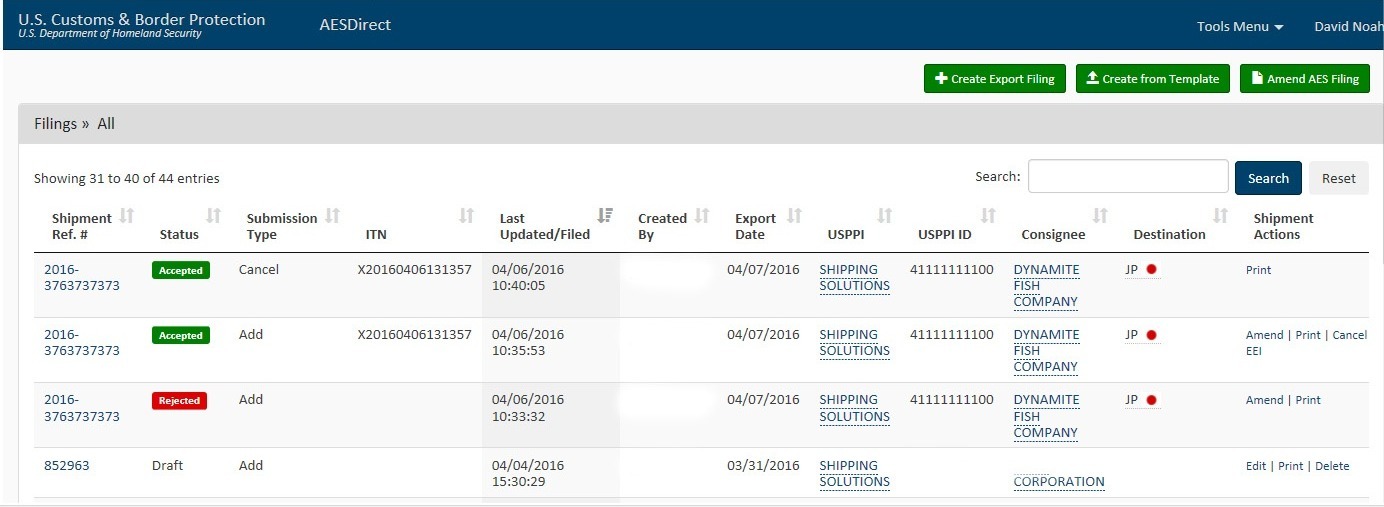
The ITN will seem on the AESDirect submitting abstract display together with inexperienced field that claims “Accepted” underneath the standing column. In addition, AESDirect will electronic mail the ITN to the e-mail handle related to the account that submitted the EEI.
That quantity is your proof of submitting, and must be included in your payments of lading and the Shipper’s Letter of Instruction (SLI) so your forwarder—and U.S. Customs and Border Protection—know you’ve filed. (You can download free samples of those documents here.)
Example of an ITN
An ITN contains 15 characters: the letter X adopted by 14 digits. The first eight digits symbolize the 12 months, month and day AES accepted the submitting. The closing six digits are assigned by the system. For instance: X20160406131357. It must be preceded in your paperwork by AES ITN.
Why Is an ITN Important for Exporters?
Your ITN performs three necessary roles within the export course of:
1. It’s your proof of submitting.
Your AES ITN quantity is proof that you just or your agent has filed the EEI as required by the FTR. An ITN confirms that AES accepted your EEI submitting. It doesn’t set up that each reported element is appropriate or change an export license or different required authorization. Exporters should nonetheless evaluation their submitting data and resolve relevant AES messages.
Filing incorrect data may end up in civil penalties, and figuring out violations can carry prison penalties as enforced by the Office of Export Enforcement (OEE) inside the U.S. Department of Commerce, and U.S. Customs and Border Protection inside the Department of Homeland Security.
2. It may help you confirm the accuracy of submitting in a routed export transaction.
In a routed export transaction, the ITN means that you can make certain the knowledge crammed out in your behalf was correct. While I’d counsel not letting anybody else file by means of AES in your behalf, should you do, you must no less than be monitoring every transaction and ensuring the freight forwarders you’re employed with are finishing the documentation accurately.
This is straightforward to do: Simply go into the ACE portal and run a report of your personal shipments in addition to the shipments third-party freight forwarders have filed utilizing your EIN. We defined the method step-by-step in a earlier article, Discover AESDirect Reports on ACE.
3. It’s required on sure paperwork.
Finally, the Internal Transaction Number should seem on sure paperwork. Without it, your shipments could also be held up in customs or by your service and/or your freight forwarder.
How Long Should You Keep ITN Records?
Keep your ITN with the associated EEI submitting and supporting cargo data. Under the Foreign Trade Regulations, data typically should be retained for 5 years from the date of export. If one other relevant company requires an extended retention interval, observe that requirement. Keeping the ITN alongside your export paperwork makes it simpler to find the submitting when reviewing a cargo or responding to an audit.
Simplify AES Filing with Shipping Solutions
With Shipping Solutions export documentation software, you should use the cargo data you’ve already entered to your export paperwork to file your EEI by means of AESDirect. That means much less rekeying and fewer alternatives for discrepancies between your export paperwork and your AES submitting.
Shipping Solutions prompts you for the extra data wanted to your submitting and connects you to AESDirect by means of the ACE portal. Once AES accepts your submitting, you obtain your ITN as proof of submitting.
Request a free demo to see how Shipping Solutions can simplify your export documentation and AES submitting course of.
Like what you learn? Subscribe today to the International Trade Blog to get the most recent information and ideas for exporters and importers delivered to your inbox.
This article was first printed in August 2017 and has been up to date to incorporate present data, hyperlinks and formatting.