‘Walkie-talkie and paper just doesn’t cut it anymore’: FAA ground stop exposes outdated airline tech
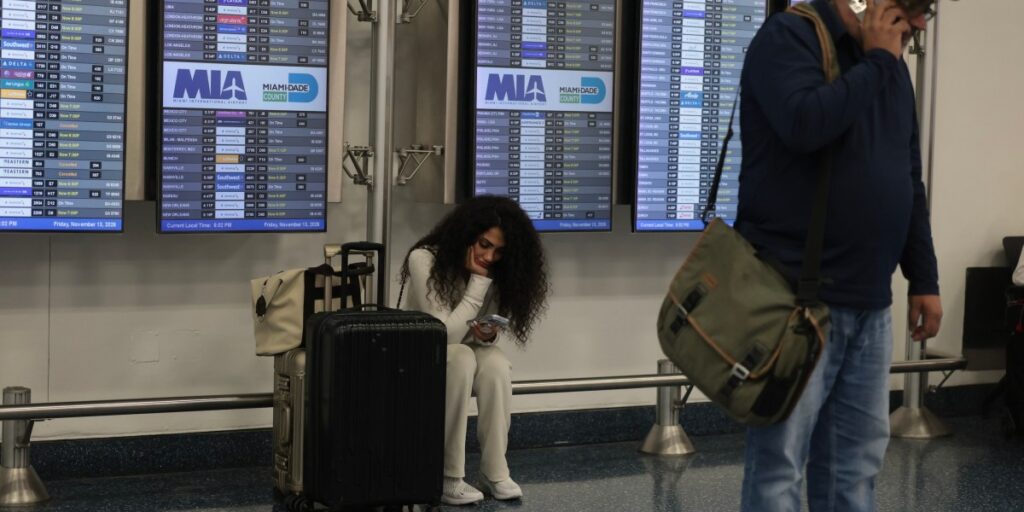
On Friday, the Federal Aviation Administration made the rare decision to halt all flight departures nationwide, throwing travel plans into chaos. More than 1.5 million passengers were scheduled to depart from U.S. airports after the order took effect. The agency lifted the ground stop more than four hours later, but two days on, airlines were still struggling to get flights moving again.
FlightAware counted 9,201 canceled flights Friday, 6,698 Saturday and at least 1,956 by Sunday evening, roughly 17,850 cancellations over three days involving flights within, into or out of the U.S.
Restarting the system was the easy part. Getting aircraft, crews and schedules back in sync is harder, and much of that work still runs on radios, spreadsheets and manual communication, according to Javier Vidal, co-founder and CEO of Moonware, a company that develops software to coordinate airport ground operations.
“Many airlines operate flights where the plane goes to one city and then it goes to the next city and then it goes to the next city,” Vidal told Fortune. “So it’s not like there’s one big ground stop and then everything can resume normally… Those planes need to be repositioned to the right cities.”
What triggered Friday’s ground stop
Only two other nationwide ground stops have been ordered this century: after the September 11, 2001, terrorist attacks and during an FAA computer system failure in January 2023.
This one was serious enough to trigger a response at the highest levels of government. FAA Administrator Bryan Bedford said the White House Situation Room and the national security apparatus were activated, with FBI personnel also investigating, as Fortune reported on the federal response to the ground stop. Officials found no evidence of a cyberattack or other nefarious activity.
Instead, officials linked the disruption to a flood of data that overwhelmed parts of the FAA’s aging telecommunications network, interfering with air traffic control communications and radar feeds. According to the FAA’s preliminary investigation, the excess data may have originated from two locations: a radar site in Amarillo, Texas, and a radio communications site in El Dorado, Arkansas, where contractor L3Harris had been installing a new router. The precise cause remains under investigation.
The timing was striking. A day earlier, a global Microsoft outage disrupted police departments, courts, hospitals and government services around the world. Microsoft said there’s no indication the FAA’s ground stop was related to its services.
Why airlines can’t simply hit restart
One delayed or canceled flight can throw off an entire day’s schedule, Vidal said. Even after a plane reaches its gate, ground crews must refuel and clean it, restock food and handle baggage before it can depart again. Workers are often assigned to service multiple aircraft, so one late flight sets off another chain reaction.
“If that first plane is late, then the other plane also gets late,” Vidal said. During a widespread disruption, ground crews may struggle to track what each aircraft still needs. “They don’t know what operations have already happened to the plane or what operations still need to happen to the plane,” he said.
Part of the problem is that ground workers are typically assigned tasks based on scheduled arrival times, which rarely match reality. When one aircraft lands late and another arrives early, a worker assigned to both faces a conflict, and the delays cascade through the day. When hundreds of planes need servicing at once, it gets worse.
Asked why the industry still relies on such outdated methods, Vidal, whose company sells software meant to replace them, said, “You know what? I ask myself the same question every day.” He attributed it partly to an “if it’s not broken, don’t fix it” mentality.
“Walkie-talkie and paper just doesn’t cut it anymore,” Vidal said.
The frustration with dated technology extends to the skies above the ramp. Delta CEO Ed Bastian has said air traffic controllers’ screens “look like something out of the 1960s and ’70s,” and that flying from Atlanta to New York takes longer today than when Delta launched the route in the 1950s. He has also argued that air traffic control is AI’s biggest opportunity in aviation.
What the disruption could cost
Airlines face expenses from repositioning aircraft, rescheduling crews and accommodating stranded passengers. Travelers lose time, miss work and face unexpected costs, while delayed cargo can disrupt businesses.
Past disruptions show how expensive recovery can be. After a faulty CrowdStrike software update triggered roughly 7,000 cancellations over five days in July 2024, Delta estimated a $380 million revenue hit and $170 million in added expenses, partly offset by $50 million in fuel savings, for a net cost of about $500 million.
The total financial impact of Friday’s shutdown has not yet been established.
When flights should return to normal
Bedford said Saturday that airlines expected to restore normal schedules by the end of Sunday. The FAA said Sunday that its system was stable, even with almost 2,000 flights still canceled and 9,000 delayed.
Some carriers remained cautious. Delta Air Lines encouraged passengers with flexible plans to move their flights to Monday, Nov. 16, or later.
Cancellation rates offer one gauge of recovery. About 5.2% of scheduled U.S. departures were canceled Sunday, compared with an average of 3.4% before Friday’s disruption, the Associated Press reported, citing aviation analytics firm Cirium.
“This usually takes a few days to recover,” Vidal told Fortune. While he could not speak for the FAA or individual airlines, he expected operations to return to normal early this week. “I don’t think it’ll take much longer,” he said.