Rethinking Disability, Resilience, and Independence with Spencer West
Guy Kawasaki:
Hello, everybody. It’s Guy Kawasaki, and I am in California today. My guest is in Toronto, Canada. I love Canadians. I can honestly tell you, Spencer, that I have never met a Canadian that I did not like.
Spencer West (He/Him):
That’s nice.
Guy Kawasaki:
I cannot say that about America, so I just want you to know I love Canada. I love hockey. I love maple syrup. I love beer. I love everything Canada stands for, although that might be kind of a stereotype. I love Tim Horton’s. If I get sick of America, which is rapidly happening, I’m going to apply for a work visa in Canada, so I hope I can use you as a reference in the future.
Spencer West (He/Him):
Please do.
Guy Kawasaki:
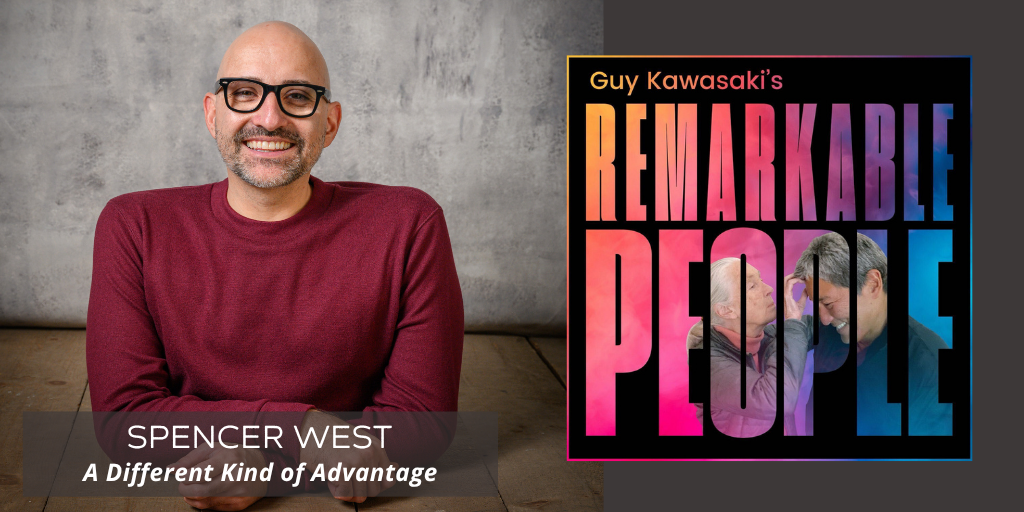
All right. So today, my guest is Spencer West. Holy shit, that’s a rhyme, Spencer. Today, my guest is Spencer West. Ah, man, I should be a rapper. Yeah. So Spencer is an author, he’s a speaker, and he is an advocate for disability, and we’re going to come to that topic.
But anyway, he is also someone who, like, listen I have problems walking up from my barn to my house which is about eighty steps, but my God, Spencer has climbed to the top of Mount Kilimanjaro. And just so you know, okay, so a lot of people have done that, but not without legs.
So that is kind of a difference. So Spence, he has a disease called, I got to get this right, sacral agenesis. Is that right?
Spencer West (He/Him):
It’s a tough one. It’s sacral agenesis. Yeah.
Guy Kawasaki:
And what this means is that the lower spine doesn’t completely form, and so he had operations which first removed his legs, and then the second operation, if I got this right, it is at the pelvic level, right?
Spencer West (He/Him):
Just below my pelvis.
Guy Kawasaki:
Yeah, and his latest book is called Breaking Free, and this is a very inspiring book.
All right. So I got to start with this story. When I read this story, or I don’t know if I read it or I saw it, or I hope I didn’t imagine it. There’s this story that you volunteered to go on stage with a magician who was going to saw people in half.
Please tell us that story. I said, “This guy has no legs, and as a joke he tells the magician, ‘I can be your subject for sawing people in half.'” Did I get that right?
Spencer West (He/Him):
You did. So this is a joke I used to use when I would speak to a youth audience specifically, like junior high or high school kids, because although I don’t have any legs and I do walk on my hands, I usually get around in a wheelchair. And so seeing someone in a wheelchair is different to begin with than someone without legs.
So I tried to usually break the tension with maybe what people might be feeling a bit nervous about seeing somebody like me because we don’t learn about disabled people in school or in society.
So I usually started with that joke of like, “You want to know how I lost my legs? I raised my hand at a magic show, and they asked for someone to be sawed in half. I said yes, and this is what happened.”
But Guy, I have to tell you, I made the mistake once of telling that joke to a group of fourth graders, who don’t understand sarcasm, and I broke them. I broke the whole class. I lost them. The rest of the speech, they were, like, horrified that like this was going to happen to them. And I was like, “Okay, noted. You can’t tell this to younger kids.” They don’t get the humor.
Guy Kawasaki:
If you ever testify to a GOP-controlled Congress, I suggest you not open up with that because they will not understand that either.
Spencer West (He/Him):
Correct.
Guy Kawasaki:
Anyway, so I want to know if the term “disabled” is still acceptable as a description because it seems to me disabled means you have a reduction in one’s ability. I watched your video. I read your books. I don’t see any reduction in any of your abilities, and I am deaf. I don’t think of myself as reduced in ability or even handicapped.
Is there a better sounding word? But then if you find a better sounding word and if it’s a euphemism, then are you patronizing or you’re confusing? So relieve me of my guilt here. What’s the word?
Spencer West (He/Him):
Totally. The word is disabled or disability. That’s the proper word, and here’s why. Here’s why I prefer that word, and anybody that is really in, I would say, disability justice prefers the word disabled.
And one of my mentors who I got to spend just one hour with on a podcast, but it felt like we’d known each other for years, is Judy Heumann, who is responsible for a lot of the ADA in the United States and a lot of the protections and freedoms that we have now.
Anyway, she said, “We use the term disabled or non-disabled because we are the only marginalized group of people that everyone will experience at some point in their lives. So it’s not a question of if you get a disability, it’s a question of when you get a disability.”
And disability is the proper term. When we think of terms like special needs, that was one that was used a lot when I was a kid. It’s like, “Oh, he’s got special needs.” Wanting access to a bathroom is not special needs. It’s basic human rights. Let’s just call it what it is. And so disability is the proper term to use. We don’t need to do differently abled or any of those things.
It’s disabled or non-disabled. It’s very easy because at some point you all, and this isn’t to scare you, but you all will have access needs, whether that’s temporarily or permanently. That’s just statistically very high probability. So that’s why that’s the best word to use.
Guy Kawasaki:
All right. So my conscience is clear. I can continue in this interview.
Spencer West (He/Him):
Good.
Guy Kawasaki:
Do you need some kind of special courage or superpower for you to deal with your disability? Or is it at this stage in life, you’re in the mid-forties, like, “Yeah, fuck it, Guy. I just wake up in the morning, and I am what I am”?
Spencer West (He/Him):
There’s this weird thing. I still get this question a lot of “Where does your resilience come from?” and it comes from no other choice. If I’m not resilient, then I don’t get to exist in this world. People constantly are actively choosing to create barriers that keep someone like me from fully participating in society.
So some of it comes from that. Some of it is just I have an excitement for life and want the same experiences. Some of that comes from just pure anger of how often I feel excluded and left out of things based on physical and emotional barriers that exist in our world. So it’s like a whole hodgepodge of things.
So it’s a mix of all those things. Part of it is I have no choice. If I want to survive, I have to be resilient, which is exhausting and beautiful. And then the other part is I want to enjoy the life that I get to live as much as possible.
Guy Kawasaki:
Yeah, like if I started to sink into woefulness because of my deafness, it would be like a whole different orientation in life, right?
Spencer West (He/Him):
Totally. And do you know what? I do want to say though, it’s important to recognize those feelings and be with them and acknowledge them, but then eventually we have to move through them in some capacity. So I get all those same feelings. I wake up angry, I’m frustrated, I’m pissed off, all those things, and I have a therapist. I talk about it and I move through it.
Guy Kawasaki:
All right, so now I also read someplace that you said that you have come to view your disability as a competitive advantage. Pray tell, how the hell can that be true?
Spencer West (He/Him):
Yeah, so you know, when I turned sixteen and I was living in Wyoming at the time, that’s where I grew up and that’s where my family’s from, I started applying for the normal jobs that every sixteen-year-old would apply for. Fast food, retail, and from age thirteen to fifteen, I worked for my grandmother.
She had her own real estate business, and so that was obviously nepotism, and I would just work there during the summers.
But I had a lot more experience than my friends and my peers, and I was applying for the same jobs they were, and I wasn’t getting an interview, I wasn’t getting a phone call. And they were all getting jobs, and so I can only guess that part of it had to do with my disability because those were the days when you like physically handed in your resume to someone.
You didn’t just apply online and hope for the best. So you know, where I’m going with all of this is a friend kept saying as I was getting older, “You should be a motivational speaker,” and I was like, but there’s this weird thing when you’re disabled where people want you to tell them your story to inspire them, to make them feel better about their lives, which just always feels so shitty.
So when people are like, “Oh my God, seeing somebody like you makes me feel like I can do anything,” I’m like, “Well, that feels like a backhanded comment. That doesn’t feel nice to me.” But the reason I’m saying all this is because when I became a motivational speaker and I was working for the social enterprise that was based here in Canada, I had this story that no one else had.
I had the experience that no one else had. There was lots of other disabled folks who could talk about other topics of disability, but my disability allowed me to be in rooms that other people couldn’t be in. It allowed me to access things that other people didn’t have access to, and it’s brought me experiences that I didn’t think I would have.
One of those was like going on tour with the pop star Demi Lovato and opening for her shows all across North America. Part of that was because of my disability, and because of that, I was able to fundraise and climb Mount Kilimanjaro and raise a half a million dollars for clean water in East Africa.
So what I realize is that for so long I just thought my disability was something that happened to me, and then I realized not only is it not just something that happened to me, it’s an identity, and it’s what sets me apart from everyone else.
Now, that has its pros and its cons, but the cons are I have a different lived experience and I have a different perspective, and I can use that in a way, for me, that is hopefully helpful for the larger world.
And also, we live in a capitalist society where we have to make money. I wish it wasn’t that way, but that’s the system we live in. So that’s why I think of it as my competitive edge.
Guy Kawasaki:
Okay. I think I own the niche of deaf podcasters.
Spencer West (He/Him):
You might.
Guy Kawasaki:
I want you to tell the story. First of all, let us acknowledge that the Chamber of Commerce was the first organization that gave you a real job, right?
Spencer West (He/Him):
Yeah.
Guy Kawasaki:
Here’s to the Chamber of Commerce, right?
Spencer West (He/Him):
Totally.
Guy Kawasaki:
Okay, but then Beth Whitman enters your life. I want you to tell the story of how Beth Whitman helped you and showed you the way.
Spencer West (He/Him):
Yeah, so Beth was the one that actually got me the job at the Chamber of Commerce. As I was mentioning, when I was sixteen and I couldn’t get a job, I was like, “This is bullshit. What is the deal here?” And again, we sort of made the assumption that part of it was my disability. People didn’t know what to do with me or didn’t want to take the time to ask me, “What can you do?”
So Beth Whitman was a part of a program that at the time was called JTPA. This was in the mid-nineties. Now I think it’s been rolled into the 504, which is just government jargon. Anyway, Beth Whitman, her job was to help folks like me find a job, and she knew people in the community that would potentially be interested in hiring someone like me, aka someone with a disability.
Which is so absurd because we have rights and protections that everyone should be looking at disabled candidates, but that’s a topic for another day. But Beth connected me with Dave Hanks, who was the director of the Chamber of Commerce. And I knew right away it was different because when I went in, Dave first saw me as an employee.
So we sat down and he asked me what my qualifications were, what my background was, what my experience was. And then when he realized that I had the qualifications for the job that he was looking for, we didn’t ignore my disability. He was like, “Okay, what kind of accommodations would you need?”
So this Chamber of Commerce not only functioned as a normal chamber where they support local businesses and often the local government, but our Chamber of Commerce was also an information center for the state of Wyoming.
So my job roughly was going to be admin work, but also working the front desk, and anybody that came in, showing them points of interest in the state of Wyoming. So the counter was very high and, Guy, I’m very agile. I can walk on my hands, and I can crawl up on the counter, and I can sit on the counter.
So I said, I was like, “Listen, I can help these people and I can sit on a counter, but I feel like that’s going to be jarring for most people. So I think for me, I’ll need a stool to sit so I’m a bit taller, but I can still perform the job that you need me to do.”
And that’s the only accommodation I needed, was just that stool. So Beth Whitman was the first person that helped me navigate employment and helped me find the right employer.
Guy Kawasaki:
My point here is that I hope that the Beth Whitmans of the world understand how much they can help a person because she probably doesn’t make a half million dollars a year working in Wyoming for some government agency, right?
Spencer West (He/Him):
Yeah. Hopefully she’s retired by now.
Guy Kawasaki:
Yeah. I read a funny story about you that you were very good at dodgeball. And I said to myself, this guy has a sense of humor. So he has no legs, and he’s bragging about how good he is at dodgeball.
Spencer West (He/Him):
That’s right. I’m small and not so much anymore, but in my early twenties and early thirties, I was fast. And this also came from a very difficult experience. I hated gym class in school because there was a lot of sports that I couldn’t play because of my disability, and a lot of my teachers didn’t know how to make accommodations.
There was one great gym teacher who did, and he worked really hard to do his best to include me, but most didn’t. And the one day that I knew I would like gym class is dodgeball, and it was the one day where people picked me to be on their team. The rest of the time, they didn’t want me on their team.
They didn’t want me to participate because they thought we would lose. So I do have a really funny story, though, that I don’t think I’ve ever told publicly. The organization that I used to work for here in Canada, we were all in our mid to late twenties, and there was a gym near our office that they would allow us to use on the weekends, and so we would do a game of dodgeball.
And one day, this person came in off the street, just was, like, wondering what all the commotion was. And I was the last one of my team left, and there was, like, five or six other people just trying to pelt me with these foam balls. And the guy was like, “Hey, hey, hey, be nice to him.” And I was like, “No, no, we’re fine. We’re, like, playing a game.” But he thought I was being bullied.
Guy Kawasaki:
Oh my God. I thought of something for you, Spencer, because Madisun and I are both avid surfers and have you ever tried surfing?
Spencer West (He/Him):
I have. My friend and colleague, Jake, was an avid surfer. I never tried it by myself, but one time I sat on the front of his board while he surfed at the same time.
Guy Kawasaki:
I got to tell you, okay, so because you do all your walking with your arms, I guarantee you your arms and shoulders are better developed than 99 percent of the surfers in the world and then because you don’t have legs, your pop-up will be a lot shorter, right? Just physically, and so, you would rock at surfing. Yeah.
Spencer West (He/Him):
Listen, if you want to teach me, I’m willing. You know what I did find though, Guy? The board was so heavy for me, so it was hard to control. I think I need a different board.
Guy Kawasaki:
We can take care of all that. We’ll have a custom board made for you by Bob Pearson. It’s no problem.
Spencer West (He/Him):
Great.
Guy Kawasaki:
Okay, I don’t want you to think I’m on ketamine or something today, but I am just having a blast here. So, what is your advice to parents of disabled kids?
Because it seems to me your parents were very, very supportive. So what do you tell parents when they have disabled kids?
Spencer West (He/Him):
The thing that I’m so grateful for my parents is they did two things. Number one, they didn’t treat me differently, meaning if I wanted to take swimming lessons, I took swimming lessons.
If I wanted to do gymnastics, they put me in gymnastics. They gave me the space and the freedom to become the person that I wanted to be while doing their best to remove barriers that existed that would prevent me from doing so.
And we also didn’t pretend that I didn’t have a disability. You know what I mean? It was there. It’s very prevalent. It’s visible. You can see it all of the time. And when I had the opportunity to really ask my parents, they’re still alive. I keep talking about them as if they’re not here anymore. But when I asked my parents, this is what I wrote my first book was about, was a bit more of my story.
I said, “Why did you do that?” because to me it was just my childhood and my mom said, “Spencer, your dad and I wanted to make sure that you could be as independent as possible, so if for some reason something were to happen to us, you’d be able to take care of yourself to the best of your ability.”
And what I think is important, Guy, is we still live in a system here in North America, both in Canada and the United States, that if you cannot take care of yourself, you are put away somewhere.
You are put in assisted living or institutionalization still exists, it just looks differently. We see conservatorships and those sorts of things. But this is what happens to a lot of disabled folks because we don’t have a proper system set up for people to live as independently as possible.
And I have a lot of privilege with my disability where I can get out of my wheelchair. I’m very ambulatory, I can move around, I’m able to work, but that’s not every disabled person’s experience. I’m a bit more of the exception, not the rule. And so for my parents, it was just about removing and providing the space to be whoever I wanted to be as independently as possible.
Guy Kawasaki:
Oh, so great. So great. Do you have any advice for people who might be considering changes or another ADA Act in America? Like, how would you make ADA better?
Spencer West (He/Him):
Judy Heumann used to say, I think it was Judy, that the ADA was the floor, not the ceiling. So the ADA is just the base level, and the United States has done a decent job with base level things. Canada is far behind the United States in that regard.
But I think about folks that, again, need twenty-four hour care and who their parents have been caregivers, and then their parents leave or leave this earth, there’s no option for them.
There’s no support system. There’s no way for them. So then that’s where they have to go live in a group home or an institution, which is not great. You know, I know a lot of disabled couples that would like to get married but can’t because if they get married, that means that their combined income, they make too much money, and they’ll lose their benefits.
And that combined income is still not enough to get them the support that they need. So these systems that are in place with the ADA and the 504 that allow people to exist, these sort of social programs, they need to be better. They need to be better funded, and I live in a socialist country now where my previous home is not that, and a lot of people rage against that.
But I see a lot of the benefits of how it can help, and we don’t have it perfect here either in Canada. But I think just looking at that lens and understanding that what really disables people is these barriers that exist and these attitudes that we’re taking advantage of the system, or we don’t deserve the same quality of life as everyone else.
So just understanding that. And then even, Guy, just like the basics. This is something that I experience all the time.
If I go into a public restroom, if you don’t need the accessible stall, don’t fucking use it. Leave it open for someone that needs it. It’s the same with the elevator. If you have the ability to use the elevator or the escalator, use that and leave the elevator open for the folks that need it.
Now, if you have those needs, please use that accommodation. That’s what it’s there for. But if you don’t, and you know who you are, don’t use them. And so it’s just these like basic attitudinal things that we need to change as well.
Guy Kawasaki:
Okay. I must admit I have used the disabled bathroom stall. Guilty as charged, Spencer. Guilty as charged.
Spencer West (He/Him):
And you don’t know what you don’t know.
Guy Kawasaki:
Yeah.
Spencer West (He/Him):
You don’t think about these things. So maybe now you will think about it next time.
Guy Kawasaki:
I’ll just hold on a little longer, yeah.
Spencer West (He/Him):
If it’s an emergency, don’t put your body in danger. This is what I tell people. I created a video about this, and people just were like, “What if I’m about to shit my pants?” And I was like, “Five million people are all about to shit their pants right now. And not everyone is having an emergency all of the time.”
Guy Kawasaki:
I have to ask you about Kilimanjaro, okay? Everybody asks me what it was like to work for Steve Jobs.
Spencer West (He/Him):
Yeah.
Guy Kawasaki:
Everyone asks you what it was like to climb Kilimanjaro, so basically Steve Jobs is my Kilimanjaro. It is one way of looking at it.
Spencer West (He/Him):
Totally.
Guy Kawasaki:
So first of all, if I were an asshole, which I am not, and I was skeptical, and I was trying to disprove, I would say that, so he said he climbed the Kilimanjaro, so how much was on his arms and hands? How much was on wheelchair? And how much was he carried?
Spencer West (He/Him):
Yeah. It depended on the day. It really depended on the day. I went in wanting to do it, but I’m not some sort of adrenaline seeker. So I was like, “I’d like to be alive at the end, so however we get to the top is however we get to the top.” So the first day, I had trained to do half and half.
I had trained to do half on my hands and half in my wheelchair, and then we got there, and the first day I had to do 80 percent on my hands. And I was in my early thirties, and we had trained for a year, so I was like fit, and I was like in the best shape I’d ever been in, and I was like, “There’s no way I can do this.”
Your arms aren’t meant to be walked on like this. They’re just not built for that, and so we had to rely on help. That’s why I asked my two best friends to come with me because like I knew at some point I was going to need their help, but it turned out it was from day one that I needed that.
And so then the next day we would oscillate between walking as far as I could in the morning on my hands, then if there were places where they could push me in my chair, they would do that, and then, the porters would carry me either wrapped in a blanket on their back or this contraption that they built where I could sit in my wheelchair and they could carry me above their heads.
So that’s how we made it to the top. It was a combination of all of those things.
Guy Kawasaki:
So as you look back on that experience of climbing Kilimanjaro, do you view that as proof of the concept of your independence or of your interdependence? Because I could make a case either way.
Spencer West (He/Him):
Yeah. I’m glad that you asked this because it’s actually a case of interdependence. The only reason I was successful is because I had support and vice versa. On the last day, my buddies got altitude sickness and I didn’t, and so suddenly they needed my help, and I couldn’t carry them physically, but I could carry them emotionally and walk right next to them until we made it to the top.
And it was that exchange of support that we got to the top. And I talk about this in my new book, Breaking Free. There’s this term called super crip, where it’s a disabled person that is doing these big things and overcoming all these obstacles, and that’s not everyone’s experience.
That’s not the normal experience of a disabled person. And for a while I talked about Kilimanjaro in that way, that I did this thing where I climbed it on my hands and used my wheelchair. And a wonderful individual named Naomi Ortiz, they’re so fantastic.
They’re disabled themselves, and they’re an activist and a writer, and I was facilitating a workshop where they were guest speaking, and they pulled me aside and they basically said, “Listen, the way you talk about Kilimanjaro is not helpful for our community. It’s actually detrimental. You didn’t get to the top on your own. You weren’t independent. You had help the entire way.”
And they said, “I’m not taking away from your experience. It’s a great accomplishment. But you have to talk about it differently because you’re portraying it as something that you did, and it’s not.”
I’m paraphrasing their words. But ultimately I was like, “Oh my gosh. I didn’t realize that I was doing harm for my community.” And that’s what really set me on the path of understanding my disability as an identity and how I show up for my community and understanding all the nuance that exists in the disability community and how I can start to show up differently.
Guy Kawasaki:
Wow. You know, Spencer, I don’t see if you can read this, but I swear to God, my next question was about Naomi Ortiz.
Spencer West (He/Him):
You teed it up.
Guy Kawasaki:
Let me just check that off the box here.
Spencer West (He/Him):
Please. Yeah.
Guy Kawasaki:
Here, so now, as I think about how your life must be, does this mean that everybody who has a disability has to now be an activist?
Can’t you just live or do you feel that pressure that everywhere you go, you got to tell this story, you got to be the evangelist for disability rights. You know, in the past few years, there’s been a lot of Asian American violence, right?
Spencer West (He/Him):
Yeah.
Guy Kawasaki:
And then there’s a lot of people who contact me, and they say, “Guy, you got to come out, and you got to speak against Asian American violence.”
I’m like, “Okay, so I got to represent the deaf, I got to represent the Japanese Americans, the people who have PTSD for working for Steve Jobs. I’m not going to have time to live.”
Spencer West (He/Him):
Totally.
Guy Kawasaki:
Do you feel this kind of pressure?
Spencer West (He/Him):
Here’s how it went for me. I don’t know if it’s pressure, but what I realized is you know, I came to disability justice work, in general, late. I would say the first time I really started to understand justice work is when I came out as a gay man and I was starting to understand the history of the people that came before me.
I know you’ve had Raquel Willis on your podcast before and talked about the Stonewall riots and all of those things. And so I was starting to learn and understand what discrimination looked and felt like as a queer gay man. And that’s when I started to understand, oh, I have the opportunity to show up for my community and fight for my community.
And so that started with showing up and going to Pride events. Ultimately, Pride is still a protest. That’s what it is, showing people that we exist and that we’re not going anywhere. And so it started there, but Naomi was the person that put me on the path of okay, I think I really need to start understanding disability justice.
And at that time, Guy, my profile, this is before Instagram and all of those things existed, but my profile started to grow a little bit. And with Kilimanjaro, I was on every major news program including the BBC and ABC and CBS and like all of the things. And I thought, “I don’t want to just have this platform and just use it for personal gain.”
I never wanted that, and this is one of the lessons that I talk about in my book is passion to purpose. It could’ve been very easy for me to just continue to lean into that, but it wasn’t working for me. I didn’t like that anymore, and so what I realized is that I’ve got this platform.
If I have this platform, I’m going to choose to use it to educate folks on the things that I think are important for people to understand. Now, what I will say is there’s a distinction there. I use my work on social media and speeches and here with you to talk about these topics that I think are important and to educate folks, to create allies to then hopefully make the world better.
But there’s a limit. You know what I mean? And so now when I’m, like, out at the grocery store or I’m buying clothes at a clothing store, for so long people would come up to me like, “Oh, what happened to you?”
And I thought it was my obligation and my job to tell every single person, whether they were a stranger or not, what happened to my legs, and then after reading a lot of activists’ work in the disability community, I was like, “Oh, I don’t have to do that. I can tell people no.”
I don’t want to tell you the most traumatic thing that’s happened to me to a complete stranger while I’m in H&M. Like I don’t have to do that. I can say no. And so I’ve found what boundaries work for me, and I don’t know if this is what you’re asking, but you don’t have to be an activist.
You don’t have to do that if you don’t want to, but I think sometimes when folks have platforms, it’s something to look at. You know what I mean? And I’m not telling you to do that. You get to do whatever you want with your life, but for me, I thought, “I don’t want to just have this platform and not use it in a way that can create some sort of value.”
Guy Kawasaki:
I hear you. It is a moral obligation, and as the saying goes, from those who, I got to paraphrase this, but from those who got a lot, they have to give back a lot, right? So yeah, now I’m an author too, Spencer.
Spencer West (He/Him):
Yeah.
Guy Kawasaki:
I don’t know if at the back of your mind you’re saying, “Guy, fine, we covered my disability, we covered Kilimanjaro, but what the fuck, Guy? I am trying to sell books, so can we get onto the subject of my book? With all this background that we have been doing.”
Spencer West (He/Him):
No, it’s okay.
Guy Kawasaki:
So now we are going to break free, and we’re getting to the book, so question is: how do people break free? How do they get trapped? What does trapped mean? Okay, so now we’re in book mode.
Spencer West (He/Him):
That would be great. If you want to help support disabled people, this is a great way to do it, at least for me. But yeah, and I prefer the organic conversation, so you’re good. But I appreciate that we’re transitioning into this.
Yeah, you know what I realized, having now being forty-five and having a decent amount of life experience is I lived a lot of my life trying to live up to everyone else’s expectations.
From the moment we enter the world, we’re given expectations of what success should look like, who we should marry, what our life should look like, what our job should be, all of those things. And I found the minute that I stopped doing what other people expected me to do and I did what I wanted to do, everything worked out for me.
And so I talk about this trap that we put ourselves in. It’s the trap of our own making, where we’ve listened to other people’s expectations, and we find ourselves in a place where we’re like, “How did we get here, and why am I here?” So that’s a big focus of the book, and I’ll give you an example.
I went to college, and I studied at Westminster College, and I got a degree in communication. And I came rolling out to the world thinking, “I did what you told me to do. I went to school. I got a degree. Now I can go get a job and make lots of money, and then all my dreams will come true.” None of that happened.
No one says, “Hey, that might not happen.” They said, “No, do this thing, and then this will happen.”
Guy Kawasaki:
Wait, but I thought it was your dream to help women who are pissed off about their hair appointment.
Spencer West (He/Him):
I know. We’ll get to that. We’re coming to that.
Guy Kawasaki:
Okay. I just want to prove to you I read your book. Oh, I’m not just reading your Wikipedia entry here. I know more about you than you, maybe.
Spencer West (He/Him):
You’re very sweet. Yeah, so I couldn’t get a job, and I was mad. I was like, “I’ve been lied to. You told me that this is what I do,” and no one told me what you do when it doesn’t happen. There was no plan for that.
And so I worked retail for a bit, and then I ended up getting a job at a salon and spa, as you were alluding to, that I found in the newspaper where I thought, “I’ll just do this job for a couple of months until I can find something in my field.”
But it turns out in a relatively short amount of time, I was good at the job and other things and very quickly climbed their corporate ladder to become one of their client operations directors. And I made a trap of my own making, and what I mean by that is this paid my bills.
It gave me extra money to do things that I wanted to do in my personal life. On the outside, I had everything we’re told that we should want or need, but on the inside I was like, “There’s no purpose for me here.” It just feels a bit shallow, and I loved the people that I worked with, but I didn’t like the job.
And part of my job as an operations director is to field client complaints. And at the time, this was a high-end salon in the Phoenix Valley in Arizona where I was living at the time. And I was like, “I can’t be on the phone all day with people talking about these things. I know it’s important to them, but it’s not important to me.”
But I stayed, Guy. I stayed there for so much longer than I needed to because I was like, “It’s giving me the things that I should want.” And so it wasn’t until I realized that’s not what I want and that I needed to do something different, that’s when I started to break free from that and started to explore what could it look like to do something else. So that’s the trap.
Guy Kawasaki:
You were trapped.
Spencer West (He/Him):
Yeah.
Guy Kawasaki:
You were basically trapped, economically trapped. Yeah. Okay, so now you decide you’re trapped, so how do you get out of this? How do you take the risk?
Spencer West (He/Him):
Yeah. I want to make it very clear too, my story is about employment, but the trap could be anything. It could be a relationship. It could be a city that you’re living in. It could be something small, like you don’t want to play this sport anymore, but you’ve committed. Whatever that thing is, we all have these little traps that we make for ourselves.
But what I found is the trap killed my self-esteem and my self-confidence. And so I didn’t actually know what to do. And my best friend and roommate at the time, he was living his best life. He was, like, going to school for interior design, and he was, like, getting a job, and he was, like, buying a car, and his whole life was changing.
And I thought, “Wow. Okay.” I used to love theater. I studied theater in college. I studied it all through school. I really loved it, so I thought, “Shit, I’ll go back to school.” So I went and took some theater classes. And I always wanted to be an actor, but I don’t think that was my path, truthfully.
Maybe later in life it will be. But what I realized is it just gave me joy. It just brought me joy when I didn’t have any. And what that joy did is it brought back my self-confidence and my self-esteem and my self-worth, and I thought, “Okay, I got to get more of this. How do I find more of this joy?”
So the first thing was just doing something that I loved to do to remind me that there were still wonderful things out there that could get me excited. And then from there, it took off.
And then I was, like, sharing with a friend how I was, like, disappointed with the direction of my life, and he was like, “We’re going to East Africa to help build a school. Is that something you’d be interested in coming and joining us?” And I was like, “I don’t know. If I can’t find happiness here, am I going to find it in East Africa? I don’t know.”
But then, and this is something that they talk about in the book, my family was like, “I don’t know. We think this might be a good thing for you.” So the next step of getting out of the trap was, like, getting outside of my comfort zone. And so I went to East Africa, and it was life changing.
I found myself asking questions about globalization and colonization and international development, things that I didn’t study, I didn’t have a background in, but I was like, “I’m finding myself thirsting for more of what this is and what this means and the work that this organization was doing.”
And then we got to build a school, and we did the things that you do in East Africa as well. We went on safari and all those things, which was lovely and fun, but I was more interested in the work that was happening.
And then I got to share my story with a bunch of kids at one of the schools, and after I told them what happened to my legs, a young girl raised her hand and she said to me that she didn’t realize that something like this, meaning, not having legs, could also happen to white people, too.
Guy Kawasaki:
Yeah. That is a great story.
Spencer West (He/Him):
Thank you. That just broke me wide open and helped me understand that, oh, maybe my disability isn’t just something that happened to me.
Maybe it’s something I need to understand better, and maybe I could use it not as a way to make non-disabled people feel better about their lives, but maybe I could use it in a way that on behalf of this organization, it doesn’t exist anymore, unfortunately, but at the time I was like, “I’ll use it as a way to get people’s attention to the work that I’m passionate about.”
So it’s like, “Look, I don’t have any legs. Cool. Now let me tell you what I want you to know.”
Guy Kawasaki:
So do you believe that it is a conscious, manual sort of direction that you seek out your passion, or does your passion find you? It seems like maybe your passion found you, right? You didn’t go down the checklist, and it came to the bottom of the list and it says, “All right, your next step is to go to East Africa.”
Spencer West (He/Him):
I think it’s probably a mixture of both. I think it depends on your journey and where you are. Mine, I sort of stumbled upon, and this is what I talk about in the book, but the reason that I even did it in the first place is because I just started to do things that brought me joy, and then I got outside of my comfort zone.
I disrupted the pattern of what I was doing to then seek something else. Now, I could have gone to East Africa, and I might not have found it, and then I would have disrupted the pattern in a different way. And these are, like, such large examples of ways that I broke free.
But sometimes it’s just as simple as, you know, I recently did it just this last year. I was, like, feeling like things were mundane, and I was like, “You know what? I kind of want to learn sewing.” So I just started taking sewing classes, and I love to sew now. So it’s just these little things.
You just do these little things to break the pattern, to get outside of your comfort zone as best as possible, and to try something new, and you never know what you’re going to find in those areas.
Guy Kawasaki:
The lesson there is that if you want to find your passion, you have to turn over a lot of stones. You have to collect a lot of data, right? As the Chinese say, “You have to stand by the side of a river a very long time before the Peking duck will fly in your mouth.”
Spencer West (He/Him):
Yes. That’s it. That’s it. Yes. You have to be able to try things. No one’s going to do it for you. You have to do it for yourself.
Guy Kawasaki:
By the way, this roommate you were referring to, is he the guy that you were demoing Grindr to, and he pressed the button and that led to you meeting. I don’t know if you’re still with that guy.
Spencer West (He/Him):
I am, yeah.
Guy Kawasaki:
Yeah, so the guy who pressed the button by mistake?
Spencer West (He/Him):
No, that’s someone else. That’s someone else. I’m still best friends with the guy that I used to live with in Arizona, but he’s married and lives in New York now. But no, so the story that you’re referencing is how I met my now partner, Mario.
My friend Jake was over, who’s also gay, and our friend Katya, who is a heterosexual cisgender female, and she’d never seen Grindr before, which for those that are listening that maybe don’t know, it’s a gay dating app.
And so she was like, “Oh, show me what Grindr is.” And so Jake took my phone and was showing Katya how it works, and there’s a feature where you can tap someone, and it just sends them an alert that you’re interested in them.
And he accidentally tapped Mario on my behalf, and he was like, “Oh, shit, I’m so sorry.” And I was like, “He’s cute. Maybe he’ll respond.” And he did, and we’ve been together for four years now.
Guy Kawasaki:
As I recall, isn’t Mario or wasn’t Mario like living across the street from you or something like that?
Spencer West (He/Him):
Yeah, so Mario, yeah, lived literally across the street. Our buildings are right next to each other separated by a street. We now live together, but yeah, it was like this weird, serendipitous thing. I know, we met accidentally. Mario still thinks that story is a lie, but it’s not a lie, it’s true.
Guy Kawasaki:
I have to say, your book is just full of great stories like this.
Spencer West (He/Him):
Oh, thank you.
Guy Kawasaki:
I read these stories, like I’m just shaking my head, oh my God, he’s bragging about dodgeball. He’s bragging about how he found his mate from Grindr by mistake, and oh my God, this guy.
Spencer West (He/Him):
Might as well just tell the truth, you know?
Guy Kawasaki:
Okay, my last question for you.
Spencer West (He/Him):
Sure.
Guy Kawasaki:
My last question for you is, pretend I have this magic wand, and I give you this wish. I’m granting you this wish, and now I can make it so that nobody ever asks you one particular question again. What question do you want me to wipe off from people ever asking you again?
Like in my case it would be if nobody ever asked me about what it was like to work for Steve Jobs, my life would be better. So what is the question that you never want people to ask you? What was it like climbing up Kilimanjaro? Were you ever scared? What kind of dumbass questions do you face?
Spencer West (He/Him):
Honestly, I’m just going to go for it. The amount of people that want to know about my penis is absurd.
Every day on every video everywhere all the time people are just so curious about it. You know what I mean? And so like that’s the question. I’ve answered this 1,000 times.
I would never actually do this, but we joke that maybe one of these days if we’re really hurting for money, we’ll post one nude photo so everyone can just see it. But I’ll post on OnlyFans and make like four million dollars and then retire and then never do anything again.
Guy Kawasaki:
I sort of intuited or picked it up some sensitivity to that by watching some of your videos.
Spencer West (He/Him):
I don’t know why people are so concerned about that. You would never ask that of anyone else in the world, so why is it okay to ask me.
Guy Kawasaki:
That would be like, somebody says, “Oh, I had breast cancer. I had a mastectomy.” And you say, “Do you still have nipples?”
Spencer West (He/Him):
Yeah. You wouldn’t ask that.
Guy Kawasaki:
No.
Spencer West (He/Him):
That’s the question. I know it’s a bit superficial, but I’m tired of talking about it. The only person that needs to care about that is my partner and my doctor. We’re good.
Guy Kawasaki:
Yeah. All right. Spencer West, I got to tell you, not everybody, not every podcast goes like this.
Spencer West (He/Him):
We really ended on a blushing sort of note here.
Guy Kawasaki:
I bet this has been unlike any other podcast you’ve ever been on.
Spencer West (He/Him):
Correct. It’s been a blast.
Guy Kawasaki:
I hope that is a positive.
Spencer West (He/Him):
Absolutely.
Guy Kawasaki:
I’m going to hold up his book one more time.
Spencer West (He/Him):
Thank you, Guy.
Guy Kawasaki:
That’s Spencer West. His book is called Breaking Free. Thank you very much for your remarkableness, for sharing how to break free. It’s been a pleasure. It’s been an honor.
Spencer West (He/Him):
Likewise, Guy. Thank you for the time.
Guy Kawasaki:
If you ever want to try surfing, Madisun and I will take you out, and we will make sure that you also come back.
Spencer West (He/Him):
Great.
Guy Kawasaki:
And I have to thank my staff, so don’t hang up yet. We got to upload the file.
Spencer West (He/Him):
Sure. Of course.
Guy Kawasaki:
Of course, I have to thank Madisun, who is this extraordinary co-producer. I have another co-producer named Jeff Sieh, who is extraordinary in his own way with his technology. He has an extraordinary sound design engineer named Shannon Hernandez, and we also have Tessa Nuismer helping us out. I got a lot of extraordinary people. So Spencer West, thank you very much.
Spencer West (He/Him):
Thank you, Guy.