OFAC Extends Cuba Sector Sanctions Risk to Electronics, Manufacturing, Marine, and Technology
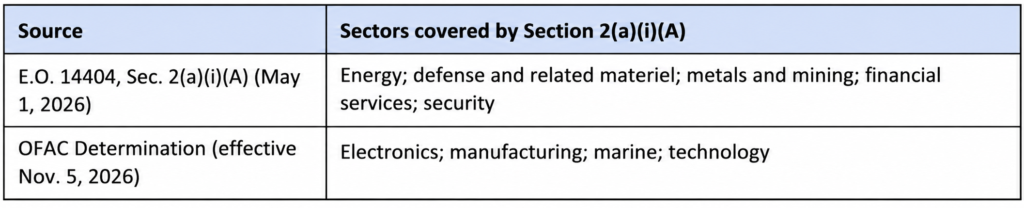
On November 5, 2026, the Office of Foreign Assets Control (OFAC) determined that the sector-based sanctions authority in Executive Order (E.O.) 14404 applies to the electronics, manufacturing, marine, and technology sectors of the Cuban economy. Any foreign person that the State Department or Treasury determines operates, or has operated, in those sectors is now exposed to blocking sanctions. U.S. importers, exporters, carriers, and logistics providers are affected through their foreign suppliers, vessel operators, and customers, which is where screening and contract reviews should start.
KEY TAKEAWAYS
- Effective November 5, 2026, OFAC determined that the sector-based sanctions authority in Section 2(a)(i)(A) of E.O. 14404 applies to the electronics, manufacturing, marine, and technology sectors of the Cuban economy.
- These four sectors join the five named in the Executive Order itself: energy, defense and related materiel, metals and mining, financial services, and security.
- Operating in a listed sector does not trigger sanctions automatically. Sanctions attach only when the State Department or Treasury makes a determination about a specific foreign person (OFAC FAQ 1256).
- The same day, the State Department designated Cuban and third-country companies, individuals, and tanker vessels under E.O. 14404, including two Chinese electronics companies.
- Importers, exporters, carriers, and logistics providers should re-screen foreign suppliers, vessels, and customers with any Cuba connection in these sectors.
What OFAC Determined on November 5
E.O. 14404, “Imposing Sanctions on Those Responsible for Repression in Cuba and for Threats to United States National Security and Foreign Policy,” was signed on May 1, 2026 and published at 91 FR 25061 on May 7, 2026. It created a new Cuba sanctions program under the International Emergency Economic Powers Act (IEEPA) that is separate from, and in addition to, the long-standing Cuban Assets Control Regulations (CACR), 31 CFR part 515 (OFAC FAQ 1251).
Section 2(a)(i)(A) of the order authorizes blocking sanctions on any foreign person determined to operate or have operated in sectors of the Cuban economy that Treasury identifies, in consultation with the State Department. Acting under 31 CFR 516.106, OFAC Director Bradley T. Smith issued a determination that this authority “shall apply to the electronics, manufacturing, marine, and technology sectors of the Cuban economy.” The determination took effect on November 5, 2026.
The determination also states that any foreign person determined to operate or have operated in these sectors “shall be subject to sanctions pursuant to section 2(a)(i)(A).” The reference to persons who “have operated” means past activity in these sectors is within the scope of the authority, not only current activity.
The Cuba Sector List After November 5
Sources: E.O. 14404; OFAC Determination Pursuant to Section 2(a)(i)(A) of E.O. 14404 (Nov. 5, 2026).
A Sector Listing Is Not a Designation
OFAC has stated that identifying a sector signals sanctions risk for foreign persons active in it, but does not sanction everyone in that sector. Only persons specifically determined under the order are subject to its sanctions (OFAC FAQ 1256). The same FAQ notes that a person not sanctioned under E.O. 14404 may still be subject to CACR prohibitions.
The practical risk is not that a client’s supplier is sanctioned today, but that a supplier, carrier, or customer with Cuba exposure in one of these sectors can be designated without prior notice. Section 2(e) of E.O. 14404 states that prior notice of designations is not required. Once a counterparty is designated, U.S. persons are generally prohibited from dealing with it.
What Happened the Same Day
The determination was released alongside new State Department designations under E.O. 14404. According to the State Department’s November 5, 2026 fact sheet, the bases for designation were as follows:

Sources: U.S. Department of State fact sheet (Nov. 5, 2026); OFAC Recent Actions (Nov. 5, 2026). CAROIL and CEIEC were already on the SDN List under other programs; OFAC added the [CUBA-EO14404] tag to their existing entries.
The State Department also identified five tankers as blocked property in which designated entities have an interest: ESPERANZA, GLORIA C, MARIA CRISTINA, EMILIA, and LOURDES.
While none of these recently designated entities appear to be listed for operating in the newly designated sector, OFAC’s November 5 determination creates the authority to make such designations, which we believe will follow in later actions.
Where U.S. Companies Stand
U.S. persons were already broadly restricted from Cuba-related dealings under the CACR. E.O. 14404 does not change those rules; every existing CACR prohibition and authorization remains in force (OFAC FAQ 1252). What changes for U.S. companies is the population of foreign counterparties that can be designated, and the consequences once they are.
- Blocking. Property and interests in property of designated persons that are in the United States, or in the possession or control of U.S. persons, are blocked and must be reported to OFAC. Entities owned 50 percent or more by blocked persons are also blocked (State Department fact sheet, Nov. 5, 2026).
- Regulations. OFAC implemented E.O. 14404 through the Cuba Sanctions Regulations, 31 CFR part 516, effective September 30, 2026. Part 505 of OFAC’s regulations governs penalties, and willful violations may be subject to criminal penalties under 50 U.S.C. 1705.
- CACR-authorized activity. Cuba General License 1 authorizes transactions prohibited by E.O. 14404 to the extent they are authorized or exempt under the CACR. It does not expand any CACR authorization (OFAC FAQ 1253).
- Humanitarian trade. The State Department stated that the United States continues to authorize humanitarian trade, including food, medicine, and medical devices.
- Foreign financial institutions. Under Section 4 of E.O. 14404, Treasury may restrict U.S. correspondent or payable-through accounts of a foreign financial institution that conducted or facilitated a significant transaction for a blocked person. DTL’s read: banks on both ends of a trade payment may scrutinize Cuba-linked counterparties more closely, which can slow or stop payments.
The CACR itself was also amended effective September 30, 2026, including new restrictions on financial transactions with entities on the State Department’s Cuba Restricted List (OFAC Alert, Sept. 29, 2026). Companies that relied on earlier CACR authorizations, including those described in our prior article on 2024 Cuba policy changes, should confirm those authorizations still apply. See our Cuba resource page for related coverage.
Action Items for Importers, Exporters, and Logistics Providers
In our experience, sector-based designations reach companies through their supply chain before anyone in the compliance function hears the word “Cuba.” We recommend the following steps now:
- Re-screen counterparties against the SDN List, filtering for the [CUBA-EO14404] tag. Include foreign suppliers, freight forwarders, ship owners, ship managers, and vessels by IMO number.
- Map Cuba exposure in the four new sectors. Ask foreign electronics, manufacturing, technology, and marine counterparties whether they operate, or have operated, in Cuba, since the determination reaches past activity.
- Apply the 50 percent rule to ownership chains. A supplier that is not listed may still be blocked if designated persons own 50 percent or more of it.
- Review contracts. Confirm that supply, logistics, and distribution agreements include sanctions representations, notice obligations, and suspension or termination rights tied to a counterparty’s designation.
- Revisit CACR reliance. If your business relies on a CACR general or specific license, confirm the activity still fits that license after the September 30, 2026 amendments, since General License 1 only covers activity that remains authorized or exempt under the CACR.
- Escalate hits immediately. If screening identifies blocked property or a designated counterparty, stop the transaction, block as required, and report to OFAC. If past dealings raise concerns, evaluate a voluntary self-disclosure with counsel before taking further action.
How Diaz Trade Law Can Help
Diaz Trade Law advises importers, exporters, logistics providers, and financial institutions on OFAC sanctions screening, counterparty due diligence, license analysis, and voluntary self-disclosures. We help clients identify Cuba exposure across supplier and carrier networks, update screening protocols, and respond when a counterparty is designated.
Contact us at [email protected] or 305-456-3830 to review your Cuba-related sanctions exposure.
ATTORNEY ADVERTISING
This article is for general informational purposes only and does not constitute legal advice. Reading it does not create an attorney-client relationship. The hiring of a lawyer is an important decision that should not be based solely upon advertisements. Before you decide, ask us to send you free written information about our qualifications and experience. Diaz Trade Law, P.A., 12700 Biscayne Blvd., Suite 401, North Miami, FL.