My First $1 Million: Fire Department Lieutenant, 46, Virginia
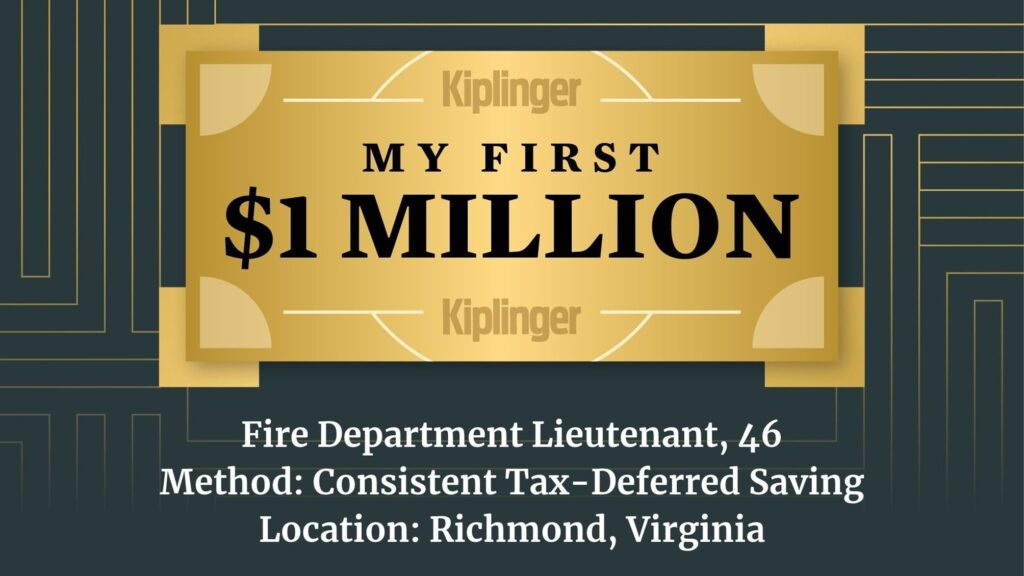
Welcome to Kiplinger’s My First $1 Million series, in which we hear from people who have made $1 million.
They’re sharing how they did it and what they’re doing with it. This time, we hear from a single 46-year-old fire department lieutenant and small business owner in Richmond, Virginia. He reports a salary range of $180,000 to $210,000.
See our earlier profiles, including a writer in New England, a literacy interventionist in Colorado, a semiretired entrepreneur in Nashville and an events industry CEO in Northern New Jersey. (See all of the profiles here.)
Sign up for Kiplinger’s Free Newsletters
Profit and prosper with the best of expert advice on investing, taxes, retirement, personal finance and more – straight to your e-mail.
Profit and prosper with the best of expert advice – straight to your e-mail.
Each profile features one person or couple, who will always be completely anonymous to readers, answering questions to help our readers learn from their experience.
These features are intended to provide a window into how different people build their savings — they’re not intended to provide financial advice.
To learn what these millionaires have taught us, check out the articles 5 Key Insights We Learned From 50 Millionaires and 5 Things 50 Millionaires Wish They’d Known Before They Retired.
And to hear more about My First $1 Million, you can check out this podcast with bestselling author and tax attorney Toby Mathis:
The Basics
How did you make your first $1 million?
I did it by taking advantage of tax-deferred retirement accounts and biweekly automatic contributions offered through my employer starting in 2003. These accounts were specifically designed for public servants years ago.
From my small business, I took advantage of a SEP IRA in 2021 with Charles Schwab.
I have been contributing to a Roth IRA for 10-plus years with Vanguard.
(Image credit: Getty Images)
We also have a family investment club that we started in 2010 with Charles Schwab. I own 10% of the value of that.
I also have a brokerage account with Charles Schwab.
What are you doing with the money?
I keep investing the money. I want the money to compound and grow on itself many times over.
I allowed myself to purchase a new Ford Explorer in 2023. I hemmed and hawed about purchasing the vehicle, but I work hard and have been working two jobs for over 20 years.

(Image credit: Getty Images)
I recently purchased a new Ford F-250 truck for my business. It was necessary, and I had consulted with my accountant first.
The Fun Stuff
Did you do anything to celebrate?
I do not recall. I do recall telling myself to remain humble and don’t think that the race is over and time to celebrate.
I congratulated myself for a minute and then continued with my financial plan.
What is the best part of making $1 million?
Now I am excited to see that $1 million turn to $2 million to $4 million, etc.

(Image credit: Getty Images)
Did your life change?
It has given me confidence. It has also given me a little bit of cushion and a slight sigh of relief. But the job is not done. I still have to maintain the course.
Does anyone know you’re a millionaire?
I will share that information sparingly. I share it with my parents as well as other like-minded investors and small-business entrepreneurs.
I consider myself a part of the investor class.
Any plans to retire early?
No. I don’t mind working. I like to stay busy. I do not want to sit idle.
My grandfather told me years ago that the day I retire I need to stay busy or risk dying young. He lived to be 101.

(Image credit: Getty Images)
I would like to retire as a firefighter in six years and start a new business. My plan is to start the business before I retire and hopefully get it running by that time.
Looking Back
Anything you would do differently?
There have been some financial blunders along the way. There were some financial decisions that were not smart, or there were investments made that did not pan out.
There were about eight years of my fire department career when I went without any raise. That hurt a lot, and that compounds over time. The results of that still hurt a little bit today.
(Image credit: Getty Images)
When I purchased my second home in July 2014, I had to cut back on the amount of money I was putting into retirement accounts biweekly. I couldn’t afford the mortgage and what I was putting into accounts.
I did not like to reduce those retirement account contributions, but I had no choice.
I have since recovered from that and now max out my contributions.
What advice would you give to your younger self?
Try to picture a few years out from making whatever financial decision it is that you have to make. And ask yourself, Is this going to work or be a wise decision or play out in my favor? How is this going to benefit me?
Years ago, I thought I wanted to get a graduate degree. A very good friend of mine who is very financially disciplined asked me how it was going to benefit me and whether there was any guarantee for success. And I could not come up with positive answers.
I ultimately decided not to get the graduate degree, and I am glad I did not. It was going to cost well over $20,000 at the time, which was a lot of money for me. It still is.
There was no guarantee that the graduate degree was going to get me a better job or put me in a better position for success.
Did you read any books that helped you on your journey?
The Millionaire Next Door (by Thomas Stanley and William Danko), Rich Dad Poor Dad (by Robert Kiyosaki). A lot of Kiplinger Personal Finance magazines.
Did you work with a financial adviser?
No, I did not. Through my employer, there are sponsored plans with a financial firm that offers the retirement accounts and funds for employees to invest — Mission Square Retirement. I simply took advantage of that company and its products to invest in 457(b) and 401(a) accounts.
I also use Charles Schwab for brokerage and SEP IRA accounts.

(Image credit: Getty Images)
Vanguard manages my Roth IRA. I am very happy with Vanguard and their low fees and wise management that consistently brings solid returns.
Did anyone help you early on?
My grandfather and family as a whole. My grandfather started investing in the 1950s with the Catholic men’s club where he was a member. They formed their own investment club.
One of the first stocks they bought was Brown-Forman (BF.B). My grandfather held that stock for 60-plus years and did quite well with it. And he did it while a civil servant with nine children.
His mentality trickled down to his children, thus my mother and my aunts and uncles.
(Image credit: Getty Images)
My mother and father have passed on their knowledge and investing passion to me and my brother.
Looking Ahead
Plans for your next $1 million?
Keep feeding the market! And stay healthy physically to enjoy what I’ve worked to accomplish.
Any advice for others trying to make their first $1 million?
Stay the course and keep feeding the market. That was one of the most important pieces of advice I ever received from a friend. This friend was a financial planner for very wealthy people in Delaware.
Years ago, he told me, “Markets go up. Markets go down. Keep feeding the market.”
Have a plan, most importantly! Refer back to that plan periodically and make changes if necessary.
Put the plan on paper so you have something to refer to if need be. Use that plan to hold yourself accountable. Be able to pivot.
Do you have an estate plan?
No, I do not. And that is high on my list to resolve.
What do you wish you’d known …
When you first started saving? Don’t keep too much money in bank accounts. They don’t pay interest. Put the money in the market to work.
Utilize the brokerage account. The money can grow exponentially more, and if you need it, then tap into it. Yes, you’ll have to pay a little capital gains tax, but the money will grow in the market more so than it will in a bank account.
(Image credit: Getty Images)
Yes, there is potential to lose money in the market. Investing in solid, well-performing companies that have consistent returns and earnings and pay dividends is a solid path, though.
Don’t touch money in your retirement accounts. Don’t even borrow against them. That is why you should have a brokerage account. Learn the difference between brokerage accounts and retirement accounts.
When you first started investing? Don’t make hasty decisions. I believe in buying individual stocks and mutual funds. I have a plan when I buy one to try to keep the stock for at least one year. There’ve been times when I deviated from that plan and have regretted it.
Anything you’d like to add?
My plan for all of the money in the end: There is a possibility to create a legacy scholarship at my alma mater.
I will give to my church.
Perhaps I will give to some friends and their children who have remained loyal over the years.
I believe in donating to food banks in the local community.
If you have made $1 million or more and would like to be anonymously featured in a future My First $1 Million profile, please fill out and submit this Google Form or send an email to [email protected] to receive the questions. We welcome all stories that add up to $1 million or more in your accounts, although we will use discretion in which stories we choose to publish, to ensure we share a diversity of experiences. We also might want to verify that you really do have $1 million. Your answers may be edited for clarity.
Related Content
TOPICS