Meet the Sad Wives of AI
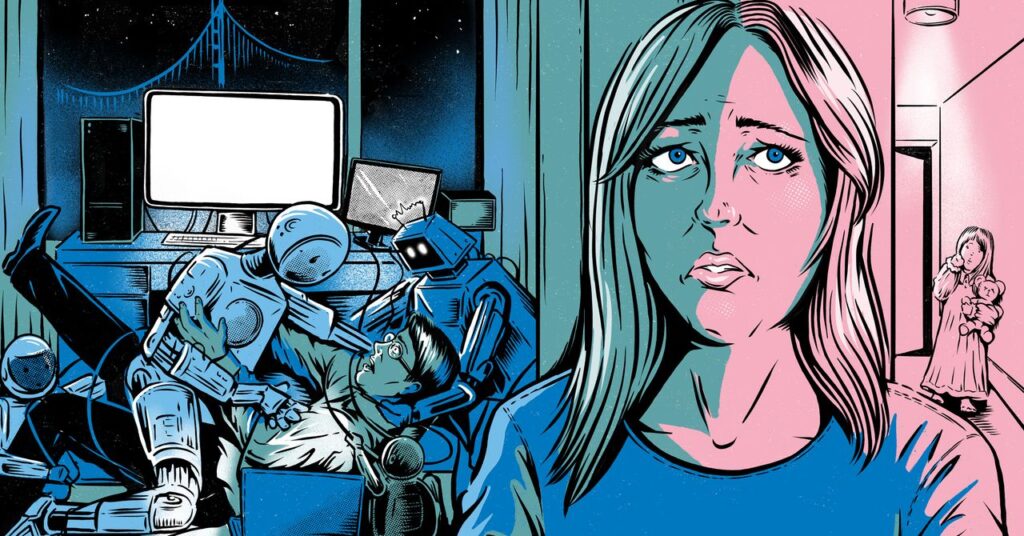
Yana van der Meulen Rodgers, the chair of labor studies and employment relations at Rutgers University, has a blunt take: What’s happening in Bay Area households isn’t just a lifestyle story. It’s a labor market story. The AI boom, Rodgers says, is creating a “perfect storm” of forces reshaping household dynamics, playing out along predictably gendered lines.
The story is older than Silicon Valley, of course. Every major technological boom has produced the same figure, the person who gives everything to the wave. During the industrial revolution, it was the factory worker. During the Gold Rush, it was the men who left their families and headed west. During the dotcom boom, it was the founders sleeping under their desks in SoMa. Now, it is the person who is building, building, always building—vibe coding at midnight, constantly upgrading their models—convinced that stopping for five minutes means missing everything. Economists call this the “ideal worker.” Rodgers calls it a trap. “Someone who works many hours, giving all of themselves to this new force,” she says. “That means less time at home for the partner, less time for care work.”
Though things keep changing, some analyses suggest that women are about 20 percent less likely than men to use generative AI. “It’s a function not of gender per se,” Rodgers suggests, “but of the occupations that women hold.” Women are disproportionately represented in jobs—education, health care, social services—that right now use AI less. The result could be a compounding disadvantage. Over time, it means less access to the boom’s financial rewards, more responsibility for the domestic labor it generates.
And what happens when it doesn’t work out for the men? Many, if not most, won’t make it in AI, a lucrative but volatile business. “With job loss comes some depression,” Rodgers says. “Within the household, if one person is going through adverse mental health effects around job loss or uncertainty, the other naturally becomes the support person.” The cruel irony, for some sad wives, is that the moment their husband does leave AI, whether by choice or by force, there’s no relief. Now he’s home. Spiraling. Now she’s managing that too.