How Far Does A 5G Cell Phone Tower Reach? It Depends
We may receive a commission on purchases made from links.
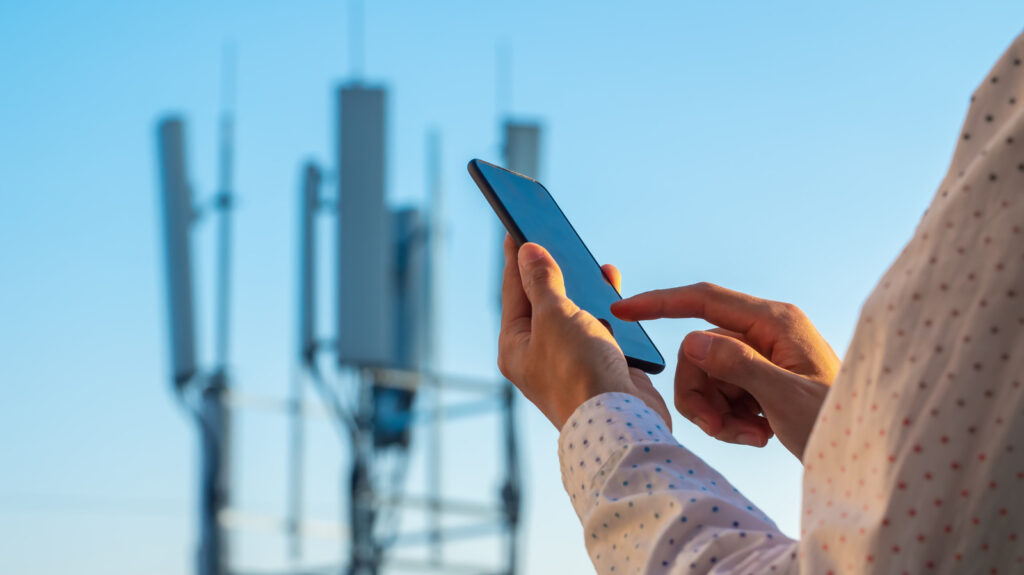
Cell phone towers are the backbone of modern communication, allowing us to make calls, send and receive messages, and access the internet from practically anywhere, provided there’s a tower nearby. But how far does a 5G cell phone tower really reach? Because that’s the radius within which your smartphone can receive signals. For 5G towers, it could be anywhere from a few hundred feet to about 10 miles, depending on the frequency.
As is the case with Wi-Fi, where a lower-frequency band like 2.4 GHz has a better range than the 5 GHz band, cell phone networks behave the same way. For instance, low-band 5G signals can travel up to 5-10 miles, while high-band or mmWave, with a frequency of 24-39 GHz, travel about 600-1,800 feet. Verizon’s official post states that 5G Ultra Wideband signals reach 1,500 feet. Keep in mind that while higher frequencies, like the 5G Ultra Wideband, translate into smaller coverage areas, they do have two benefits: faster speeds and lower latency.
With 5G, you also have small-cell technology, where small cells are more compact and simpler to set up than macrocells that are associated with 4G. This makes their deployment relatively easier, even in areas with higher population densities. And given that 5G cell towers don’t reach as far, the role of small cells becomes all the more important for seamless connectivity and coverage.
Factors affecting the range of cell phone towers
There are several factors that affect the range of a cell phone tower, but generally speaking, frequency is the most important one. As you may already know, the higher the frequency, the lower the range. Higher frequencies also lose power faster as we move away from cell phone towers, and don’t penetrate walls as well as lower frequencies.
The terrain and line of sight play a key role, too. Buildings, trees, and hills can all obstruct the signals, reducing the range of cell phone towers. So, the clearer the area, the farther the signals will travel. That’s why you often see antennas or small cells placed on higher towers. However, increasing the height beyond a certain point without reconfiguring the downtilt may weaken signals in the target area. Apart from that, the transmission power and network load are two other key factors that determine the range of cell phone towers.
Ultimately, the coverage or range of a cell phone tower depends on a combination of these factors. That’s why 5G home internet isn’t the best choice for everyone. As for your phone, generally being within the range of a nearby tower is all you need. In cities where the 5G rollout is complete, connectivity may not be a problem, but in rural areas where the rollout is underway or planned, your phone may switch to 4G or receive no signal at all.