CBP Will Require Foreign Importers of Record to Be CTPAT-Validated or Use a CTPAT-Validated Broker Beginning January 5, 2027
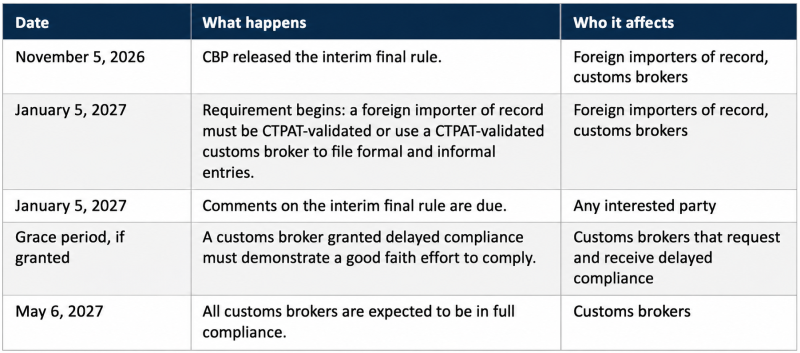
U.S. Customs and Border Protection (CBP) released an interim final rule on November 5, 2026 under which a foreign importer of record must be validated under the Customs Trade Partnership Against Terrorism (CTPAT), or use a CTPAT-validated customs broker, to file formal and informal entries beginning January 5, 2027. The rule implements Executive Order 14411, Strengthening Customs Enforcement. Foreign companies that import in their own name, the U.S. buyers that depend on them, and customs brokers that are not CTPAT-validated each need a plan before January 5.
Key Takeaways
- Beginning January 5, 2027, CBP will require a foreign importer of record to be validated under the Customs Trade Partnership Against Terrorism (CTPAT), or to use a CTPAT-validated customs broker, in order to file formal and informal entries.
- The rule treats any importer of record that does not meet its definition of a U.S. importer of record as a foreign importer of record. That definition turns on U.S. citizenship or lawful permanent residency, U.S. organization and location, U.S. beneficial ownership and control, or direct ownership of a significant amount of unencumbered U.S. real property.
- Customs brokers may individually request delayed compliance. A broker granted delayed compliance must demonstrate a good faith effort to comply during the grace period, and all brokers are expected to be in full compliance by May 6, 2027.
- Comments on the interim final rule are due January 5, 2027, the same day the requirement begins.
Who Counts as a Foreign Importer of Record
The interim final rule defines a foreign importer of record as an importer of record that does not meet the rule’s definition of a U.S. importer of record. Under the rule, a U.S. importer of record is:
- an individual who is a U.S. citizen or permanent resident; or
- an entity that is organized under the laws of the United States and located in the United States, and that maintains 51 percent beneficial owners who are U.S. citizens or permanent residents and have control of the entity, or that has direct ownership of a significant amount of unencumbered real property in the United States.
DTL’s read: This test is narrower than having a U.S. address, a U.S. Employer Identification Number, or a U.S. subsidiary. A U.S. subsidiary of a foreign parent that does not satisfy the U.S. beneficial ownership prong, and does not directly own a significant amount of unencumbered U.S. real property, should plan as though it is a foreign importer of record. Companies that intend to qualify through real property should confirm how the rule treats leased or financed property, since the rule refers to direct ownership of unencumbered property.
Our EO 14411 Implementation Tracker includes screening questions for applying this definition to each importing entity.
What Changes on January 5, 2027
Beginning January 5, 2027, a foreign importer of record has two routes to file entries with CBP: obtain its own CTPAT validation, or file through a customs broker that is CTPAT-validated.
The first route is not open to every foreign company. Executive Order 14411 conditions self-validation on CBP determining the foreign importer of record to be eligible. In its September 2, 2026 advance notice of proposed rulemaking on heightened import disclosures, CBP listed the businesses eligible to apply for CTPAT partnership, including U.S. importers of record, non-resident Canadian importers, licensed U.S. customs brokers, and Mexican and Canadian manufacturers, among others.
DTL’s read: For many foreign importers of record, the practical route on January 5 is a CTPAT-validated customs broker rather than their own validation. Foreign importers of record that do fall within an eligible category should still line up a validated broker while any application is pending.
The Delayed Compliance Window Runs to Customs Brokers
Customs brokers may individually request delayed compliance with the requirement. A broker that receives delayed compliance must demonstrate a good faith effort to comply during the grace period. CBP stated that all brokers are expected to be in full compliance by May 6, 2027.
DTL’s read: The delayed compliance mechanism, as CBP described it, is requested by and granted to individual customs brokers. We have not seen a parallel mechanism for foreign importers of record, and importers should not assume that their broker’s grace period protects their own entries. A foreign importer of record relying on a broker that has requested delayed compliance should obtain written confirmation of the request, whether CBP granted it, and the broker’s steps toward validation.
How the Rule Fits Executive Order 14411
Executive Order 14411 was signed June 3, 2026 and published at 91 FR 35125. Section 2(c)(i) directs the Secretary of Homeland Security to require, for formal entry, that a foreign importer of record (1) not rely on a continuous bond except as permitted by CBP when the foreign importer of record has shown that the revenue would be fully protected and compliance assured, and (2) be validated in CTPAT, if CBP determines it eligible, or use a CTPAT-validated and licensed customs broker to file entries. We covered the order in detail in New Executive Order on Strengthening Customs Enforcement.
The order also reaches customs brokers directly. Section 2(f) directs enhanced and recurrent vetting for customs brokers, among others, and Section 4(a) directs maximum penalties for brokers who, for example, fail to conduct due diligence, repeatedly represent noncompliant clients, or fail to cooperate in a timely manner with CBP requests for information.
DTL’s read: Taken together, these provisions place CTPAT-validated customs brokers at the center of foreign importer of record activity. We expect validated brokers to tighten onboarding for foreign clients, to request more ownership, financial, and supply chain documentation, and to decline some foreign importers of record they previously served.
What to Do Before January 5
Foreign importers of record
- Screen every entity that appears as importer of record on your entries against the rule’s U.S. importer of record definition.
- Ask your customs broker, in writing, whether it is CTPAT-validated today. If it is not, ask whether it has requested delayed compliance, whether CBP granted it, and its timeline to validation.
- Identify a CTPAT-validated customs broker as a backup and begin onboarding now. Expect requests for ownership, financial, and compliance documentation.
- If your business falls within a CTPAT-eligible category, evaluate whether to apply, and keep the broker route open in the meantime.
U.S. buyers relying on a foreign importer of record
- Identify shipments where a foreign supplier, marketplace, or logistics provider acts as importer of record, including delivered duty paid arrangements.
- Confirm who will be importer of record on entries filed on or after January 5, 2027, and what happens to goods in transit if that party cannot file.
- Evaluate whether your company should become the importer of record, including bond, Form 5106, and reasonable care obligations that come with that role.
Customs brokers
- Decide now whether to request delayed compliance, and build a record of good faith steps toward validation from the date of the request.
- Inventory foreign importer of record clients and the entry volume they represent.
- Update due diligence procedures for foreign clients in light of Sections 2(f) and 4(a) of the order.
Everyone affected
Comments on the interim final rule are due January 5, 2027. Small importers, foreign importers of record, and customs brokers seeking delayed compliance are the parties most likely to have operational data CBP can use, such as onboarding timelines, cost per entry, and the share of entries filed through non-validated brokers.
How Diaz Trade Law Can Help
Diaz Trade Law advises foreign companies, U.S. importers, and customs brokers on importer of record structure, CTPAT applications and validations, customs broker compliance, and CBP enforcement matters. We can screen your importing entities under the rule’s definition, review your broker arrangements before January 5, and prepare comments on the interim final rule. Contact us at 305-456-3830 or [email protected].
Read more: