CBP Releases Foreign IOR Overview, Reference Guide, and Broker Delayed Compliance Form
U.S. Customs and Border Protection (CBP) has published three implementation documents for its Heightened Requirements for Foreign Importers of Record interim final rule: a one-page Overview, a three-page Reference Guide on U.S. importer of record (IOR) status, and a Broker Delayed Compliance Request Form.
Together they set out which records CBP lists for verifying U.S. IOR status, the new entry data fields, and the steps a customs broker must take to request delayed compliance before January 5, 2027. Foreign IORs, U.S. companies that rely on them, and every licensed customs broker filing entries for clients that claim U.S. IOR status are affected.
KEY TAKEAWAYS |
|
In June, our article New Executive Order on Strengthening Customs Enforcement covered Executive Order 14411, which directed CBP to tighten the rules for foreign IORs. Last week, in CBP Will Require Foreign Importers of Record to Be CTPAT-Validated or Use a CTPAT-Validated Broker Beginning January 5, 2027, we covered the interim final rule that implements Section 2 of that order. This article lists the CBP reference guides and resources released with the rule, links to each, and explains what each adds.
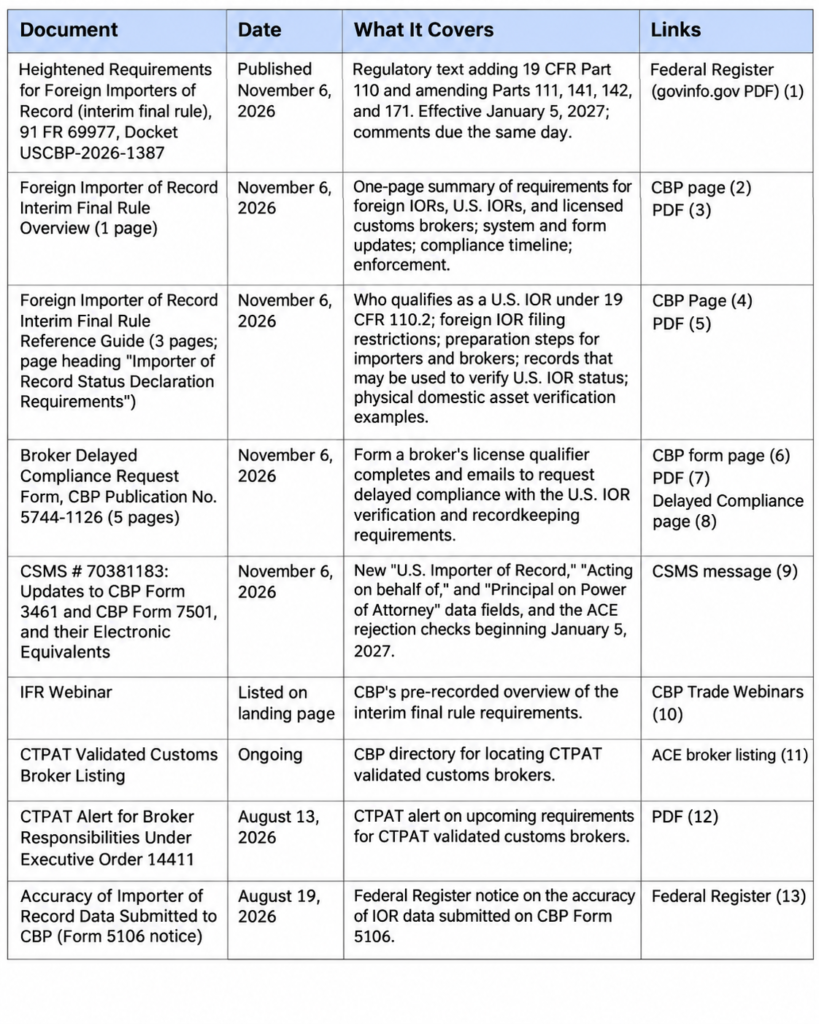
CBP Reference Guides and Links
CBP posted the following documents and resources on its Strengthening Customs Enforcement landing page.
Links and Resources
₁ Federal Register (govinfo.gov PDF)
₂ Foreign Importer of Record Interim Final Rule Overview – CBP Page
₃ Foreign Importer of Record Interim Final Rule Overview – PDF
₄ Foreign Importer of Record Interim Final Rule Reference Guide – CBP Page
₅ Foreign Importer of Record Interim Final Rule Reference Guide – PDF
₆ Broker Delayed Compliance Request Form – CBP Form Page
₇ Broker Delayed Compliance Request Form – PDF
₈ Delayed Compliance – CBP Page
₉ CSMS #70381183 – Updates to CBP Forms 3461 and 7501
₁₀ IFR Webinar – CBP Trade Webinars
₁₁ CTPAT Validated Customs Broker Listing – ACE Broker Listing
₁₂ CTPAT Alert for Broker Responsibilities Under Executive Order 14411 – PDF
₁₃ Accuracy of Importer of Record Data Submitted to CBP – Federal Register
All of these are collected on CBP’s Strengthening Customs Enforcement landing page. Questions go to [email protected].
What CBP’s Overview Adds to the Rule
The Overview organizes the rule by party. Several points go beyond what we covered in our initial article.
Foreign IORs and CTPAT Eligibility
Under the Overview, a foreign IOR must either be a validated participant in the Customs Trade Partnership Against Terrorism (CTPAT) program or designate a CTPAT validated licensed customs broker to make entry. CBP adds a note that, currently, only Canadian foreign IORs are eligible for CTPAT validation. The Overview also states that foreign IORs who are not CTPAT validated can no longer use non-CTPAT validated brokers.
DTL’s read: In our initial article we noted that self-validation is not open to every foreign company. CBP’s Overview narrows that point further. For a foreign IOR that is not Canadian, we expect the practical route on January 5 to be a CTPAT validated customs broker. CBP maintains a customs broker directory for locating one.
New Data Fields on Forms 3461 and 7501
The Overview lists three updates to CBP Forms 3461 and 7501 and their electronic equivalents:
- a checkbox to declare U.S. IOR status (“Y”);
- a checkbox indicating when a broker is acting as IOR on behalf of a principal; and
- a mandatory principal identifier field, requiring a CBP Form 5106 to be on file, when a non-CTPAT broker acts as the IOR on behalf of a principal.
CSMS # 70381183 states that, as of January 5, 2027, CBP may reject entries and entry summaries where a foreign IOR attempts to file without CTPAT validation or without a CTPAT validated broker, or where a non-CTPAT validated broker acting as IOR does not provide the principal when required.
DTL’s read: The principal identifier field ties to Form 5106. Importers that have not reviewed their Form 5106 data against CBP’s August 19, 2026 accuracy notice should do so before January 5.
Compliance Timeline

Enforcement
The Overview states that inaccurate declarations or failure to meet the new standards may result in enforcement actions, including but not limited to imposition of live entry, discontinuation of immediate delivery privileges, and civil penalties under 19 U.S.C. 1592 or administrative remedies under 19 U.S.C. 1641 for brokers. In the rule text, the live entry and immediate delivery provisions (new 19 CFR 142.13(a)(5) and 142.25(a)(5)) apply where an IOR, including a broker acting for a principal, inaccurately declares U.S. IOR status.
The Records CBP Lists for Verifying U.S. IOR Status
The Reference Guide restates the 19 CFR 110.2 test. An individual qualifies as a U.S. IOR if a U.S. citizen or lawful permanent resident. An entity qualifies if it is located in the United States (including Puerto Rico), organized under U.S. law, and maintains at all times either at least 51% U.S. beneficial ownership with control or direct ownership of a significant amount of unencumbered real property in the United States. An IOR that does not meet these criteria is a foreign IOR, and the Guide states that ACE may reject entry summary filings involving a foreign IOR if the applicable CTPAT validation requirement is not satisfied.
CBP frames the Guide’s examples as general guidance and states that the totality of the circumstances should be evaluated on a case-by-case basis. The Guide lists the following potential records:

Physical Domestic Asset Verification Examples
The third page of the Guide gives document examples for five asset types: cash in a U.S. bank, U.S. Treasury holdings, real property, inventory, and machinery/equipment. For several of them, CBP lists an officer declaration confirming intent to maintain ownership. The Guide also states that:
- brokers should review historical records to confirm whether assets were maintained in the U.S. over time, not recently acquired solely to qualify as a U.S. IOR, and assets should align with the IOR’s business model, operations, and financial statements;
- inventory should reflect a regular, meaningful U.S. presence, not merely recently imported goods likely to be quickly sold, and perishable or readily disposable inventory may be insufficient;
- ownership, U.S. location, value, business use, and remaining useful life should be evaluated, and assets near the end of useful life may be insufficient;
- brokers should verify claimed assets rather than rely solely on the IOR’s assertion, including continued verification for the duration of the broker-IOR relationship;
- if concerns arise, brokers should request additional information and, if unresolved, decline to verify the IOR as a U.S. IOR or decline to do business with the IOR; and
- brokers should retain records for at least 5 years and provide them to CBP upon request.
The Guide also states that customs brokers are responsible for verifying the IOR’s declaration and must maintain a valid power of attorney on file before conducting customs business, including where the broker acts as the IOR for the entry.
DTL’s read: The asset examples go well past a bank letter. Companies that intend to qualify through ownership or real property should assemble the file before their broker asks for it, and should expect the request to recur over the life of the relationship.
How a Customs Broker Requests Delayed Compliance
Under the rule, beginning January 5, 2027, brokers must verify, before filing an entry or entry summary for a client that declares itself a U.S. IOR, that the client meets 19 CFR 110.2. The Broker Delayed Compliance Request Form is the mechanism for requesting additional time. To request it, a broker must:
- Complete every field of the form, including broker name, organizational or sole proprietor license number, permit number, filer code, license qualifier name, email, and individual license number, approximate employee count, approximate number of current clients that may claim U.S. IOR status and have a valid power of attorney, and a detailed explanation of the need for delayed compliance.
- Email the completed form no later than January 5, 2027 to [email protected], with the subject line “Broker Delayed Compliance Request – License Number: XXXXX.”
The form lists five conditions that make a broker ineligible, including but not limited to: removal from CTPAT without reinstatement; current revocation of CBP Form 5106 filing privileges; active suspension or debarment by a federal agency with an exclusion record on SAM.gov; current entry filer code suspension; and notification of CBP-initiated revocation proceedings against the broker license.
The license qualifier certifies the form under penalty of perjury. The form states that an intentional false statement may result in a fine under 18 U.S.C. 1001, entry summary rejection, entry filer code suspension, or broker license or permit revocation or suspension. During an approved delayed compliance period, the broker must continue making satisfactory progress, and CBP states it may contact the broker and may accelerate the compliance date if progress is not satisfactory or the period is being misused. Brokers that receive delayed compliance must be in full compliance by May 6, 2027, and CBP states that no additional extensions will be granted beyond that date.
General questions go to [email protected] with the subject line “Delayed Compliance Question – License Number: XXXXX.”
DTL’s read: The detailed explanation field and the perjury certification make this more than a checkbox. Brokers should support the explanation with concrete figures, such as the number of active POAs requiring verification and the staff available to review them, and keep a dated record of verification progress from the day the request is filed.
Action Items Before January 5, 2027
CBP’s Reference Guide lists preparation steps for each party. We have added our recommendations, labeled as ours.
Importers
- Determine your status as a U.S. IOR or a foreign IOR under 19 CFR 110.2 (CBP).
- Gather records supporting U.S. IOR status or CTPAT validation ahead of time (CBP).
- Confirm your broker has an accurate, up-to-date power of attorney, CBP Form 5106, and filing information on file (CBP).
- If you qualify as a U.S. IOR, declare that status at entry and entry summary, maintain records, and be ready to provide them to your broker or CBP upon request (CBP).
- If you are a foreign IOR that is not CTPAT validated, confirm your customs broker’s CTPAT validation status (CBP).
- DTL recommends: U.S. buyers that rely on a foreign IOR, including under delivered duty paid terms, should confirm in writing who will be the IOR on entries filed on or after January 5, 2027.
Customs Brokers
- Review your client base to identify foreign IORs versus clients claiming U.S. IOR status (CBP).
- Revise intake and verification protocols so POAs are obtained before transacting any customs business, including where the broker acts as IOR (CBP).
- Update filing systems and software for the new ACE data fields on Forms 3461 and 7501 (CBP).
- Put systems in place to retain U.S. IOR verification records for 5 years from the verification date and to verify status on an ongoing basis (CBP).
- If needed, submit a delayed compliance request within 60 days of publication, that is, by January 5, 2027 (CBP).
- DTL recommends: decide now whether to pursue CTPAT validation, and file comments on Docket USCBP-2026-1387 with operational data such as onboarding time and cost per verification.
How Diaz Trade Law Can Help
Diaz Trade Law advises importers, foreign companies, and customs brokers on importer of record structure, CTPAT applications and validations, customs broker compliance, and CBP enforcement. We can screen your importing entities under 19 CFR 110.2, assemble the verification file CBP’s Reference Guide describes, prepare a broker’s delayed compliance request, and draft comments on the interim final rule.
Read more:
Contact us at 305-456-3830 or [email protected].
This article is for general informational purposes only and does not constitute legal advice. Reading it does not create an attorney-client relationship. The hiring of a lawyer is an important decision that should not be based solely upon advertisements.