A Slight Upgrade, But Still The Most Accessible MacBook Pro
It’s more of the same, but that’s still pretty great.
RATING : 9 / 10
- Excellent case
- Powerful M6 chip
- Great Liquid Retina display
- Tons of ports
- More expensive than before
- No significant design changes
When I reviewed the M5 Max MacBook Pro earlier this year, I predicted that it might soon feel out of date whenever Apple’s fabled touchscreen MacBook Pros arrived. That’s even more true for the new MacBook Pro with an M6 chip, which was briefly announced last week before the new touchscreen-equipped PROLED XDR MacBook Pros arrived. Those systems are clearly going to get most of the attention this holiday season from Apple’s marketing team and deep-pocketed Mac-heads, so where does that leave the lowly entry-level MacBook Pro?
The M6 MacBook Pro is more of the same design we’ve seen for years, with a slightly faster chip. And yet, at $1,999, it’s still a pretty compelling machine for anyone not crazy enough to spend an extra $900 for an OLED touchscreen and a slightly lighter system. Even Apple’s leftovers are still miles ahead of most of the competition.
What’s new with the MacBook Pro M6?
The biggest selling point of this MacBook Pro is Apple’s new M6 chip, which we’ve already seen in the recent Mac mini. It’s a 12-core CPU, 12-core GPU system-on-a-chip, which is slightly more powerful than last year’s M5 chip and its 10 CPU cores and 10 GPU cores. The CPU is made up of two super cores for single-threaded work, four performance cores for more intensive multithreaded tasks and six efficiency cores for background tasks. The M6 chip also features dual 16-core neural engines for the first time, which helps to make it twice as fast at AI tasks compared to the M5 chip, according to Apple.
Apple’s own benchmarks suggest otherwise modest gains for the M6 chip. The company claims that it’s 11.7x faster at 3D rendering compared to the M1 MacBook Pro, while the M5 chip is 9.2x faster than that older system. The M6 is reportedly 3.2x faster while playing Cyberpunk 2077 compared to the M1 system, whereas the M5 was 2.5x faster. Basically, you don’t need to throw out your M5 MacBook Pro anytime soon.
Just like with the Mac mini, you’ll have to bump up to the M5 Pro or M5 Max chips if you want more power, as those have significantly more CPU and GPU horsepower. Those are the current top-end options since Apple hasn’t yet launched faster M6 Pro or Max chips yet. You also get faster RAM performance by jumping to the M5 Pro or Max. The M6 tops out at 32GB of RAM running at 170 GB/s, while the M5 Pro can fit in 64GB at 307 GB/s.
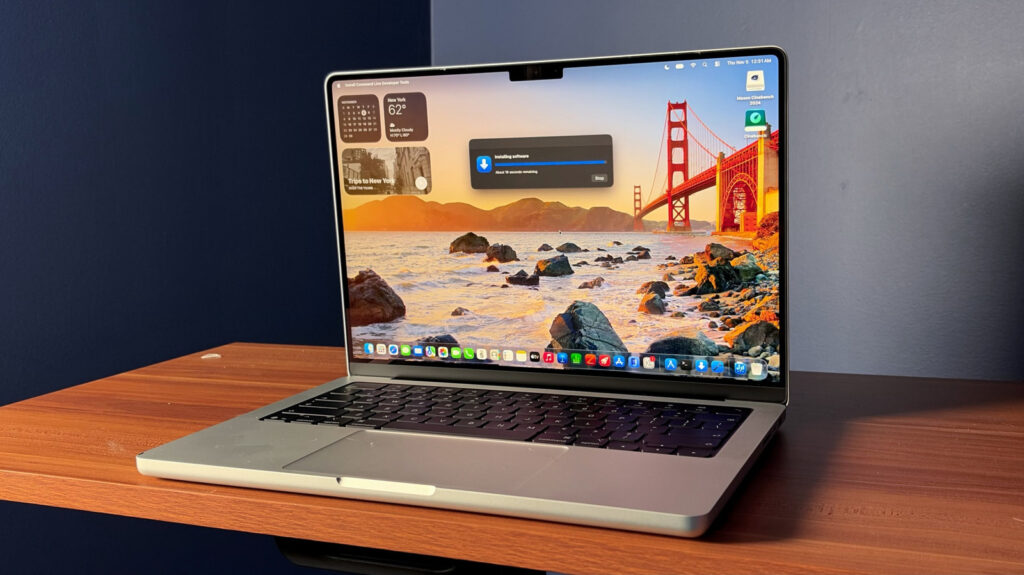
Beyond the new M6 chip, the 14-inch MacBook Pro has all of the same hardware as the previous systems. There’s the MiniLED Liquid Retina screen with a 120Hz ProMotion refresh rate, sturdy unibody case and healthy port selection (three Thunderbolt 4 USB-C ports, a MagSafe charging connection, HDMI, headphone jack and an SD card slot). At 3.4 pounds, it’s not significantly different from the slimmer 3-pound 14-inch PROLED MacBook Pro.
Though we’ve seen most of this hardware before, I don’t mean to dismiss it. There’s certainty in battle-tested hardware designs, and for years Apple has schooled most PC makers when it comes to overall hardware quality.
In-use: Faster, but not noticeably
I’ll say this up front: The M6 MacBook Pro is yet another fast and reliable entry in Apple’s lineup. Our review unit, which was equipped with 16GB of RAM and a 1TB SSD, flew through my daily workflow with no noticeable hiccups. But that’s been true of every MacBook Pro for the past decade — this one is just ever-so-slightly faster than the previous model.
In the Geekbench 6 CPU benchmark, the M6 MacBook Pro scored 4,458 points for single-threaded work and 19,077 points for multi-threaded tasks. Last year’s M5 14-inch MacBook Pro was only a bit slower with 4,310 single-threaded points and 18,003 multi-threaded points. The M6’s more powerful graphics capabilities shined in the Geekbench 6 GPU test, though, scoring 64,115 points compared to the M5 system’s 48,840 points. I saw similarly better gains in Cinebench R24, where the M6 MacBook Pro was around 30 percent faster than the M5 in multi-threaded performance.
I was already pretty impressed with the M5 MacBook Pro’s gaming performance, and the M6 chip just pushed things a bit further. Lies of P ran between 90 and 100 fps while playing at the highest resolution (3,024 by 1,890) with graphics settings cranked to the max. That’s a 25 fps gain from the M5 system, but it’s not something I’d actually notice during gameplay.
It’s also worth noting that I didn’t miss the PROLED XDR MacBook Pro’s touchscreen one bit. Apple’s large touchpad remains far easier to reach for scrolling through web pages and documents. The M6 MacBook Pro’s MiniLED screen isn’t as bright as the PROLED system’s, but it still looks great while viewing photos and videos. And most importantly, it’s bright enough to use outside in direct sunlight.
Battery life remains great, as well. The M6 MacBook Pro lasted nine hours and 35 minutes while running the MacBatteryBenchmark script, which simulates real-world programming workflows. In my testing, the battery reached 50 percent after six hours of continuous work, which involved juggling dozens of browser tabs, editing images and hopping on video calls.
Should you buy the M6 MacBook Pro?
While it’s a shame that its price jumped from $1,599 to $1,999 in the last year, the 14-inch M6 MacBook Pro remains the cheapest Pro-grade laptop Apple currently sells. Unless you’re willing to gamble on the used or refurbished market (something I wholeheartedly support), this is the MacBook Pro most people should consider. The M6 MacBook Pro is fast enough to handle content creation, gaming and demanding tasks that would make the MacBook Air sweat.
Your decision making becomes more complicated if you’re considering upgrading to the M5 Pro chip, which costs $2,499. At that point, you might as well spend a bit more to get the redesigned $2,899 PROLED MacBook Pro, which also has an M5 Pro chip and a lighter design.
Wrap-up
It’s unclear how long Apple is going to juggle multiple MacBook Pro models, but personally I’ve always been a fan of the base 14-inch MacBook Pro. It’s always been fast enough for most people, and it’s a significant leap up from the MacBook Air thanks to its fast ProMotion MiniLED screen, active cooling and bevy of ports. The M6 MacBook Pro doesn’t bring much new to the table, but it remains one of the best laptops you can buy today.