What Captain Picard taught us
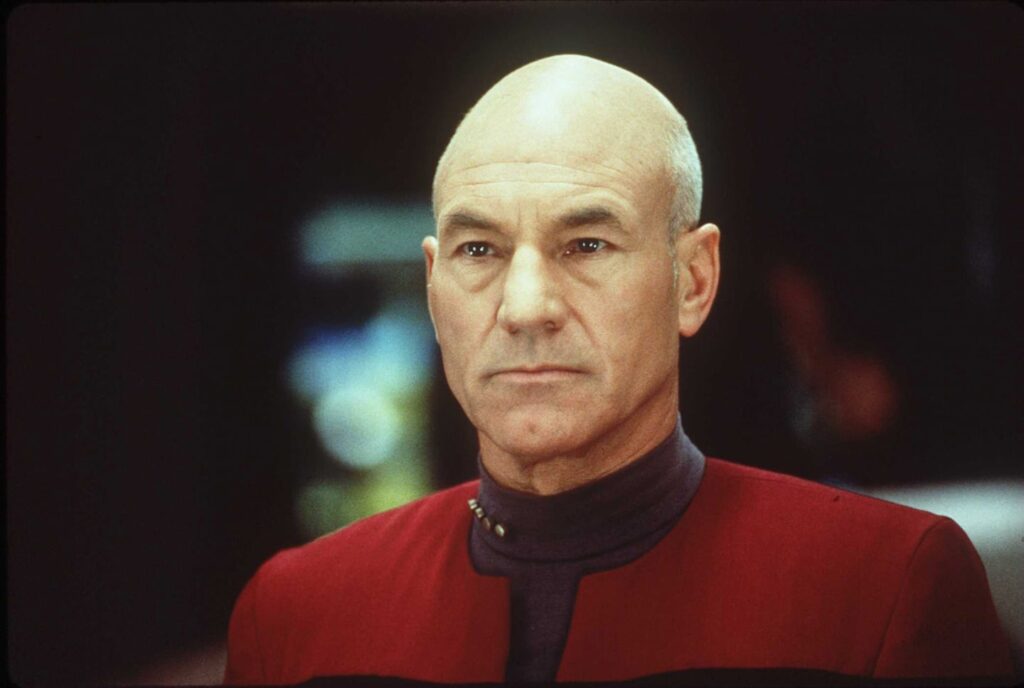
Two of the Globe’s dyed-in-the-wool Star Trek fans share what Captain Picard, and Patrick Stewart, meant to them.
John Hilliard: For a younger, and likely wiser generation, stanning a bald middle-aged English actor who played a French guy on a spaceship may be a questionable life choice. But here is the thing: What made Stewart resonate as Picard was how he rooted the character, as in the best of fairy tales, in emotional truth.
Jason Laughlin: I agree. Picard seemed as real as the complex characters that would start to populate prestige TV a decade later. But unlike anti-heroes such as Tony Soprano and Walter White, Stewart gave us a nuanced character we actually admired. He loved his job. He had passions like archaeology, Shakespeare, and music. He held to his ideals even when it meant terrible personal sacrifice.
In the mess of American politics over the past 20 years, there have been so many times I’ve longed for a Picard-style speech that makes right and wrong crystal clear.
“You know, there are some words I’ve known since I was a schoolboy,” Picard said when a Joe McCarthy-esque admiral began witch hunting on the Enterprise. “With the first link, the chain is forged. The first speech censured, the first thought forbidden, the first freedom denied, chains us all irrevocably.”
His character’s moral clarity, and Stewart’s conviction in delivering it, put an end to the admiral’s reign of terror. If only real world oppression could be dispelled so easily.
JH: Full disclosure: Star Trek is a show, which Youtube will prove, that leaned hard on latex foreheads and sometimes-flimsy production to tell stories of intergalactic scallywags known as Klingons and Borg, Romulans and Cardassians. Like free office coffee, it’s an acquired taste.
JL: One of my friends has a theory that if you didn’t get into Star Trek before you’re 18 years old, you’re never really going to get it.
To me, what’s so accessible, and radical, about Stewart, though, was his ability to convincingly portray vulnerability while still maintaining Picard as a credible leader.
One episode saw Picard return to his home village in France to heal from a traumatic assault.
At the conclusion, Stewart surrenders the control that was his character’s hallmark and falls into the mud, sobbing, over his failure to fight off his assailants. It’s a raw, real, depiction of a broken man. Stewart shifts from total collapse into slow recovery by reconciling with his brother. Grief is replaced by warmth, and Stewart sells it perfectly.
JH: Totally. He knew how to make that show work for him.
That’s despite an episode where he faces off against a giant, talking tar pit. Or the one where he sells eating a sandwich in the sci-fi version of the family station wagon. Or when he chugs Ecto Cooler (remember Ecto Cooler?) with a depressed Scotty, from the original Star Trek, and shares stories about first jobs and first girlfriends. He even shows up in tights, as discount Errol Flynn Robin Hood.
As a kid raised on television before there was an Internet, Stewart plugged into a world where figures like Mr. Rogers and Bob Ross presented a model for manhood that was gentle, patient, and a teacher. Stewart played Picard in a similar vein, basically everyone’s Space Dad.

JL: This is embarrassing, but the first TV episode that moved me to tears was from The Next Generation.
“The Inner Light” has Picard experience an entire lifetime as a different person on an alien planet. Again, the actor found his character’s humanity through slow revelation that perhaps a life with a wife and children is just as big an adventure as exploring space.
“Seize the time,” Picard says to his daughter in this other life. “Live now! Make now always the most precious time. Now will never come again.”
At the end of the episode, it’s revealed the decades he spent in that other life were an illusion he experienced in less than an hour. The only tangible thing he has from that world is a flute he learned to play in that other life. In the final moments, Picard plays it again, and without saying a word Stewart plays absolute heartbreak.
Seeing a strong, confident leader who was able to express regrets, sadness, and heartache left a lasting impression.

JH: Imagine you’re a kid watching TV, and you feel kind of alone, unsure of yourself. And then there’s Stewart, in full reassuring teaching mode. It’s the episode where Wil Wheaton’s character is struggling with tremendous guilt as he tries to hide his complicity in the death of a friend. Stewart, as Picard, is on to him.
Wheaton’s character, Wesley Crusher, is as close to a son as Picard will likely ever have, and Stewart leans into Picard’s grief, grief from knowing that doing the right thing will likely destroy the younger man’s future.
“A lie of omission is still a lie,” Picard tells Wheaton. Stewart’s voice cracks as Picard remembers meeting Wheaton’s character for the first time. He sat in Picard’s chair. He knew every button on the ship, every function. He was annoyed, Picard growls.
Stewart pulls back. Picard never had any doubt that Crusher would grow up into an outstanding officer. Until that moment.
“The first duty of every Starfleet officer is to the truth, whether it’s scientific truth, or historical truth, or personal truth,” says Picard, who then delivers the gut punch. “If you can’t find it within yourself to stand up and tell the truth about what happened, you don’t deserve to wear that uniform.”
It doesn’t matter if you know what a Starfleet is, or if someone can be an officer of one. Stewart always finds a way to connect his audience to the emotional truth.
When you’re a kid, you’re looking for lessons, even if you don’t want to admit it. Stewart, as a master of navigating the human heart, understood the moment and his character. Ultimately, Picard was a teacher, and a guide, not just for the characters with whom he shared a scene, but for the audience as well.
JL: Stewart was 47 when he began playing Picard. I’m just a year older than him now, and the very best of his episodes have taken on new resonance. Family tensions are real and devastating. Professional choices have lasting consequences. The melancholy of middle age lingers on the periphery of every happy moment.
Patrick Stewart’s Picard still serves as a role model. He showed how to face those moments with dignity, optimism, and a belief in the enduring capacity to be our best selves.
Jason Laughlin can be reached at [email protected]. Follow him @jasmlaughlin. John Hilliard can be reached at [email protected] or on Signal at john_hilliard.70. Follow him on Bluesky at iamjohnhilliard.bsky.social.