5 Advantages Of Japanese Mini Trucks
Thanks to a plethora of JDM classics now being over 25 years old (and thus eligible for import into the United States), it’s become easier than ever to import your dream JDM car, and plenty of them are on American roads today for that very reason. Well, in order to bring it into the country, you have to go to the port of entry and collect the car in-person, and one thing you’ll notice in the automotive terminal is a sea of little white trucks.
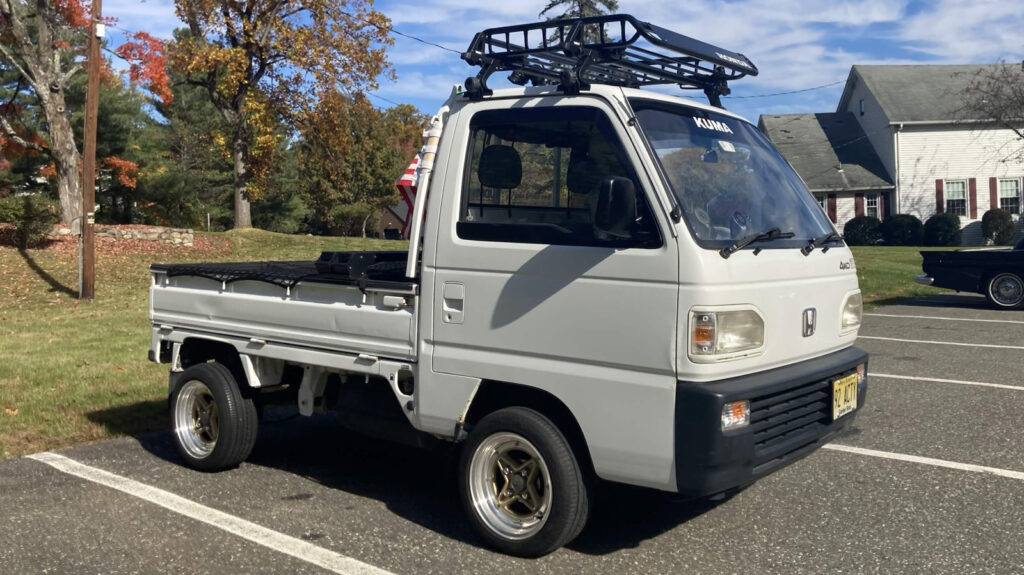
These distinctive, boxy commercial vehicles are known as kei trucks. The term “kei” is short for “keijidosha,” literally “light car” in Japanese, and it denotes the smallest category of multi-wheeled passenger cars in Japan. Specifically, a kei car has an engine no greater than 660cc and 63 horsepower, it’s no longer than 11.2 feet, 5 feet wide, and 6.6 feet high. That makes it comfortably smaller than most subcompacts sold globally, forget America.
One might assume, then, that such a diminutive size means it’d make for a poor commercial truck platform. But this couldn’t be further from the truth; there’s a reason why there are hundreds of these things in the States and available for sale. From remarkable capability and resilience to simplicity and ease of repair, these tiny trucks punch well above their weight. Even their size is an advantage, and that’s not getting into options like 4WD and tipping beds. In many ways, the humble kei truck even outperforms full-size American trucks in terms of light-duty, construction, and agricultural work. Let’s explore just a few of the many advantages these trucks have.
Their size works to their advantage in the city
If you drive a large crew-cab pickup, you probably have dealt with more than one headache resulting from city driving or reversing into tight spots. Kei trucks have no such problem, and it’s easy to see why. You’re basically just driving a pickup bed with a couple of seats and steering wheel jammed to the front; it’s tough to get any smaller than that.
Think of it in terms of inner-city work, then expand it to the job site. Let’s assume you’re a delivery driver working in a place like upstate New York or Minneapolis or whatnot, somewhere it gets cold and slippery. You want to be out of the weather, but you still have to haul goods in heavy traffic. Kei trucks are quite literally made for these jobs. Built for the narrow alleys of Tokyo and tight, rural backroads of the Japanese countryside, these are just as comfortable in American cityscapes that demand maneuverability and ease of parking. Plus, you don’t have to worry about getting out into traffic. They’re basically mail trucks you can legally own.
Of course, that footprint comes with certain caveats. You get the turning radius of a scooter, but at the cost of legroom — don’t expect to be comfortable if you have a 30-plus inch inseam (NOTE TO EDITOR: This comes from personal experience, a friend of mine owns a kei truck and I cannot physically drive it because my knees press against the steering wheel). Moreover, don’t expect much accommodation for passengers, unless you get a van. But these are no-nonsense job site work trucks; imagine the versatility of this thing on, say, a construction yard hauling cement around, or a food delivery van parking in spots shared with motorcycles. Not even American compact pickups can do such work as well as kei trucks.
They’re excellent off-road
We all think of 4WD, not AWD, as being the absolute defining factor of what makes a car good off-road, and that’s certainly true to an extent. But another factor is weight — having a low center of gravity and good weight distribution to get adequate traction. You’re moving a lot of metal over a rough surface, so the less metal you’re moving and the better it’s packed, the easier it’ll be.
Of course, having 4WD helps, certainly with kei trucks where the engine isn’t over the rear axle like a Daihatsu Hijet. But the right platform is nigh-unstoppable on rough terrain, thanks to its extremely light weight and ease of modification. You can fit these trucks with wide tires, long-travel suspension, and reinforced undertrays and they’ll work in loose agricultural fields all day long.
This drastically increases the applications of these trucks. Because of their size and weight, they’re perfect for farm work or hunting, where you want small footprints to navigate fields or wooded terrain. Moreover, the Subaru Sambar actually has a four-cylinder engine behind the rear axle, further aiding in weight distribution and power (most kei trucks are three-cylinder).
All of that couples with the plethora of options available for these trucks. Remember that these are Japan’s primary agricultural workhorses, so it’s not uncommon to see these fitted with diff and/or axle lock, four or five-speed manuals or automatics, and so on. Plus, when you factor aftermarket mods for these trucks, the sky is truly the limit. And that’s not mentioning how convenient these things are for hauling camping or fishing equipment up tight ATV trail heads and such.
They’re affordable and plentiful
As mentioned before, all it takes is casual observance of the port of entry or any marketplace search to reveal tons of these little trucks. Various manufacturers built them in a plethora of configurations, with some major ones being the Daihatsu Hijet, Subaru Sambar, Suzuki Carry, Honda Acty, and Mitsubishi Minicab, among many other examples. But then you have oddball vans, such as the Mitsubishi Delica and Honda Vamos; and even three-wheelers like the original Daihatsu Midget. Each of these vehicles has their own individual quirks — they may look alike, but they’re all built to different specs, like Mopar vs. Ford vs. GM.
That said, unless you’re looking for a particularly low-mileage example — and mileage is its own discussion with kei trucks — or something truly funky, you’ll seldom find anything for more than five figures. They are basic work trucks produced in the millions, after all. They’re excellent as disposable appliances, either to be continuously fixed up or simply replaced when their service life expires. And with millions of them floating around Japan and foreign markets, you’re spoiled for choice no matter what your work is.
Looking for a good kei truck is like any other used car. You need to check your usual data points — does it have rust, how are the mechanical components, was it well-maintained, and so on. Bear in mind that many of them were used as agricultural vehicles in their past lives, so you’ll have to consider engine hours and idle time. Be sure to do your research into the specific manufacturer; every major Japanese automaker has their own kei trucks, and they’ll have unique strengths and weaknesses.
They’re incredibly versatile and surprisingly capable haulers
Let’s get the obvious out of the way. No kei truck can haul as much as, say, an equivalent 90s Ford F-150. They have a specific carry capacity, in fact — that is 350 kilograms, as denoted on the rear of every truck bed. That’s about 772 pounds, so basically they’re capable of hauling a little over one quarter ton of cargo. Makes sense when you’re talking about a truck with around 40 horsepower from a three-cylinder engine.
But let’s be real here — how many people actually regularly carry enough cargo to max out their modern full-size or even compact pickup truck’s maximum cargo capacity? Sure, you have company trucks that haul the big stuff, but there’s also municipal work, delivery driving, running errands like grocery-getting or bringing the ATV to the trail head, whatever it is. Most private individuals use their pickup trucks for these more mundane tasks, all of which realistically could be done for a fraction of the cost with a kei truck.
Moreover, kei trucks are incredibly accessible as work trucks. They’re small and handy, perfect for shorter or less mobile people who can’t easily reach full-size truck beds. They’re easily repaired, given that they’re just glorified agricultural implements. And they have a variety of bed configurations, including tilting beds, dumpers, beds with fold-down sides, flatbeds, panel vans, accessory lines, and more — some are even full-blown campers. This makes them far simpler, easier to maintain, and more usable than large trucks — imagine a sideways-tipping bed that allows you to neatly pile loose soil exactly where you want it without awkwardly reversing, climbing up, and scraping it out of the bed.
They’re endlessly customizable and easily maintained
Most kei trucks are painted a generic white, gray, or blue color, sporting basic interior and a slab-faced front end. They don’t have many amenities to speak of, apart from a stereo and maybe climate control. This makes them the perfect platform for personalization — just try looking up images of custom kei trucks and see how varied they really are. People do everything from stancing them and fitting them with wild body kits, to raising them up and put them on tank treads. There’s a healthy and incredibly diverse subculture dedicated to these trucks, which is great because it’s easy to find resources to maintain and upgrade them.
Ultimately, you’ll have to learn to maintain one of these trucks yourself, but the subculture largely makes it fairly trivial in comparison to more niche vehicles. The sheer commonality of kei trucks ensures that OEM parts will always be available, and if you want to upgrade them, there are resources for that as well.
Many modern pickup trucks tend to be rolling electronics boutiques on wheels. This makes them incredibly comfortable and versatile as family vehicles and long-haul cruisers, absolutely, but it also invites complexity. They’re difficult, if not impossible to maintain yourself, with many parts simply inaccessible or otherwise requiring specialized software to service. Moreover, it takes a heavy monetary investment to actually get the truck and customize it; by comparison, you can likely buy, mechanically restore, and completely personalize a kei truck for less than half the price of a brand-new F-150. Kei trucks’ simplicity and quirky personality really lend a special character that you frankly never see anymore on new truck lots, and that’s important to many enthusiasts.