What Happens When CBP Audits Your Business? A Complete Guide for Importers
Receiving notice of an audit from U.S. Customs and Border Protection (CBP) can raise serious concerns for any business importing merchandise into the United States. What records will CBP request? How far back will the agency investigate? Could your company face additional duties or penalties?
A CBP audit is designed to evaluate whether an importer is complying with U.S. customs laws and regulations. Depending on the type and scope of the audit, CBP may examine import transactions, accounting records, internal procedures, and the systems a company uses to manage its customs compliance responsibilities.
An audit does not automatically mean CBP suspects fraud or that penalties will follow. However, it can uncover errors that result in substantial financial exposure, particularly when those errors affect multiple shipments over several years.
For importers, understanding the CBP audit process and preparing before an audit begins can make a significant difference.
What Is a CBP Customs Audit?
A CBP customs audit is a review of a company’s import activities to determine whether the business is meeting its obligations under U.S. customs laws.
Unlike a routine examination of an individual shipment, a customs audit may involve a broader review of an importer’s operations, records, internal controls, and historical transactions.
CBP’s Regulatory Audit function conducts audits under authorities that include 19 U.S.C. § 1509. Depending on the circumstances, an audit may evaluate whether an importer has properly:
- Classified merchandise under the Harmonized Tariff Schedule of the United States (HTSUS)
- Declared the correct customs value of imported goods
- Identified and paid applicable duties, taxes, and fees
- Complied with any antidumping and countervailing duty (AD/CVD) requirements
- Substantiated country-of-origin declarations and any trade preference claims
- Maintained required import records
- Established adequate internal controls to identify and correct customs compliance errors
The scope of the review will depend on the audit program, identified risks, and the company’s import activities.
Why Does CBP Audit Importers?
CBP uses risk-based enforcement and compliance reviews to assess whether importers are meeting their legal obligations.
Several circumstances may increase the likelihood of additional scrutiny.
- Inconsistent Import Data
CBP collects extensive information about merchandise entering the United States.
Discrepancies involving tariff classifications, declared values, countries of origin, or duty payments may raise questions about an importer’s compliance practices.
For example, a company that consistently reports substantially lower values than comparable imports may attract attention, although differences in value do not necessarily mean a violation occurred.
- Tariff Classification and Duty Concerns
Incorrect classification can result in the underpayment or overpayment of customs duties.
An importer may face additional scrutiny if CBP identifies repeated classification inconsistencies, particularly when those classifications affect applicable tariff rates or special trade measures.
- Antidumping and Countervailing Duty Exposure
AD/CVD requirements can create significant financial risks because applicable duty rates may be substantial and final liability may not be known when merchandise enters the country.
CBP may review whether an importer correctly identified merchandise subject to AD/CVD orders and complied with applicable entry and deposit requirements.
- Customs Valuation Issues
Valuation is another important area of customs compliance.
CBP may examine whether the importer properly reported the transaction value of merchandise and included required additions, such as certain assists, royalties, or other payments.
The agency may also review whether claimed deductions or alternative valuation methods are legally supported.
- Prior Compliance Problems
Previous errors, penalties, disclosures, or compliance reviews may influence CBP’s assessment of an importer’s risk.
However, a previous compliance issue does not automatically mean a company will be selected for an audit.
- Industry or Supply Chain Risks
Certain products, industries, sourcing arrangements, and trade programs may receive additional scrutiny based on CBP’s enforcement priorities.
An importer may be reviewed as part of a broader examination of compliance risks affecting a particular industry or type of merchandise.
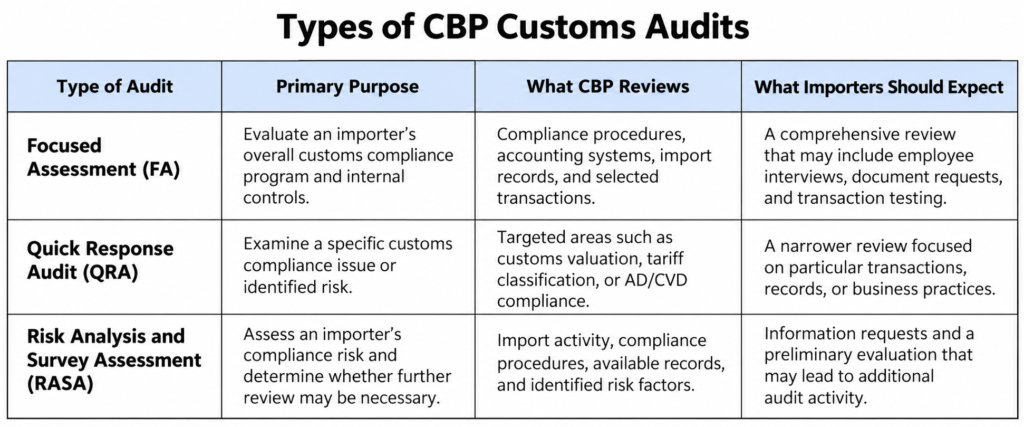
What Types of CBP Audits Are There?
Not every CBP audit follows the same process or involves the same level of scrutiny.
Understanding the type of review your company is facing is an important first step.
Focused Assessment Audits
A Focused Assessment (FA) is a structured review of an importer’s compliance systems and internal controls.
Rather than examining every import transaction individually, CBP evaluates the company’s processes for identifying, reporting, and correcting customs compliance issues.
A Focused Assessment may involve reviewing company policies, interviewing personnel, testing transactions, and evaluating whether internal controls operate effectively.
The objective is to determine whether the importer presents an acceptable level of compliance risk.
Quick Response Audits
A Quick Response Audit (QRA) is generally narrower in scope and addresses a specific issue or compliance concern.
For example, CBP may examine a particular valuation practice, tariff classification issue, or other identified area of risk.
Although these reviews may be more limited than comprehensive assessments, their findings can still have significant consequences.
Risk Analysis and Survey Assessments
CBP also uses risk analysis and survey activities to gather information about importers and assess compliance concerns.
These activities may help CBP determine whether additional review or more extensive audit work is warranted.
The precise procedures and scope depend on the review being conducted.
What Happens During a CBP Audit?
Although the process varies, CBP regulatory audits commonly involve several stages.
Step 1: CBP Notifies the Importer
For a formal compliance assessment, CBP generally provides advance notice and information about the anticipated review.
The communication may identify the subject of the audit, relevant time periods, and documents or information the agency expects to examine.
Importers should carefully review the notice and determine the scope of the request.
It is also important to identify the appropriate internal personnel who will coordinate the response.
Step 2: The Initial Meeting or Entrance Conference
CBP may conduct an entrance conference to explain the audit’s purpose, expected procedures, and anticipated duration.
During this meeting, CBP may request information about the company’s import operations, organizational structure, customs compliance program, and internal procedures.
The agency may also seek to understand how the company works with customs brokers, suppliers, purchasing teams, and accounting personnel.
Importers should use this opportunity to clarify the scope of the audit, establish communication procedures, and understand the agency’s expectations.
Step 3: Document Requests and Record Review
One of the most significant parts of a customs audit is the examination of business records.
Depending on the issues under review, CBP may request:
- Customs entry summaries and entry documentation
- Commercial invoices and purchase orders
- Bills of lading and shipping records
- Supplier agreements and payment records
- Accounting and general ledger information
- Product descriptions and classification support
- Explanations of what manufacturing steps occur in particular countries
- Country-of-origin documentation
- Free trade agreement certifications and supporting records
- AD/CVD-related documentation
- Internal compliance policies and procedures
- Communications relevant to specific transactions
CBP may compare information across these records to determine whether the company accurately reported its import transactions.
For example, the agency may compare commercial invoices with accounting records to identify payments that were not reflected in declared customs values.
Step 4: Interviews and Internal Control Testing
CBP may interview employees responsible for purchasing, logistics, accounting, customs compliance, and other relevant business functions.
These interviews help auditors understand how the company’s procedures work in practice.
For example, CBP may ask:
- Who determines the HTSUS classification of imported products?
- How does the company verify customs values?
- What procedures are used to identify applicable AD/CVD orders?
- How are changes in suppliers or sourcing countries reviewed?
- Who checks the accuracy of customs broker filings?
- What happens when an entry error is discovered?
A written compliance policy may be helpful, but CBP may also evaluate whether the company actually follows that policy.
Step 5: Transaction Testing and Audit Findings
CBP may select samples of import transactions to test whether the company’s records and procedures support accurate customs declarations.
If auditors identify discrepancies, they may request additional documentation or explanations.
Some issues may be isolated errors. Others may suggest broader weaknesses in the company’s compliance systems.
The distinction matters because recurring errors can affect a much larger number of import transactions.
Step 6: Closing Conference and Audit Report
Depending on the audit and its findings, CBP may conduct a closing conference to discuss preliminary results.
The company may have an opportunity to address factual issues, provide additional information, or clarify its procedures.
CBP may then issue a report identifying compliance findings and any recommended corrective measures.
The report does not necessarily resolve every potential duty, penalty, or enforcement issue. Separate administrative or enforcement processes may follow when appropriate.
What Should You Do If CBP Notifies You of an Audit?
Receiving an audit notice does not mean a company should immediately begin making changes without first understanding the issues involved. A careful, organized response is important.
- Review the Notice and Determine the Scope
Identify the type of audit, applicable time periods, requested records, and any deadlines. Determine which business functions and import transactions may be affected.
- Consult Experienced Customs Counsel
An attorney experienced in CBP audits can help evaluate the agency’s requests, identify potential exposure, and coordinate an appropriate response. Legal counsel can also help determine whether any issues warrant additional internal investigation or consideration of voluntary disclosure options.
- Preserve Relevant Records
Make sure employees understand the importance of preserving documents and communications relevant to the review. This may require coordinating with information technology, accounting, purchasing, logistics, and compliance teams.
- Designate an Audit Response Team
Identify the individuals responsible for coordinating document collection, communicating with CBP, and reviewing information before submission. A centralized process can reduce confusion and help maintain consistency.
- Review Potential Compliance Issues
Consider whether the audit concerns areas where the company has previously identified errors or weaknesses. Relevant issues may include tariff classification, valuation, country of origin, AD/CVD, and recordkeeping.
Any internal review should be appropriately structured, including consideration of legal privilege where applicable.
- Respond Accurately and on Time
Importers should provide accurate, complete, and responsive information within applicable deadlines. If a request is unclear, overly broad, or difficult to satisfy, the company should address those concerns through appropriate communications with CBP rather than simply ignoring the request.
Frequently Asked Questions About CBP Audits
Does a CBP audit mean my company is under investigation for fraud?
No. A CBP audit does not automatically mean the agency suspects fraud.
Audits may be conducted to assess compliance risks, evaluate internal controls, or examine particular customs issues. However, serious violations discovered during an audit may lead to additional enforcement action.
Can CBP audit a small importer?
Yes. Customs compliance obligations apply to importers of different sizes. Although CBP uses risk-based approaches to allocate enforcement resources, smaller businesses are not automatically exempt from audits or record requests.
How long does a CBP audit take?
There is no single timeline for every CBP audit. The duration depends on the type of review, the scope of the issues, the company’s operations, the availability of records, and the complexity of the findings.
Does CBP have to give advance notice before an audit?
Formal compliance assessments generally involve advance notice and an entrance conference.
However, not every CBP inquiry, record request, investigation, or enforcement action follows the same notification procedures.
Can CBP request records from previous years?
Yes. CBP may request historical import records within the scope of its lawful authority. Most customs entry records are subject to a general five-year retention requirement, although exceptions apply.
What if my company cannot produce the requested records?
Failure to maintain or produce required records may create separate compliance issues and potential penalties. Importers should promptly assess what information is available, whether alternative records exist, and how to respond to CBP’s request.
Should I hire an attorney for a CBP audit?
Yes. Experienced customs counsel can help businesses understand the scope of the review, assess potential duty or penalty exposure, respond to information requests, and address compliance issues that may arise.
How Diaz Trade Law Can Help With CBP Audits
CBP audits can involve complex questions of customs valuation, tariff classification, AD/CVD, recordkeeping, and importer liability. For businesses with significant import activity, even a relatively small recurring error can result in substantial financial exposure.
Diaz Trade Law assists importers with customs compliance matters, including CBP audits, regulatory inquiries, internal compliance reviews, prior disclosures, and enforcement issues.
Our attorneys work with businesses to evaluate customs risks, respond to government inquiries, strengthen compliance procedures, and navigate the legal issues that arise during CBP reviews.
Facing a CBP audit or concerned about your company’s customs compliance practices?
Contact Diaz Trade Law to discuss your situation and learn how our team can assist.
Learn more:
Disclaimer: This article is provided for general informational purposes only and does not constitute legal advice. Customs laws, audit procedures, and enforcement requirements may vary based on the facts and circumstances of each matter.