
CBP Wants Your Foreign Export Documents: What the Supply Chain Visibility ANPRM Means for Importers

On September 2, 2026, U.S. Customs and Border Protection published an advance notice of proposed rulemaking that would fundamentally change what importers must know, keep, and disclose about the parties behind every shipment entering the United States. The notice implements Section 3 of Executive Order 14411 and covers foreign export documentation, replacement of the manufacturer identification code, foreign tax and global business identifiers, supply chain tracing technology, and expanded CTPAT requirements. Comments are due December 1, 2026, and the questions CBP is asking tell importers exactly where enforcement is headed.
KEY TAKEAWAYS
- CBP published an advance notice of proposed rulemaking on September 2, 2026 (Docket No. USCBP-2026-1058) that would give the agency visibility into every party in an import supply chain, from the foreign factory to the final delivery address.
- The headline proposal: importers of record may be required to obtain, retain, and submit the export declaration, invoice, packing list, and other documents their foreign supplier filed with its own customs authority. CBP says the purpose is to catch dual invoicing and undervaluation.
- CBP is openly considering replacing the manufacturer identification code (MID) with real business identifiers, collecting foreign tax IDs for manufacturers and sellers, requiring identification of online marketplaces and the ultimate delivery party, and moving entry filing deadlines earlier.
- CTPAT is on the table too: mandatory supply chain tracing technology, cybersecurity minimum security criteria, and restrictions on foreign-controlled logistics platforms such as LOGINK.
- Comments are due December 1, 2026. This is the stage where the rule gets shaped. Importers who wait for the proposed rule will be reacting to requirements written with someone else’s data.
Background: Executive Order 14411 Is Now Producing Rules
When President Trump signed Executive Order 14411, Strengthening Customs Enforcement, on June 3, 2026, we wrote that Section 3 was the provision importers should watch most closely. Our summary of the order is here: New Executive Order on Strengthening Customs Enforcement. Section 3(a) directed the Secretary of Homeland Security to require disclosure of foreign tax and global business identifiers and detailed supply chain and production information. Section 3(b) directed the Secretary to mandate submission of any documentation the foreign exporter was required to file with its own customs administration before exporting to the United States.
The advance notice of proposed rulemaking (ANPRM), Docket No. USCBP-2026-1058, is CBP’s first formal step on both mandates. It is not a proposed rule. CBP is collecting information and data that it will use to draft a Notice of Proposed Rulemaking, and it says plainly that comments answering its 64 specific questions with data, cost estimates, and descriptions of current practice will carry the most weight. The agency also asks commenters to address whether each requirement should be phased in by entry type, commodity, country, or mode of transportation, and whether small entities, foreign importers, CTPAT participants, and high-volume filers should get different timelines.
CBP’s stated enforcement purpose is consistent throughout the notice: detect and interdict illicit importations, especially goods illegally transshipped to evade U.S. customs and trade laws. Every proposal below should be read through that lens.
What CBP Is Proposing
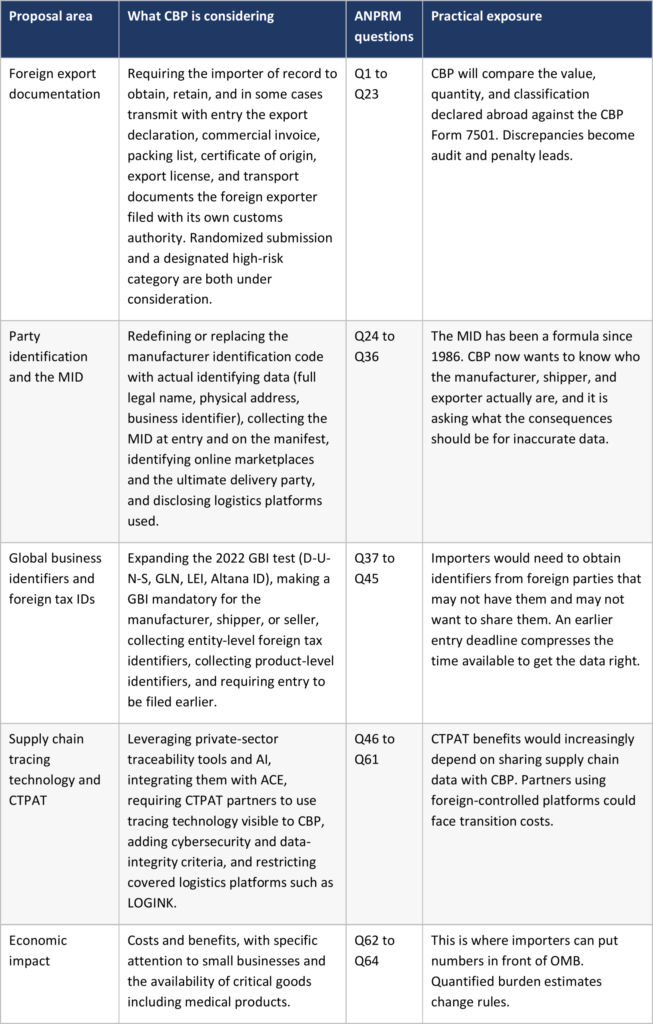
The notice is organized into four areas. The table below maps each area to the questions CBP is asking and the practical exposure for importers.
Foreign Export Documentation: The Dual Invoicing Problem
CBP states its purpose directly. Foreign export documentation may help the agency verify and reconcile entry and entry summary information and detect discrepancies that could indicate violations of U.S. customs and trade laws, such as dual invoicing. Dual invoicing, where a foreign seller declares one value to its export authority and a lower value appears on the invoice presented to CBP, is one of the oldest undervaluation schemes in customs enforcement. Until now, CBP has generally needed a whistleblower, a foreign customs cooperation request, or an audit to prove it. This proposal would make the comparison document part of the importer’s own file.
The questions in this section deserve careful reading because several of them would shift legal exposure onto the importer:
- Question 2 asks whether foreign export documentation should be transmitted with entry or entry summary, or treated as a recordkeeping requirement under 19 U.S.C. 1508. Either way, the importer would need to obtain it from the foreign supplier.
- Question 5 asks whether the duty of reasonable care is the appropriate standard for the importer to assess and ensure the accuracy of documentation before submitting it to CBP. That would make an importer responsible for the accuracy of a document it did not prepare and filed with a government it does not deal with.
- Questions 10 and 11 acknowledge that the price reported to a foreign customs authority may differ conceptually from the price relevant to CBP, and ask how importers should reconcile and document those differences.
- Questions 19 through 23 contemplate a Secretary-designated category of imports posing an unusually high or grave risk to national security, for which foreign export documentation would be a condition of entry.
There are many legitimate reasons an export declaration and a CBP entry will not match: Free on Board (FOB) versus Cost, Insurance, and Freight (CIF) terms, assists and royalties added under 19 U.S.C. 1401a, first sale transactions, currency conversion dates, quantity differences from partial shipments, and classification differences between a foreign tariff schedule and the HTSUS. None of those is a violation. Every one of them will look like one to an analyst running a mismatch report unless the importer can explain it with contemporaneous documentation.
Replacing the MID and Collecting Real Identifiers
CBP says the manufacturer identification code provides limited identifying information, does not always identify the party of interest for enforcement purposes, is not always unique, and is not available early enough in the entry process to be useful. The agency is interested in proposals to redefine or replace it. The questions go further than a technical fix. CBP asks whether full company name and physical address should be provided with each shipment, whether the MID should appear on the manifest, whether an online marketplace that facilitated the sale should be identified, and whether the party to which merchandise is ultimately intended to be delivered should be declared even when that party is not the consignee.
The Global Business Identifier questions extend the same logic. CBP asks whether it is feasible to require a GBI for the manufacturer, shipper, or seller at entry, and whether importers and brokers can obtain and disclose entity-level foreign tax identifiers for those parties. It also asks, in Question 43, whether entry should be required sooner than the current 15 calendar days so CBP can review supply chain documentation before deciding admissibility. For brokers and importers operating on tight release timelines, that question alone deserves a data-driven answer.
Readers who followed our coverage of CBP’s Form 5106 enforcement will recognize the pattern: CBP Will Void Importer of Record Numbers Beginning September 18, 2026. CBP is cleaning up identity data on the U.S. side of the transaction and now intends to do the same thing on the foreign side.
CTPAT: Benefits in Exchange for Visibility
CBP describes CTPAT as a vital component of its multi-layered security strategy and notes that small businesses make up roughly 70 percent of the membership. The ANPRM asks whether all CTPAT partners, or only certain tiers, should be required to use enhanced supply chain tracing technology, whether that technology should be visible to CBP, and what benefits should be extended to partners who share supply chain visibility. It also asks whether the minimum security criteria should add cybersecurity and data-integrity requirements, including a prohibition on covered logistics platforms identified as security risks, and requests detailed cost estimates for migrating away from platforms such as LOGINK. Importers evaluating whether the program is worth the investment should review our CTPAT services page and expect the calculus to change once these criteria are finalized.
The Challenge for Importers
The uncomfortable reality is that most importers cannot answer the questions CBP is asking about their own supply chains. Few importers hold the export declaration their supplier filed abroad. Many do not know whether the entity on the commercial invoice is the manufacturer, a trading company, or a consolidator. The MID on the 7501 is frequently generated by the broker from whatever name appears on the invoice and is never verified. Foreign suppliers routinely decline to share tax identifiers, and some decline to share their own factory addresses.
The ANPRM signals that CBP intends to treat those gaps as the importer’s problem. Once foreign export documentation is a recordkeeping requirement, its absence in an audit is a recordkeeping violation under 19 U.S.C. 1509 with its own penalty exposure. Once real identifiers are required at entry, an inaccurate one is a false statement under 19 U.S.C. 1592. And once CBP can reconcile foreign export values against entry values in ACE, a discrepancy the importer cannot explain becomes the opening of a penalty case rather than a Request for Information.
The transshipment framing matters as well. CBP is explicitly building this data set to detect goods routed through a third country to obscure their origin. Importers with legitimate third-country processing should already have substantial transformation analyses on file. Our discussion of where that line falls is here: The Fine Line Between Transshipment and Substantial Transformation.
Take Action: Comment Now, Prepare Now
The comment period and the preparation period run at the same time, and importers should treat both as deadlines.
1. File a Comment That CBP Can Use
CBP has told commenters what it wants: answers keyed to specific question numbers, reasons and data supporting each position, descriptions of current practice and technology, and cost figures with enough detail to recreate the calculations. A comment that quantifies how many days a supplier takes to produce an export declaration (Question 16), what it would cost to translate foreign-language documents (Questions 17 and 18), or why a GBI mandate is not feasible for a particular supplier base (Questions 39 and 40) have the potential to shape the proposed rule. Trade associations will file, but an association comment averages its members’ positions. An importer with a distinctive supply chain, a critical product, or a small-business profile should file its own.
2. Run a Supply Chain Data Audit Before CBP Runs One for You
Regardless of how the rule is written, the direction is set. Importers should begin closing the gaps now:

3. Reassess CTPAT
For current partners, the question is whether the supply chain tracing and cybersecurity criteria CBP is contemplating are achievable, and at what cost. For non-members, the ANPRM repeatedly asks whether CTPAT-validated importers should face different documentation requirements. If the answer in the final rule is yes, membership becomes a compliance cost offset rather than a security program.
The Outcome
Importers who engage now have a chance to influence the phase-in schedule, the exemptions, the treatment of small entities, and the definition of the parties that must be identified. They will also enter the proposed rule stage with a reconciled supply chain file, verified party data, and supplier contracts that already require the documents CBP wants. Importers who wait will receive a proposed rule written around the data other companies supplied and will be reconciling foreign export values under audit rather than on their own timeline.
How Diaz Trade Law Can Help
Diaz Trade Law assists with drafting and filling rulemaking comments for importers, brokers, and trade associations. We also conduct supply chain data audits that test exactly the questions CBP is asking in this notice: whether foreign export documentation is obtainable, whether it reconciles to the entry, and whether the parties declared to CBP are the parties that actually made and sold the goods. If your company imports critical goods, relies on a foreign trading company, or is weighing CTPAT, the comment deadline of December 1, 2026 is the date to plan around. Contact us at 305-456-3830 or through diaztradelaw.com to discuss a comment strategy or a supply chain readiness review.
Learn more: